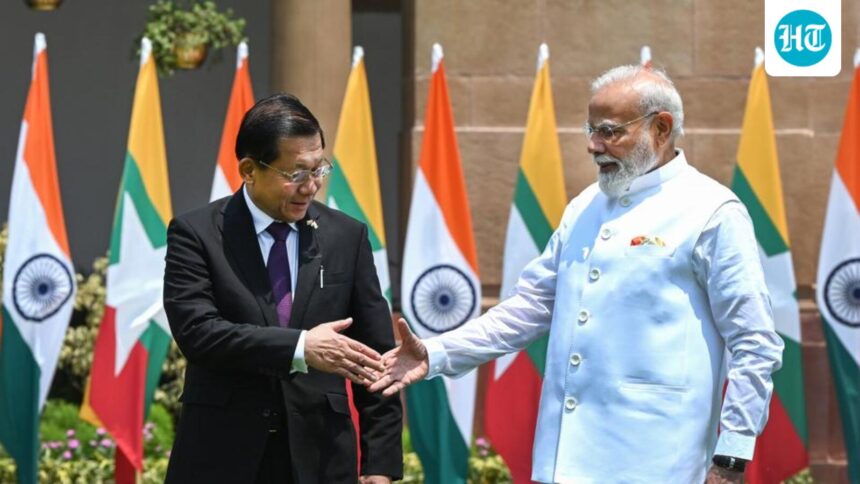
India on Monday raised the internal security situation and long-awaited connectivity and democratization projects, including that of Aung San Suu Kyi, with Myanmar President Min Aung Hlaing, who gave assurances that he would not allow his country’s territory to be used against India’s security interests.

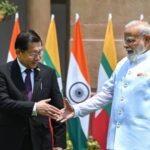
The former Myanmar junta leader made India the destination of his first foreign visit after becoming president in April, reaching out to New Delhi at a time when his new government still faces criticism over the integrity of general and presidential elections held since December. Besides holding talks with Prime Minister Narendra Modi on Monday, Helaing participated in events aimed at promoting trade and investment.
Modi and Heling did not make the usual media statements after their discussions, and a detailed read of the meeting was given by Foreign Minister Vikram Misri, who told a press conference that the internal security situation in Myanmar and its ramifications for northeastern India, stalled connectivity projects such as the Kaladan Multimodal Transit Transport Project and the India-Myanmar-Thailand Trilateral Highway, and the democratic process in the neighboring country, all figured in the talks.
Modi said in a social media post that he had a “productive meeting” with Hlaing and that India was “honoured” by him choosing the country for his first foreign visit. “Myanmar is vital to India’s ‘Neighborhood First’, ‘Move East’ policies and the Indo-Pacific region,” he said.
Al-Masry defended dealing with the new Myanmar government, saying that India believes in “sustainable dialogue” because disengagement will not lead to solutions. “History has shown that disengagement does not give us any better results than engagement, and it certainly does not lead to democratic change if that is what matters to us,” he said.
“On the other hand, disengagement only creates a vacuum that is filled by others and then at our expense. These others have no interest in democracy,” Misty said, in an apparent reference to China, which has sought to strengthen its presence in Myanmar amid a long civil war that began in October 2023.
Masri said India has a “major interest” in Myanmar’s internal security – whether the fighting between the army and ethnic armed groups, or the government’s efforts to move forward with the peace process with all armed organizations – because stability and peace in the neighboring country are linked to the security of India’s northeastern states, which share a 1,643-kilometre border with Myanmar and are connected to Southeast Asia.
“Apart from that, there is a very important issue regarding the activities of Indian rebel groups in Myanmar, near our border,” he said, noting that Modi raised this issue with Hlaing, who stressed that Myanmar is “sensitive to these concerns” and will do everything necessary to ensure that this does not become a threat to India’s security.
A joint statement issued after the talks said that Modi conveyed India’s support for Myanmar’s sovereignty and territorial integrity and its commitment to deepening security cooperation, while Hlaing reiterated Myanmar’s “assertion that it will not allow its territory to be used against Indian security interests.”
Meanwhile, Misty reiterated India’s support for resolving the country’s problems under the leadership of Myanmar and its kingdom through dialogue. “I don’t think, from the outside, anyone has any ready-made solutions to offer Myanmar,” he said.
Al-Masry acknowledged that the issue of Myanmar leader Aung San Suu Kyi, who was arrested during a military coup in 2021 and is currently under house arrest, was raised by Modi with Hlaing in the context of the peace process in Myanmar and efforts to bring all groups together to find a way forward. He added that Modi stressed the need for lasting peace, integration and dialogue as Myanmar finds its way towards democracy.
The Indian side also raised the issue of military operations carried out by Myanmar against armed groups operating on the Myanmar side near the border, and the resulting influx of refugees into Indian states such as Mizoram. Al-Masri quoted the Prime Minister as saying that the military and authorities in Myanmar “must pay close attention” to this matter, and stressed that operations must be conducted in a way that avoids harming people living on the Indian side of the border.
The India-funded Kaladan Transit Project, which envisages developing a 158-km waterway and a 109-km road to Mizoram, and the Tripartite Highway Project, which aims to connect the Indian state of Manipur to Mae Sot in Thailand via Mandalay in Myanmar, have faced long delays, and Masri said both projects were affected by the security situation in Myanmar.
He added: “The Kaladan Highway is located in an area where active hostilities are now taking place between the Myanmar Army and ethnic armies in Rakhine State. The section of the trilateral highway on which work has been ongoing and has continued intermittently in recent years is again located in an area where ethnic armed groups and the People’s Defense Forces are very active and engaged in hostilities with the Myanmar Army.”
“It is clear that in these circumstances, it is a bit difficult to achieve the pre-set targets and dates,” Masri said, adding that India continues to work with Myanmar authorities to take the work forward. “This remains a key priority. The Prime Minister raised it today with the President, [who] He reiterated that Myanmar will make every effort to ensure that these projects move forward towards completion.
The joint statement said the two sides agreed to facilitate and promote bilateral trade, including through the rupee-kyat settlement mechanism, and noted the steady growth in transactions since the activation of the mechanism in May 2024. Two-way trade currently stands at just over $2 billion, with India’s exports worth about $600 million and Myanmar’s exports at $1.5 billion. The two sides also supported close trade and investment cooperation in areas such as agro-processing, oil, energy and mining, including vital minerals.