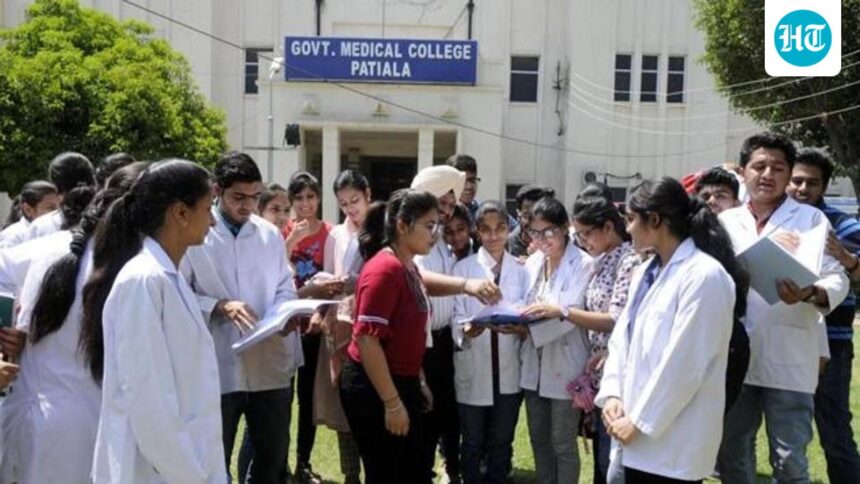
The National Medical Commission (NMC) has advised all medical colleges not to grant leave to students on May 2 and 3, except in “exceptional circumstances with due justification”, as a preventive step to avoid any misuse and ensure the integrity of the National Eligibility Test (Undergraduate) Entrance Test, or NEET-UG 2026, scheduled to be conducted on May 3.

This consultation follows guidance from the Department of Higher Education (DoHE) of the Federal Ministry of Education.
On April 20, Health Ministry Secretary Vineet Joshi wrote to Union Health Ministry Secretary Punya Salila Srivastava, urging vigilance and awareness among students against any involvement in malpractices. He also recommended refusing leave on May 2 and 3 except in justified cases.
“In view of some of the cases reported in the past… all medical colleges must remain vigilant and ensure that medical students are sensitized against any involvement in activities detrimental to the conduct of examination,” NMC Secretary Dr Raghav Langer said in a notice dated April 23.
The National Testing Agency (NTA) will conduct NEET-UG in a single shift in pen-and-paper mode across 551 cities and over 5,400 centers in India and abroad, covering around 22.8 lakh candidates.
NTA Director General Abhishek Singh said multiple steps are being taken to ensure error-free testing. He said that biometric verification has been strengthened, with one device for every 48 candidates compared to one device for every 100 candidates last year. The agency also verifies category changes made by candidates to prevent misuse of forged documents.
Singh said logistical coordination is underway to address challenges such as conflict in West Asia and elections in some countries, where votes will be counted on May 4. “We have made extensive coordination with state governments, district administrations and law enforcement agencies to minimize inconvenience to the candidates,” he said.
Enhanced security measures include transmission of question papers via GPS with police escort, double-locked strong rooms with 24X7 CCTV, Aadhaar-based biometric checks, two-layer screening, and real-time monitoring through control rooms.
“All the centers underwent stringent third-party verification, and centers associated with training institutions or suffering from inadequate infrastructure were excluded. Government officials have been appointed as center supervisors, monitors and city coordinators. We have also put in place live dashboards and real-time monitoring systems for oversight,” Singh said.
These steps come in the wake of the NEET-UG 2024 papers leak controversy, following which the Center set up a seven-member committee led by former ISRO chief K Radhakrishnan to promote the work of NTA.