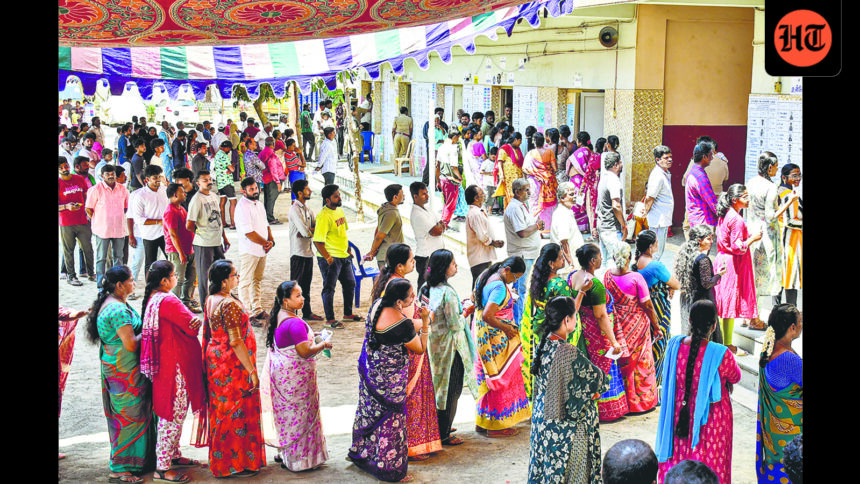
Tamil Nadu and 152 constituencies in West Bengal recorded record voting on Thursday in assembly elections that were largely free of violence, a trend that reflects mass deletions in electoral rolls and prompted ruling and opposition parties in the two states to declare victory.

In Tamil Nadu, where all 234 seats went to the polls, a voter turnout of 85.11% was recorded at 11pm. With 57.3 million voters in the state according to an IEC press release on April 23, this translates to 48.8 million voters, which is also the highest turnout rate in the state’s history. Turnout is generally expected to be higher than previous polls with a growing adult population. However, this has come into question because the SIR practice excluded 11.6% of voters in the state. Voting trends show that this has not happened.
The expected turnout of 48.8 million voters – – the numbers will be revised upwards as data arrives from more polling stations – is also higher than the 43.4 million voters in the 2024 Lok Sabha elections, the last poll before the 2026 Assembly polls. The highest turnout was recorded in Veerapandhi (93.41%) and the lowest in Palayamkottai (68.97%).
In West Bengal, the first phase recorded around 92.35% voter turnout by 11 pm. While the 152 constituencies can only be traced back to the 2011 Assembly elections due to the 2008 delimitation process (and because the Lok Sabha Elections Advisory Committee level turnout is only available from 2014), this is the highest turnout for these 152 constituencies since at least the 2011 Assembly elections. With 36 million voters at this stage, a turnout of 92.35% translates into an absolute turnout of 33.2 million, which is also the highest level since at least the 2011 House of Representatives elections. While West Bengal has excluded 11.6% of its voters in the SIR, the 152 first phase seats saw 9.9% removed. However, the turnout of 32.9 million in this first phase of polls was not lower than the 2024 Lok Sabha turnout of 31.52 million. The highest turnout was recorded in Morarai (96.95%) and the lowest in Mekhiliganj (82.12%).
In both states, female voters outperformed their male counterparts.
“Highest ever voter turnout in West Bengal and Tamil Nadu since independence – CEC salutes every voter in West Bengal and Tamil Nadu,” Chief Election Commissioner Gyanesh Kumar said. There were reports of some clashes and allegations of intimidation and attacks on at least three candidates, but the polls were largely free of violence.
In 2021, the Trinamool Congress won 92 of the 152 seats stretching from the tea gardens of north Bengal to the sensitive communal belts of tribal-dominated Murshidabad and Jangalmahal. The Bharatiya Janata Party won 59 seats.
According to Election Commission officials, polling was mostly peaceful, with sporadic incidents of violence reported in districts such as Murshidabad, Dakshin Dinajpur, Asansol and Cooch Behar in West Bengal. No serious injuries were reported, and 1,002 complaints related to violence and intimidation among other issues were received in the state as of 2 pm, according to Election Commission officials. No major incident of violence was reported in Tamil Nadu.
“As far as I know, the polling rate is exceeding all records. Fear (among voters) is declining and confidence is moving forward. Everyone says change is necessary. BJP’s victory is certain,” Prime Minister Narendra Modi said at his first rally of the day in Nadia district around 1.40 pm, when the average turnout had already crossed 62%.
Hours later, Chief Minister Mamata Banerjee told voters in Kolkata’s Chowrinji constituency that the record turnout indicated a victory for her party.
“Do you know why polling rates are so high even after many voters were removed from the voter rolls during revision of electoral rolls? People see this as their fight to save democratic rights. If BJP wins, it will order delimitation and implement National Register of Citizens… From the votes polled, I can say we have already won. I can read people,” she said.
In Tamil Nadu, the contest is primarily between the ruling secular Progressive Alliance led by the Dravida Munnetra Kazhagam (DMK) and the National Democratic Alliance led by the Anna Dravida Munnetra Kazhagam (NDA). The Bharatiya Janata Party (BJP) is contesting 27 of the 234 seats as part of the NDA. The Tamilaga Vettri Kazhagam (TVK) led by actor and politician C Joseph Vijay hopes to emerge as a third force in the state. The participation rate in 2021 was 78.29%.
Prime Minister M K Stalin is contesting from Kolattur (Chennai) and his son and deputy Udhayanidhi is contesting from Chipauk-Thiruvivalikini. AIADMK chief Edapaddi Palaniswami is contesting from Edappadi in Salem district and Vijay from Perambur (Chennai) and Tiruchirappalli East.
Kolathur recorded 86.11% while the Chibok-Thiruvalekkini seat saw 84.34% as of 6pm. Edappadi scored 92.08%. In 2021, Kolattur constituency recorded 64.63% votes, Chibok-Thiruvilikini 60.73%, and Edappadi 89.8%. Perambur and Tiruchirappalli East constituencies got 89.79% and 81.77% respectively.
Actor Ajith Kumar was the first to cast his vote, as officials allowed him to vote early for security reasons. He arrived at the polling station in Thiruvanmiyur wearing a white suit and dark sunglasses, showed his inked finger to the waiting crowd, then left. A large crowd gathered, which required the deployment of police.
Stalin, Vijay and BJP leader K Annamalai turned up to vote wearing white shirts and khaki or beige trousers. After the vote, Stalin was asked about Ajith Kumar’s statement that there was “no need for change” in Tamil Nadu. He replied: “What he said is true.”
Actor Rajinikanth voted at Stella Maris College in a white t-shirt accompanied by his daughter Soundarya. Actor Kamal Haasan arrived at Alwarpet School with his daughter Shruti Haasan. When asked if he was confident of a second term as a Rajya Sabha member, Haasan replied: “Yes.” Actor Dhanush voted in a black outfit at a booth in Chennai, while actor Vikram cast his vote in Besant Nagar, accompanied by his son Dhruv.
In West Bengal, tensions erupted in parts of Murshidabad, Birbhum, Cooch Behar and Dakshin Dinajpur, with alleged clashes between rival party workers, incidents of improvised bomb throwing and attacks on candidates.
But officials said the vote was largely peaceful. “There were no major untoward incidents and no casualties. Voting was conducted in a free and fair manner barring some incidents of violence,” West Bengal Chief Electoral Officer Manoj Kumar Agarwal said.
Samserganj in Murshidabad where 74,775 names were removed after adjudication, the highest among all the 294 councils in the state, recorded a turnout of 96.04%. Likewise, Lalgola with 55,420 deletions recorded a 96.20% turnout, Bagabangula with 47,493 deletions recorded a 96.95% turnout, Raghunathganj with 46,100 deletions recorded a 96.81% turnout, and Farakka with 38,222 deletions recorded a 96.05% turnout.