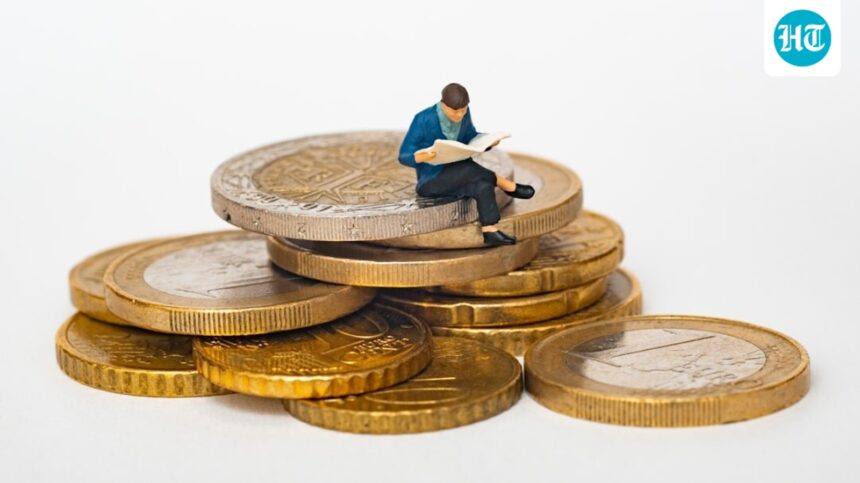
Income inequality has been rising around the world, with median wealth falling in most markets analyzed by Swiss bank UBS, and income inequality across the world has also fallen. said the annual World Wealth Report 2025, published on Tuesday.

According to the report, personal wealth in 2025 grew at the fastest pace in years, creating nearly one million new millionaires in US dollars. The Swiss bank analyzed 56 markets, estimated to represent more than 92 percent of the world’s wealth.
Total personal wealth rose 10.8 percent last year, up from 4.6 percent in 2024 and 4.2 percent in 2023. UBS attributed the growth to strong financial markets.
The report noted that there will be more millionaires everywhere “than ever before” in 2025. The United States, where more than 440,000 people became new millionaires in US dollars, accounted for nearly half of this growth.
In Europe, the UBS report found that wealth in dollar terms has grown disproportionately quickly, largely due to the decline in the value of the dollar against the euro in the past year.
But the report also sounded alarm bells, saying that while average wealth has risen, inequality has deepened since 2020. The bank added that average wealth, which better reflects average income, has fallen in most countries, highlighting the growing gap between the richest and the wider population.
Growth is slow in the Asia-Pacific region
Wealth growth in the Asia-Pacific region lagged behind other regions last year, at just over 5.9 percent. The UBS report blamed currency effects and market dynamics for the slowdown in growth, but said the overall long-term trend in the region remains positive.
The region includes most high-net-worth individuals based in Greater China and Southeast Asia.
The United States has expanded its share of global wealth since 2024. It is now home to 35.7 percent of the personal wealth found in the UBS sample. western
This is followed by Europe at just under 22 percent. Greater China, aided by its large population, comes next with 18.5 percent, although its share is slightly lower than it was in 2024.
Thus, only two markets – the United States and Greater China – still together represent home to more than half of the world’s personal wealth.
But when it comes to measuring inequality through the Gini coefficient, the UAE is the most unequal country in the world according to the report, with a Gini score of 0.82. And he follows him Russia with a score of 0.82, South Africa and Brazil with a score of 0.81, Saudi Arabia with a score of 0.78, and the United States with a score of 0.77. Sweden and India follow the top six with a Gini score of 0.74.
The Gini coefficient, a number between 0 and 1, measures the distribution of wealth across a population. The lower the score, the more evenly the wealth is distributed, and vice versa.