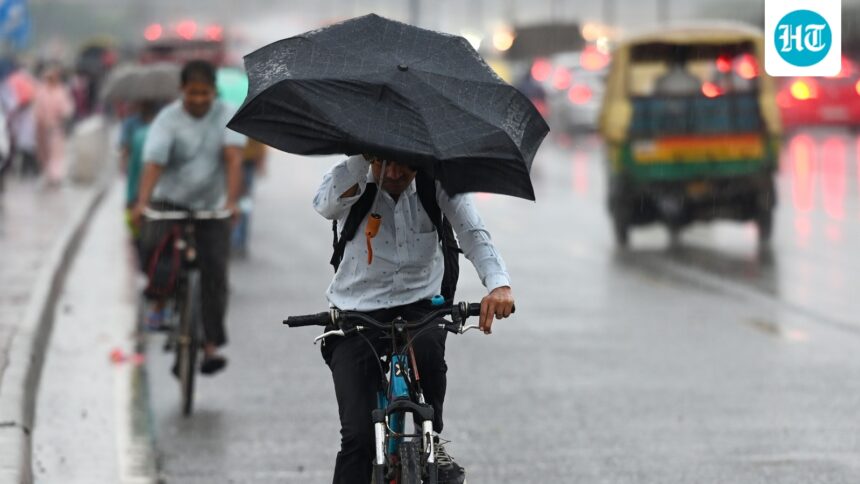
Delhi continued its hot weather during what could be the last season of summer on Tuesday, with forecasters saying the southwest monsoon is likely to begin in the national capital around July 3 or 4 as favorable conditions develop across north India.

Mahesh Palawat, Vice President, Skymet Weather, said the monsoon low currently extended from Punjab to the northern Bay of Bengal, while the monsoon had already advanced over many parts of Uttar Pradesh, most of Uttarakhand, Himachal Pradesh, Ladakh, and some other parts of Madhya Pradesh.
Read also: The temperature reading in Delhi is 37 degrees Celsius. It felt like 53 degrees Celsius. Here’s why this is dangerous
A low pressure system is likely over the Gulf
He added that the cyclonic circulation is continuing over the northern Bay of Bengal, and under its influence, a low pressure area is expected to develop and move westward, leading to widespread rain activity across the Indo-Gangetic plains from Bihar to northern Punjab over the next few days.
He also said that rain activity is expected to intensify over Punjab, Haryana, Delhi and north Rajasthan by July 2 or 3, and the monsoon is likely to reach Delhi and adjoining areas around July 3 or 4.
The east wind is still waiting
“The monsoon trough extends from Punjab to the northern Bay of Bengal. The monsoon has already advanced in many parts of Uttar Pradesh, most parts of Uttarakhand, Himachal Pradesh, Ladakh, and some other parts of Madhya Pradesh,” he told PTI.
Explaining the delay, Palawat said the humid easterly winds from the Bay of Bengal, which are essential for sustained monsoon rains, have yet to reach Delhi.
Read also: Delhi records 55.6% rainfall deficit in June amid heatwave; Monsoon possible in 4 days
“The monsoon generally advances along the monsoon trough, which currently extends from Punjab to the Bay of Bengal over a distance of approximately 1,500 km. The easterly winds from the Bay of Bengal are expected to reach Delhi around July 3 or 4 with the trough. Until then, the city is likely to receive only isolated periods of rain. Once these easterly winds blow and the trough becomes more favorable, monsoon activity will increase significantly,” he added.
The trough acts as the backbone of the southwest monsoon. It is a long area of low air pressure that attracts moisture-laden winds from the Arabian Sea and Bay of Bengal deep into the Indian mainland, helping to regulate widespread rainfall.
Continuous heat and humidity
Even as the city looked forward to the arrival of the monsoon, Delhi was experiencing extreme weather conditions, with the apparent or ‘felt’ temperature rising to 53.5 degrees Celsius at 5.30 pm. However, the IMD said the city did not meet the heatwave criteria. The maximum temperature at Safdarjung, the city’s main station, settled at 40.5 degrees Celsius, 3.1 degrees above normal.
Read also: Delayed monsoon slows down paddy cultivation in Haryana
Palam recorded 41.0 degrees Celsius, 3.2 degrees above normal, while Lodhi Road recorded 40.1 degrees Celsius, 3.1 degrees above normal.
Ridge was the hottest station with temperature reaching 41.5 degrees Celsius, 4.8 degrees above normal, and Ayanagar recorded 40.1 degrees Celsius, 2.0 degrees above normal.
IMD rules out heat wave
Little rain was recorded till 8.30 am at Safdarjung, Palam, Lodhi Road and Ayanagar, while the Ridge received no rain. Between 8.30 am and 5.30 pm, minimal rainfall was recorded in Palam and Ayanagar, while no rainfall was recorded in Safdarjung, Lodhi Road and Ridge.
The minimum temperature in Safdarjung settled at 30.2 degrees Celsius, 2.3 degrees above normal. Palam also recorded at least 30.2 degrees Celsius, 2.4 degrees above normal. Lodhi Road and Ayanagar recorded 31.2 degrees Celsius, 4.2 degrees and 4.4 degrees above normal, respectively, while the Ridge recorded 29.3 degrees Celsius, 3.8 degrees above normal.
The IMD said that no heatwave was declared over Delhi as the stipulated criteria were met at only one station in the Haryana-Chandigarh-Delhi sub-division, while at least two stations are required to declare a heatwave.
Experts said that dry westerly winds from Pakistan are keeping temperatures high, while southwesterly winds from the Arabian Sea also reach Delhi and increase the humidity.
“When these dry and moist air masses interact, clouds form, but there is not enough moisture for widespread precipitation. By the time cloud formation occurs, usually around 4 or 5 p.m., the maximum temperature for the day has already been recorded. That is why both the maximum temperature and the ‘sensible’ temperature have remained unusually high,” said Skymet’s Palawat.