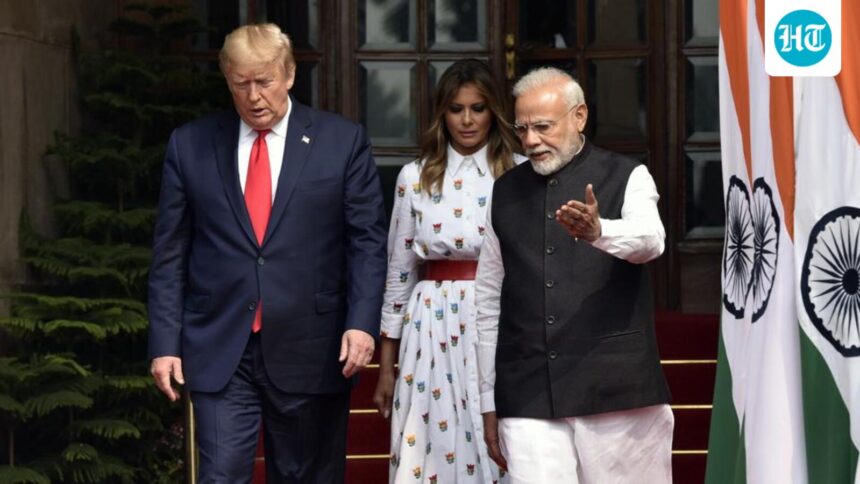
India supports restoring peace in West Asia as soon as possible, and wants to ensure the Strait of Hormuz remains open and safe for the international community, Prime Minister Narendra Modi said when US President Donald Trump called him on Tuesday to discuss the situation in the Gulf region amid growing concerns over food and fuel security.

This was the first phone conversation between the two leaders since the Israeli and US military strikes on Iran on February 28 led to a conflict that has entered its fourth week. With the impact of the closure of the Strait of Hormuz on supplies of fuel and other goods, the Indian side has in recent days reached out to Iran, Israel, all members of the Gulf Cooperation Council and the United States to find ways to end hostilities.
Modi posted on social media that he received a phone call from Trump and had a “useful exchange of views on the situation in West Asia.” “India supports de-escalation and restoration of peace as soon as possible. Ensuring that the Strait of Hormuz remains open, safe and accessible is essential for the entire world,” he said.
He added that the two sides agreed to remain in contact “regarding efforts to achieve peace and stability.”
The phone call was initially announced on social media by US Ambassador Sergio Gore, who said Trump spoke with Modi to discuss “the situation in the Middle East, including the importance of keeping the Strait of Hormuz open.”
The last time Modi and Trump spoke on the phone was on February 2, when the two sides announced progress towards concluding a bilateral trade agreement aimed at addressing the issue of US tariffs on Indian exports.
People familiar with the matter noted that the prime minister has held two rounds of phone calls with Iranian President Masoud Pezeshkian and the leadership of the six Gulf Cooperation Council member states — Bahrain, Oman, Kuwait, Qatar, Saudi Arabia and the United Arab Emirates — in addition to a conversation with his Israeli counterpart Benjamin Netanyahu since the start of hostilities.
External Affairs Minister S Jaishankar met envoys of the Gulf Cooperation Council countries on Monday and Iranian Ambassador Mohammad Fatehli on Tuesday. He also spoke with his Iranian counterpart, Seyed Abbas Araghchi, on five occasions, and called his American counterpart, Marco Rubio, on Monday.
After his meeting with the Iranian envoy, Jaishankar said in a social media post that they discussed the conflict in West Asia but did not provide details. “I appreciate the support provided to Indians in Iran in these difficult times,” he added.
The phone call between Modi and Trump should be viewed in the context of India’s outreach, which has focused on efforts to end hostilities as soon as possible and ensure the unimpeded flow of energy and other goods, especially through the Strait of Hormuz, in light of the significant implications for food, fuel and fertilizer security in the country, the people said.
“The war must be put to an end as we are already feeling its negative effects. It’s not just about India – it could be all about food security in Africa soon as fertilizer supplies decline. We could see another round of food and fuel insecurity that we saw after the Russia-Ukraine conflict started in 2022,” one person said.
At the same time, the Indian side ruled out any possibility of interfering in the situation in West Asia, sources said. The sources said that the Indian Navy’s Operation Sankalp remains focused on ensuring the security of commercial ships flying the Indian flag in the Persian Gulf and the Gulf of Oman and protecting maritime lines of communication.