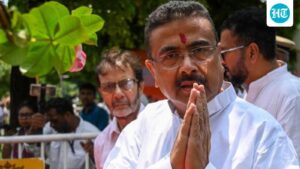
Bahujan Samaj Party chief Mayawati and Azad Samaj Party (Kanshi Ram) chief Chandrashekhar Azad on Friday publicly sparred over the protests following the killing of a Scheduled Caste college student in Meerut, with the two leaders calling for two contrasting approaches to ensuring justice for Dalits.

The exchange came even as the National Human Rights Commission (NHRC), acting on a complaint over the police response to the protests, issued notices to the Uttar Pradesh Home Minister and the Director General of Police, asking for a report to be submitted within 15 days, according to news agency PTI.
Mayawati: ‘Not through the streets’
Addressing a press conference in Lucknow, Mayawati urged Dalits and other marginalized sections to fight injustice through “constitutional means” and refrain from taking to the streets. She said that BR Ambedkar had laid the way to secure justice through law and democratic institutions.
“Some organizations and political parties, driven by narrow political interests, are misleading and provoking members of oppressed communities to launch protests,” she said, without mentioning Azad’s name.
She added, “Such organizations initially incite violence, unrest, and banditry, and then their leaders visit the affected areas to shed crocodile tears and extract political gains from the events.”
She added: “This does not guarantee justice for the victims and does not help the affected communities. In the prevailing circumstances, it only exacerbates their suffering.”
Mayawati stressed that if people are denied justice in lower courts, people should approach higher courts, including the Supreme Court, “instead of taking the law into their own hands.”
Recalling BSP founder Kanshi Ram – whose name and legacy the Azad Party also lays claim to – she said he translated Ambedkar’s vision into political action by building the BSP so that underprivileged communities could get the “master key” “on the strength of their votes”.
It sought to warn Dalits and other disadvantaged communities against being misled by “organisations seeking political gains… especially with the National Assembly, Lok Sabha and local body elections approaching”.
Chandrashekhar replies
Hours later, Chandrashekar arrived in Meerut and addressed his supporters before saying he would first meet the victim’s family and then talk to officials.
He defended the protests as a constitutional right, and questioned police actions against demonstrators. “If we go to protest, which is our constitutional right given by the Constitution, you can arrest us, register cases against us and send us to jail. But under what law are the police allowed to beat us? I have come here to ask this question,” he said.
“If you make a fuss or raise slogans, nothing will be achieved,” he said, repeatedly urging his supporters to remain peaceful. “Someone in the crowd might throw a stone and everything will be destroyed. First, we will listen to the victim’s family and then we will listen to those responsible.”
In a clear response to Mayawati’s statements, Chandrashekar said: “Our senior leaders think that we have come here to shed crocodile tears. They are sitting at home, holding a press conference to say that we are here only to shed crocodile tears.”
“The truth is that if the Bhim Army and the Azad Samaj Party do not take a stand today, no one will get justice,” he said, referring to the activist group that gave rise to the party.
He said his workers are “risking their lives”, being detained by police, and spending their own money to support the victims.
“You are not fighting while our workers are fighting on the ground,” he said, without mentioning Mayawati’s name.
Referring to her appeal to pursue legal remedies instead, Chandrashekar said: “They say there should be no protests, and if justice is not done in the lower court, go to the Supreme Court. So when our sisters are assaulted, acid is thrown at them, they are killed and hanged, should we simply wait for justice after ten years? Should we also sit idly by and not fight for justice?”
He added: “I respect them and I always will. But today they hurt me. Society is watching. Society will decide who fights for it and who only has to do with votes.”
Investigate the murder and notify the National Human Rights Commission
The protests stem from the killing of a 20-year-old Dalit university student.
According to Meerut Police, she went missing from the city’s TB Nagar area on May 15 and her body was recovered from another area on May 17. The main accused was arrested on May 18 and another accused was subsequently arrested for allegedly destroying evidence, police said.
Police said investigators have since discovered more people were involved, and the victim’s family has been informed of the progress of the investigation.
Despite the arrests, the victim’s family members and supporters continued to demand action against “all those responsible,” leading to a protest on Wednesday outside the complex.
According to police, the demonstrators gathered without permission, blocked traffic for about six hours and attempted to storm the district magistrate’s office after breaking the main gate. The police claimed that the protesters attacked police and administrative officials despite their repeated requests to disperse, resulting in 11 police officers being injured. Police said they arrested seven people and more than 30 others were booked.
However, the police action drew criticism after videos circulated on social media showing Avinash Pandey, Meerut’s senior police inspector, slapping a man in custody and assaulting a person inside a police vehicle.
The National Human Rights Commission has taken note of the complaint filed by Bhopal resident Sunil Ahirwar, in which he alleged that the police resorted to a “brutal and unjustified charge” and that widely circulated videos showed senior officers assaulting detainees.
The committee noted that these allegations, if true, “prima facie appear to be violations of the human rights of the victims.”
Wider political competition
This week’s exchange between Mayawati, 70, and Chandrashekar Azad, 38, comes as the BJP continues its prolonged decline and Chandrashekar Azad tries to expand his presence ahead of the 2027 Uttar Pradesh Vidhan Sabha elections scheduled in about six months against Yogi Adityanath’s BJP regime seeking a hat-trick.
The BSP, which formed the government alone in UP in 2007 under Mayawati’s leadership, has since seen its tally decline to 80 in 2012, 19 in 2017 and just one seat in 2022. In the 2024 Lok Sabha elections, Mayawati’s party failed to win a seat in UP despite polling more than 9% of the votes, according to Election Commission data.
Meanwhile, Chandrashekar won the Nagina Lok Sabha seat in 2024, giving the Azad Samaj Party (Kanshi Ram) its first representation in Parliament, though his presence is not yet complete.
The main opposition Samajwadi Party has sought to expand its base by also attracting Dalits, who make up about a fifth of the state’s population, with Congress leader Rahul Gandhi even demanding Bharat Ratna instead of Kanshi Ram.
Over the years, the BJP has accused Chandrashekar of dividing the Dalit vote and indirectly benefiting the BJP, while Chandrashekar has sought Mayawati’s blessings and claimed that the community needs more street style politics.