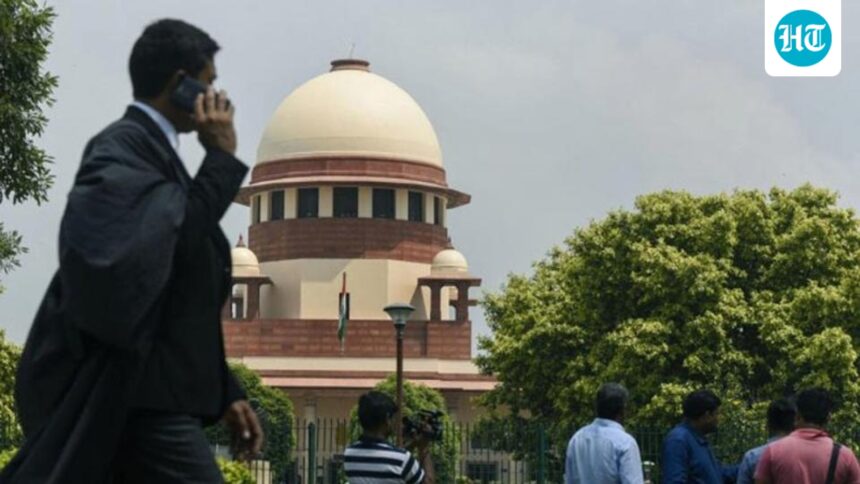
The Supreme Court on Friday made some clear observations when it disposed of a public interest litigation (PIL) seeking a nationwide menstrual leave policy for girl students and workers. The court said that making this leave mandatory under the law would deter employers from hiring women and unintentionally reinforce gender stereotypes.

There was a seat for Chief Justice of India (CJI) Surya Kant and Justice Joymalia Bagchi Hearing of the PIL, “Shailendra Mani Tripathi v. Union of India”.
What the CJI-led bench observed
“The moment you say it is mandatory under the law, no one will give them jobs. No one will take them in judicial or government jobs; their careers will be over. They will say you have to sit at home after informing everyone,” he said, as quoted by news agency PTI.
The chief justice also questioned the wording of the petition, suggesting that it risked stigmatizing periods rather than normalizing them. He said: “These appeals aim to create fear, describing women as inferior, and that menstruation is a bad thing that happens to them.”
He acknowledged menstrual leave as an inherently “positive right,” but stressed that mandating it by law was a different matter.
The court distinguished between voluntary policies and mandatory policies.
When senior advocate M.R. Shamshad, representing the petitioner, to Kerala, where relaxation has been introduced in schools, and to private companies which have voluntarily extended menstrual leave to employees, the bench acknowledged such examples. But she did not soften her stance.
“Donating voluntarily is excellent,” the CJI noted.
Noting that petitioner Tripathi had already made representation to the relevant authorities, the bench said it was not necessary to continue approaching the court for a writ (extraordinary order).
The court directed the relevant authorities to consider his representation and study the possibility of formulating a policy after consulting all relevant stakeholders. Thus, the political isolation law was eliminated.
Read also | Why many women feel that menstrual leave in the workplace should be a valid option
Not for the first time: ‘Two very different points of view’
Live Law noted that this is the third such petition filed by Tripathi on the same issue. The former was phased out in February 2023, allowing him to represent the Union Ministry of Women and Child Welfare.
He approached the court again in 2024, saying that the ministry had not responded to his representation. This petition was disposed of in July 2024, as the Center was asked to take a policy decision.
In July 2024, the bench led by then CJI DY Chandrachud, comprising Justices JB Pardiwala and Manoj Misra, expressed similar concerns as CJI Kant did on Friday.
“There are two completely different views,” observed Chandrachud, the then CJI, while hearing the PIL, “[One is that] Having a menstrual leave policy encourages women to become part of the workforce; The other perspective is that imposing such policies would actually impose a kind of ban on hiring women because the employer would avoid women in the workplace. We don’t want that to happen either.”
This Council then asked the Union Government to hold stakeholder consultations and examine whether a model policy could be formulated.
When SC defined menstrual health as the right to life
Earlier this year, a separate bench of the Supreme Court – Justices JP Pardiwala and R Mahadevan – delivered a landmark judgment in the case Dr Jaya Thakur v Union of India. Recognizing the right to menstrual hygiene as part of the right to life under Article 21 of the Constitution.
The bench held that the absence of sex-segregated toilets and access to menstrual pads deprives girls of “dignity, privacy, equality and meaningful access to education,” and that menstrual health cannot remain “a matter of charity or political discretion” because it flows directly from constitutional guarantees.
The court issued three binding directions requiring all schools – government and private – to provide functional, gender-segregated toilets with adequate water supply, biodegradable sanitary pads within the toilet blocks, menstrual hygiene management systems equipped with spare uniforms and essential items.
“Equality of opportunity requires the state to remove barriers that prevent girls from accessing education on an equal basis with boys,” the council said, adding that privacy and dignity together place “a positive obligation on the state not only to avoid invasion of privacy, but also to effectively protect it through necessary measures.”
Where countries stand on vacation for a period
Although there is no central law on menstrual leave, many Indian states have their own provisions.
Bihar is a case in point, which has provided two days of paid menstrual leave per month to female government employees since 1992 when Lalu Prasad Yadav was chief minister. Kerala granted this benefit to female students in state universities in 2023, granting up to three days off per month and relaxing attendance requirements; In 2024, it was expanded to include female trainees in industrial training institutes.
Odisha introduced a monthly paid day off for women government employees in 2024, and Sikkim extended similar provisions to women employees on the Supreme Court registry.
Karnataka went further when its Cabinet approved the Menstrual Leave Policy 2025 last October, making it the first state to impose one paid day of menstrual leave per month, for a total of 12 days annually, in both the government and private sectors, covering industries ranging from IT companies to garment factories. This policy was later challenged in court, and the final decision is still before the courts.