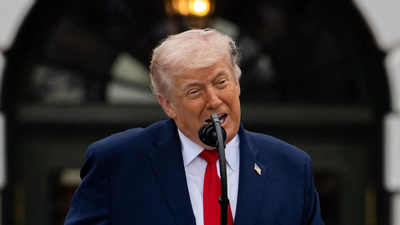
US President Donald Trump (AP Photo)
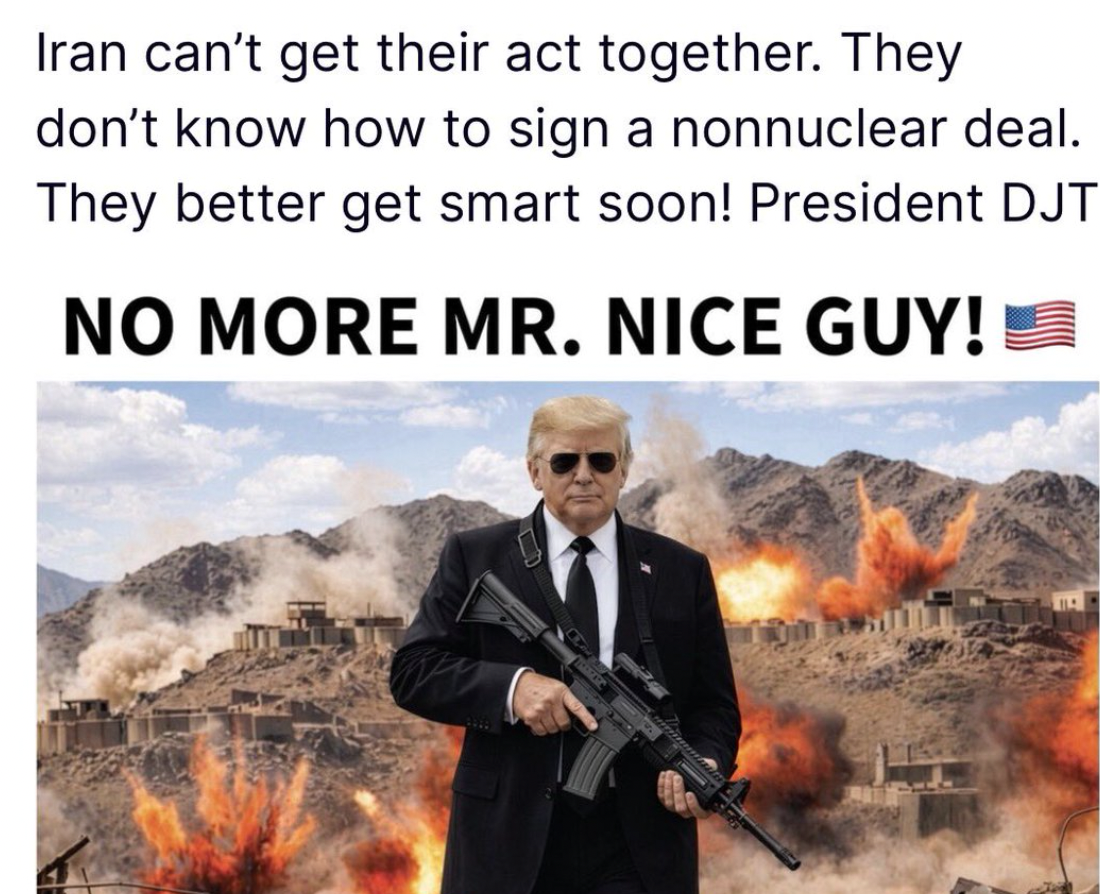
TOI correspondent from Washington: US President Donald Trump has instructed his aides to prepare for a long-term US naval blockade of the Strait of Hormuz, likely to last several months, after he launched a social media post at 4am asking Iran to “get smarter soon” and warning: “No more Mr. Nice one.
“While the bizarre post – which shows a machine gun toting Trump in silhouette of a pilot against a backdrop of war – suggests more punitive military strikes to come, US policy, despite escalating its rhetoric, appears to be increasingly based on a grinding, open-ended strategy that stops short of all-out conflict.Behind the scenes, the administration indicates that the United States’ goal is to stifle Iranian oil exports, pressure its economy, and force it to make concessions without provoking a broader regional war, which Washington considers a more dangerous alternative to the policy of “controlled strangulation.”
The blockade is already reshaping global energy flows. Shipping traffic through Hormuz has fallen to its lowest levels since the conflict began, disrupting the corridor that normally transports nearly a fifth of the world’s oil. The impact was swift and inexorable: U.S. gasoline prices rose to a record average of $4.23 per gallon, up more than 40 percent since late February, according to AAA. For American drivers, war is no longer just an abstraction, but a pain at the gas pump.
However, the effect is more severe abroad than in a country that can print currency for the world to buy. India, one of the world’s largest importers of crude oil, has rushed to diversify its supplies, relying more on shipments from Russia and the United States as it draws down strategic reserves, with a price rise imminent after the election results. Refiners in Japan and South Korea are paying hefty premiums for replacement shipments, while China has quietly increased its onshore imports and tapped government stockpiles to cushion the blow.
Europe is also facing a renewed energy crisis, just as it is beginning to stabilize the Ukrainian war that has reached a stalemate.Back in Washington, the administration insists that the strategy is working. “Thanks to the blockade, Iran is bankrupt,” said one Trump ally, echoing a broader argument that sustained economic pressure will succeed where diplomacy has failed. Some go further, predicting the imminent collapse of Iran’s oil infrastructure – a claim that analysts see as more rhetorical than realistic.Officials privately admit that the road ahead is murkier. There are few expectations of a nuclear agreement in the near term, but there is also limited appetite for escalation. The result is a policy that risks becoming its final state: an indefinite siege with no clear way out.Critics say this is precisely the problem. “Memes are all Trump has left in the Middle East,” one such critic wrote on X, portraying a growing chorus of frustration in Washington policy circles.
“There is no plan, no exit strategy, and no clarity on what success looks like. It is paralysis dressed up as rigidity.”The criticism found echoes abroad. German Chancellor Friedrich Merz claimed that Iran had “humiliated” the United States in full view – and had absorbed pressure without surrendering. It is unclear whether Mears’ comments influenced Trump in his bombastic post. The president has shown little inclination to recalibrate, instead doubling down on economic pressure while framing the conflict as a test of endurance.
In his telling, time and financial pressures are on America’s side.But this narrative is further complicated by local realities. High fuel costs began to spread through the broader economy, raising transportation and food prices and complicating the administration’s efforts to protect American consumers. The White House has held talks with oil executives aimed at stabilizing markets, but officials acknowledge that as long as the choke point in Hormuz remains limited, volatility is inevitable.Right now, the war is playing out in a strange balance: too intense to ignore, too constrained to be resolved. There are no large-scale bombing campaigns dominating the headlines, no diplomatic breakthroughs signaling progress, just a steady tightening of economic screws and a rising global bill.