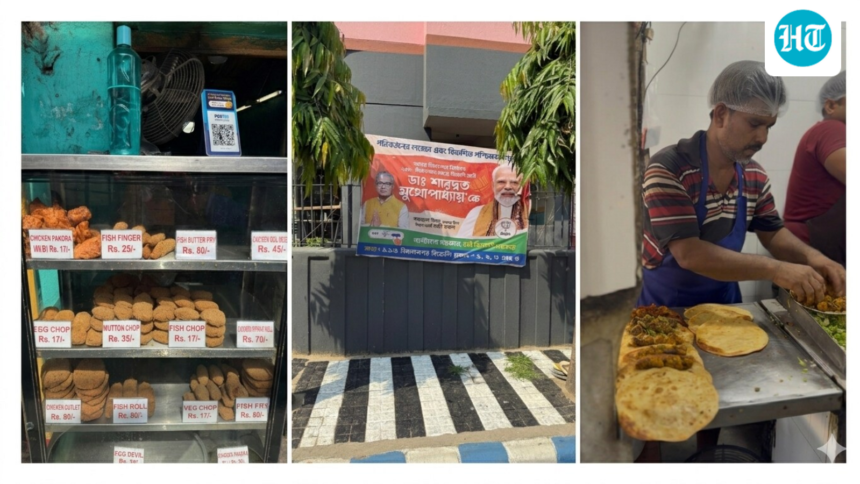
In the West Bengal elections, food politics has taken center stage as voters debate non-vegetarian rights and identity amid competing narratives by the TMC and the BJP.

Amidst the election chatter in West Bengal, one thing that has emerged as the biggest talking point is non-vegetarian foods – with Chief Minister Mamata Banerjee claiming that the BJP will make access to non-vegetarian foods difficult for Bengalis if voted to power. The BJP, on the other hand, has tried its best to dismiss these allegations as baseless, so much so that one of its candidates was recently seen campaigning carrying a fish.

Against this backdrop, conversations across some of the city’s most popular dining hubs – from biryani outlets and kati stalls to popular cabanas – have increasingly turned towards an unusual political question: food.
Food as identity
For many in Bengal, food is inseparable from identity. Mach and com. maangsho (Fish and lamb) are more than just food. They are an affection for Bengalis. At a biryani outlet, Syed Qamar Ahmed, a native of Bihar who frequently visits Kolkata, framed the issue as one of personal freedom.
He said that food choices ultimately depend on individuals, not governments, considering that no authority should dictate what people eat. While acknowledging the political debates on the issue, he noted that voters’ greatest concern remains peace and coexistence between communities and not food restrictions alone.
Ahmed added that governments should focus on maintaining harmony and ensuring that citizens of all faiths and backgrounds feel safe.
“The current government is good. The BJP also talks about good governance, but sometimes its workers provoke the sentiments of people – whether they are Muslims or any other community. The government itself is not bad everywhere, but sentiments are stirred up,” Ahmed opined.
When asked if he would like to change the government, he replied: “For people of every religion and class, any government that comes should bring peace, harmony and security. It would be better if politics does not disturb communal harmony.”
Fire where there is smoke?
Inside another busy outlet, an employee, who requested to remain anonymous, reflected a more cautious mood — a mood that mirrored many of the conversations heard around town.
The worker said Mamata Banerjee’s comments appeared to be linked to developments in other parts of India, where tensions over vegetarian and non-vegetarian foods have cropped up at times. According to him, such incidents elsewhere are making some people in Bengal wary that similar divisions will emerge locally.
He described persistent concern that policy focused on eating habits could deepen social divisions, even if immediate restrictions seem unlikely.
“Non-vegetarian food is something that is very dear to Bengalis. About 90 per cent of India’s population is non-vegetarian – how can anyone stop people from eating it? Mach Bhat in Bengal” [fish and rice] He said: Famous.
When asked if he felt Mamata Banerjee’s claims had some basis, he said: “Yes, what Mamata ji is saying is based on what we see in other states – during festivals there are fights over vegetarian and non-vegetarian food, attempts to stop people, violent behaviour. Violence over food choices happens outside West Bengal, so from that perspective what you are saying is true.”
On whether he was happy with the current government, he replied: “Yes, it is a very good government. And in all of India, you will find the most peace in West Bengal.”
Read also: How Kolkata Talks About Bengal Elections In Addas
Fear, choice and political preference
For Shehnaz Begum, a Kolkata resident I met outside a restaurant, the discussion was less about lockdown and more about stability.
Begum said people should remain free to choose what they eat, adding that conflict only arises when societies stop coexisting peacefully. While she rejected the idea of non-vegetarian food suddenly disappearing, she felt that the change in government could make daily life more difficult if tensions increased.
Expressing support for continuity, she said Mamata Banerjee’s leadership appealed to her because she believes the current government is trying to “take everyone with it”, though she also hopes that governance and development will continue to improve.
Measured evaluation of the employer
At Sankar Cabin, owner Ram Krishna Garay offered a calmer, more measured assessment. He said that the Transitional Military Council may return to power, but with a slightly smaller number of seats.
He said that he does not expect a radical political shift in these elections, although he stressed that any government that comes to power must give priority to the needs of the people.
Across Kolkata, reactions did not reveal widespread alarm or outright rejection of the Prime Minister’s claim. One bike taxi rider told me that he feels the non-vegetarian debate is not something that locals are particularly concerned about. He said that it is ultimately up to the people what they want to eat, and in a state like West Bengal where non-vegetarian food is a staple, no party or its branches will be able to impose anything.
How does the BJP counter this narrative?
Among those who disputed this narrative was Sharadwat Mukherjee, the BJP candidate from Bidhannagar, who was seen campaigning with a fish – an image that has quickly attracted attention this election season.
Explaining the move, Mukherjee said the campaign aims to respond to what he described as opposition allegations that the BJP government will turn West Bengal into a vegetarian state, depriving Bengalis of fish, a cultural staple.
Referring to the statements made by Chief Minister Mamata Banerjee, he said his campaign sought to confront this narrative head-on. Mukherjee noted that despite being a vegetarian, fish remains a staple of Bengali identity and nutrition and hence the election campaign using it was aimed at reassuring voters.
Read also: “We will not ban it,” says BJP’s Amit Shah after CM Mamata’s cultural warning.
He added that he did not expect the campaign images to go viral, but said they reflected how elections in Bengal are increasingly about emotional narratives rather than debates about infrastructure, education, investment or industry. Criticizing the state government, he said welfare policies had overshadowed long-term development priorities.
“The campaign is basically to set out my narrative and, on the other hand, to counter the narratives that the opposition has already put out. Two days before I started my campaign, there was a very loud campaign by the opposition, especially by Chief Minister Mamata Banerjee, that once the BJP arrives, the entire West Bengal will turn into a vegetarian state and we will never be able to enjoy fish, which is one of the staple foods in Bengal. So I decided that this is the right time,” Mukherjee said while speaking to Hindustantimes.com. “So – it was probably a hot-button issue at the time.”
“So, I decided to campaign using fish. Although I’m not a fan of eating fish – I’m basically an egg eater – many people in my family do eat them. We are part of Bengal, so obviously Bengalis enjoy fish, and fish is one of the best non-vegetarian items health-wise. It’s a great source of protein. So, there’s nothing wrong with campaigning with fish. I never knew it would go viral,” he added.
He said that he believes that such narratives… What political parties offer are “useless things that turn people into something they should not be.”
“It is very sad that per capita diet in Bengal has become an election issue. In other states like Maharashtra, Gujarat and Tamil Nadu, discussions usually revolve around investment, education and development,” Mukherjee added.
“Unfortunately, our Prime Minister has long forgotten that there is such a thing as infrastructure – taxpayers’ money goes to infrastructure, education, health and industry. But she is handing out subsidies… only interested in subsidies, which will not support the economy or improve the situation in Bengal in the long run. This must be corrected,” he said.
If election rallies amplify political slogans, Kolkata’s corners tell a more nuanced story. Here, voters discuss the future between bites of biryani, carefully weighing narratives, carefully expressing preferences, and revealing an electorate that remains attentive but measured in its political voice.

Nayanika is a Senior Content Producer at Hindustan Times, based in New Delhi, with over six years of experience in the digital media industry. It specializes in providing clear, in-depth coverage across public, national and international events, with a strong focus on breaking news and in-depth explainers. Known for her ability to decipher complex developments, she enjoys deconstructing multi-layered political and policy issues into accessible, reader-friendly narratives that deliver information without distraction. She previously worked in India’s leading newsrooms, including India Today, News18 and Outlook, where she has been tracking news, covering major events for the last six years and leading teams. Nayanika holds a Master’s degree in Political Science and has a keen interest in international relations and world affairs. Her academic foundations shape her analytical approach to stories, enabling her to connect the dots between local events and broader geopolitical currents. She is particularly drawn to stories that require context, nuance, and clarity—turning complex topics into compelling reads. Outside the newsroom, Nayanika is a passionate gourmet who loves to cook and share meals with her loved ones. When she’s not writing or keeping up with the latest headlines, you can often find her exploring local markets for the freshest ingredients, looking for inspiration for her next culinary experiment.Read more