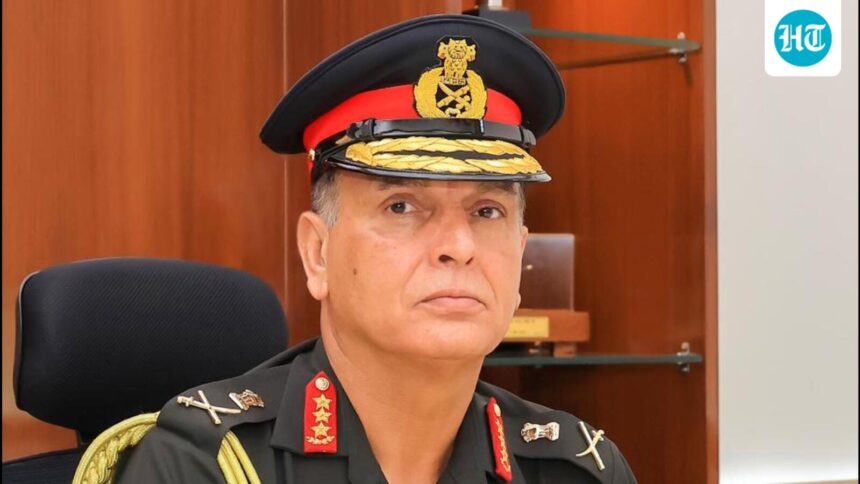
Lt. Gen. Dheeraj Seth will take over as the country’s next Army Chief, succeeding Gen. Upendra Dwivedi, who will retire on June 30, according to a government order issued on Saturday. He will be the first Armored Corps officer to lead the service in nearly three decades.

Seth, who is currently serving as Deputy Commander of the Army, will hold office till August 31, 2028. General S Roy Chowdhury was the last Armored Corps officer to hold the top post, between 1994 and 1997, the order added.
Seth, an alumnus of the National Defense Academy (NDA), Khadakwasla, and the Indian Military Academy, Dehradun, was commissioned into the 2nd Lancers on 20 December 1986. Known for his professionalism and military acumen, Seth attended the Defense Services Command and General Staff Course at the Military College in Paris, the International Defense Procurement Management Course at the Naval Postgraduate School in Monterey, California, the Mhow Higher Leadership Course, and the National Defense College in New Delhi.
“Over a distinguished military career spanning nearly four decades, he had extensive experience in operational, strategic, capability development and institutional areas, contributing significantly to the Indian Army’s combat effectiveness and long-term transformation,” the Ministry of Defense, which announced his appointment, said.
Seth, the son of a retired three-star general, commanded the Skinner Horse Armored Regiment, an armored brigade, a counter-insurgency force in Jammu and Kashmir, an Assault Corps on the Western Front, the Jaipur-based South Western Command, and the Pune-based Southern Command.
The MoD said the officer has the rare distinction of leading two Army operational commands and providing strategic oversight across vital theaters for more than two and a half years. She added that he held several key appointments that significantly impacted operational planning, force management, and capability development.
“Widely recognized for his contributions to force modernization, the general officer has held pivotal positions in the strategic planning and capability development sectors at Army Headquarters, shaping the Army’s modernization path, capabilities roadmap and long-term force structuring initiatives. His contributions have been instrumental in aligning operational requirements with emerging technologies and future battlefield imperatives,” the department said.
His appointments include Major General of Independent Armored Brigade, Assistant Military Secretary, MS Branch, Brigadier General Staff (Operations) at South Western Command, and three posts in various branches at Army Headquarters, including Director General (Discipline, Ceremonies and Welfare).
He has also been an Instructor and Assistant Assistant at NDA, Colonel Trainer at Armored Warfare School, Armored Corps Center and School, Ahmednagar. He served as an operations officer in the United Nations Angola Verification Mission III from 1995 to 1996. The Ministry of Defense added in a statement that Seth consistently excelled in professional military education, attaining senior positions in educational courses.
His appointment as Army Chief comes days after General NS Raja Subramani took over as Chief of Defense Staff and Admiral Krishna Swaminathan as the new Navy Chief, holding the top military posts before the restructuring of the main command.
The senior appointments come at a pivotal moment as the armed forces advance theater, a long-awaited reform designed to integrate the military’s resources into future conflicts. The model includes establishing a Northern Theater Command based in China in Lucknow, a Western Theater Command based in Pakistan in Jaipur, and a Naval Theater Command in Thiruvananthapuram. The government last year identified the establishment of theater commands as a key area of focused intervention to ensure integrated application of force, operational efficiency, and optimal use of resources.
In a recent interview with HT, General Dwivedi described theater as key to future combat readiness, while stressing that such a major military reform requires careful implementation. “A reform of this magnitude cannot be rushed,” he said. “It must be operationally sound, legally supported, administratively implementable, and future-ready.” Theatricalization is a far-reaching reform aimed at integrating the military’s resources into future conflicts. Steering it forward is General Subramani’s top priority.