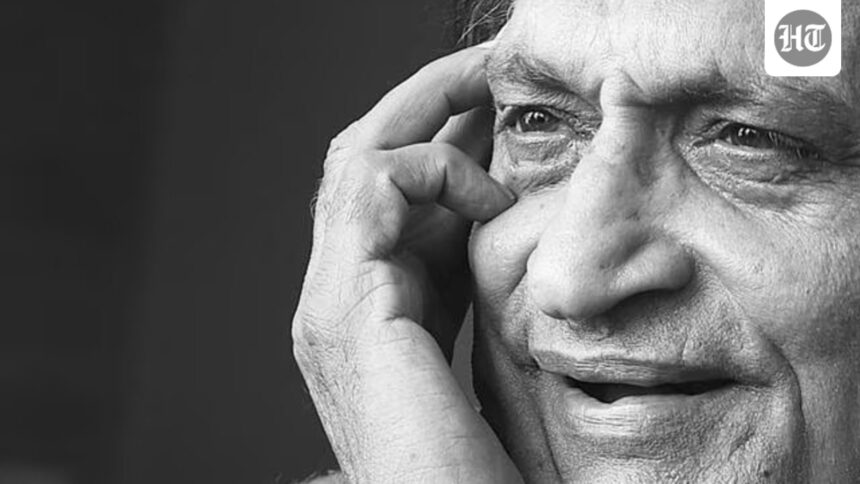
India has lost one of its most important historians. Raghu Rai, a photojournalist who spent six decades turning the streets, tragedies and quiet intimacies of this country into lasting visual records, has died at the age of 83, his family shared on his Instagram profile on Sunday.

Born on December 18, 1942, in Jhang in Punjab – now in Pakistan – Ray stumbled into photography almost by accident, borrowing a camera from his elder brother S Paul in the 1960s. This incident became a career that took him to Magnum Photos, to the front pages of Time, Life, and The New Yorker, and to the heart of India’s most defining moments—the Bangladesh Liberation War, the Bhopal gas tragedy, the quiet majesty of the Ganges.
But it was not only what he photographed that distinguished him. This was the way he thought about the act of photography itself.
Color or not
“Color images tend to lack seriousness,” he said in a 2016 conversation with Hindustan Times at the Panchkula Arts and Literature Festival. “Colors are exaggerated, not real.”
He was asked how important black and white photography is in the age of vivid digital color.
He defined the choice of monochromatic color as not only stylistic, but ethical on some level. Color, in his view, draws the eye away from the truth in the center of the frame. He said it was distracting.
In contrast, black and white demanded that both photographer and viewer put in more work, and were rewarded for it.
“With black and white, one can create visual harmony, meaning the visual noise and distortion in the image comes through like dialogue,” he said.
This was a view to which he returned throughout his career. In interviews spanning decades, he has consistently emphasized that color risks turning a photograph into decoration, drawing the viewer’s attention toward the surface rather than the substance. He said that the monochromatic color stripped away this temptation.
“Whatever takes away your heartbeat becomes your inspiration of the moment,” he told HT.
Practice the unwritten
Ray was also deeply skeptical of photography, believing that true images only appear in unprotected moments.
He saw photojournalism, his primary profession as a photographer, as a responsibility.
“History can be written and rewritten. But photojournalism is a rough draft of history, which Boca gives Proof, proof of who we are and where we come from,” he told HT.
“The origin of the picture has to come from the speed and magic that is unfolding now,” Ray said in another interview. “It will not happen again.”
Black and white heritage
Raghu Rai has produced over 18 books, founded the Raghu Rai Center for Photography in Haryana in 2016, and has been honored with the Padma Shri and the Masters Award in Photojournalism from the Lucy Foundation.
His images of Mother Teresa, Indira Gandhi, the Dalai Lama, and anonymous millions on the streets of India are seen as a visual record of a nation in constant and turbulent motion.