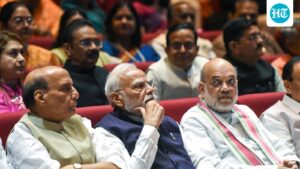
written, Echoes of Eternity: The Journey of Indian Thought from the Manipulation of the Veda to the Presentwas recently launched by Shri Nitin Gadkari in Delhi. Also on the panel was my good friend Shashi Tharoor, a contemporary of the college. Gadkari spoke with erudition and eloquence. So did Shashi, but one of his comments was that the book may not have fully represented the contributions of South India. I was quick to disabuse him, because this compendium was in fact more representative – and legitimately so – of the remarkable role played by South India in the making of Hindu civilisation.

Last week, I was invited to Chennai by the city’s Rotary Club and the Federation of Indian Chambers of Commerce and Industry (FLO) Ladies’ Organization to talk about my books, diplomacy and politics. Dr. Naveen Jayakumar, chief ophthalmologist, competition expert and pianist, was talking to me. Separately, I gave another lecture at the beautiful and dignified home of Raju and Raji Venkatraman (next to the home of Vijay, the new Prime Minister). Raju is a remarkably successful businessman and a well-known personality in Chennai. He had invited about fifty literary and famous people in the city.
In contemporary political discourse, there is often a tendency to view India through simplistic binaries: North and South, Indian and non-Indian, Aryan and Dravidian, Sanskrit and Tamil. Such formulations may serve immediate political goals, but they do grave injustice to India’s civilizational unity. If there is one region that has succeeded in nurturing, preserving, enriching and disseminating the basic values of Hindu civilization over the centuries, it is South India.
It is a matter of historical fact that the philosophical foundations of Hinduism reached some of their most complex expressions in the South. The towering figure of Adi Shankaracharya, born in Kerala in the 8th century, traversed the length and breadth of India reviving the knowledge of Advaita Vedanta. At a time when India was intellectually fragmented by competing schools of thought, Shankara presented a unified philosophical vision rooted in the Upanishadic vision of pantheism. His commentaries on the Brahma Sutra, the Upanishads, and the Bhagavad Gita remain among the greatest achievements of Indian philosophy.
Ramanujacharya had a similar influence, as his Vishisht Advaita philosophy brought a deep devotional dimension to Vedantic thought. Born in Tamil Nadu, Ramanuja challenged exclusivism and emphasized the accessibility of divine grace to all devotees. His teachings helped shape the Bhakti movement that changed religious life across India.
Then came Madhavacharya from Karnataka, who put forward Dvaita Vedanta. Vallabhacharya put forward Shuddha Advaita, further emphasizing the distinction between the individual soul and the Supreme Being. Incidentally, although Vallabh founded the Krishna sect of Vaishnavism in the Braj region of northern India, he was a Telegu Brahmin. One can also remember the seminal works of Nimbarkacharya and many others.
The same applies to sacred literature. The Tirukkural of Thiruvalluvar, written about 2000 years ago, occupies a unique place in Indian civilization. Comprising 1,330 Tamil couplets of exceptional wisdom, it deals with morality, governance, social conduct and human relations with a universality that transcends religious boundaries. His moral vision is so profound that he is often called the “fifth Veda.”
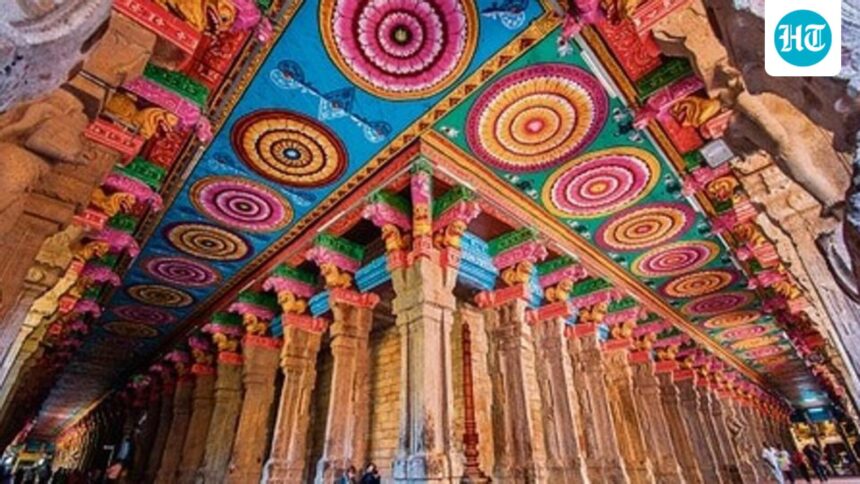
South India’s contribution to Hindu civilization is perhaps most evident in its temples. A visitor who stands in front of the Brihadisvara Temple in Thanjavur, the Meenakshi Temple in Madurai, or the Kanchipuram, Srirangam, Belur, Halebid or Hampi temples cannot help but be amazed by the magnitude of the artistic achievement they represent. These temples are not just places of worship. They are repositories of architecture, sculpture, music, dance, literature and social organization.
South India, although completely untouched, escaped much devastation caused by Turkish and other invaders. Thus, it became the guardian of architectural traditions that would otherwise have disappeared. This continuity reached notable political expression in the Vijayanagara Empire. Founded in the 14th century, Vijayanagara emerged as the last great Hindu kingdom in medieval India. At a time when much of the Indian subcontinent was under the control of various Muslim dynasties, Vijayanagara became a powerful center of Hindu political power, cultural patronage, and economic prosperity.
The influence of South India extended far beyond the shores of the Indian subcontinent. Through trade, diplomacy, and occasional military missions, the Chola Empire (9th to 13th centuries AD) extended Indian influence across Southeast Asia. From Indonesia and Cambodia to Thailand and Malaysia, one encounters unmistakable traces of Hindu culture. Sanskrit inscriptions, temple architecture (including Angkor Wat, the largest Hindu temple in the world), royal rituals, epics such as the Ramayana and Mahabharata, and countless linguistic metaphors attest to a civilizational exchange of remarkable depth.
Acknowledging these contributions does not mean diminishing the role of other regions in India. Hindu civilization is a collective heritage enriched by every part of the country. The philosophical insights of the Upanishads, the spiritual geography of the Ganges, the poetry of Bhakti saints, the intellectual achievements of ancient universities like Nalanda and Takshashila – all form part of the same civilizational continuity.
In an era when political discourse often seeks to highlight divisions between North and South, this shared heritage deserves renewed attention. The history of Hindu civilization does not illustrate separation but synthesis; Not fragmentation, but interconnection. In this interconnection, South India played a major role.