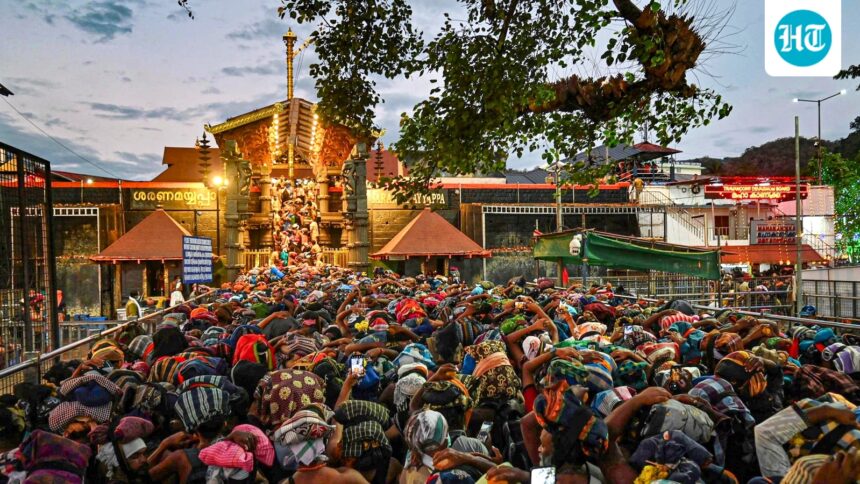
The Supreme Court on Tuesday questioned the merits of a 2006 public interest litigation that culminated in its landmark 2018 ruling allowing entry of women of all ages into the Sabarimala temple in Kerala, observing that the petition “should never have been admitted” and the recorded material should have been “thrown in the dustbin”.

A nine-judge Constitution Bench led by Chief Justice of India Surya Kant, and comprising Justices B V Nagrathna, M M Sundresh, Ahsanuddin Amanullah, Aravind Kumar, A G Masih, R Mahadevan, Prasanna B Varali and Joymalia Bagchi, made these observations while hearing a host of issues arising out of the Sabarimala review proceedings and associated questions on the scope of religious freedom.
The court’s remarks came during arguments by senior advocate RB Gupta, representing the Indian Young Lawyers Association (IALA), which had filed the original petition challenging the exclusion of women of menstruating age from the Kerala hill shrine.
The court criticizes the petition for weak evidence
Taking strong exception to the PIL basis, the court said the court had accepted the petition on the basis of materials that did not merit judicial consideration. “We filed the PIL based on this type of document, which should have been thrown in the trash immediately,” the international investigation committee noted, referring to the reliance on press reports and unverified materials.
Justice Nagaratna was equally direct, stating that “instead of ensuring security for the petitioners, the court could have ensured that there was no need for a security threat at all by not considering this petition.” She was referring to a 2016 order by a Supreme Court bench, led by CJI Dipak Misra, which not only ensured the security of the association’s officials, including its president Naushad Ali, but also said the court would go ahead with the order even if the association wanted to withdraw its petition.
Read also: Question of faith beyond judicial review: Government before Supreme Court over Sabarimala
“Since you are referring to the order of the former Chief Justice, with great respect, instead of ensuring security for the lawyers, he could have ensured that there was no need for a security threat at all by not accepting this petition. With great respect, we say this,” the judge said.
For his part, Judge Sandrich added that the petition reflects an “abuse of due process.”
Judges question the motive behind the political isolation law
In a broader critique of the PIL’s jurisdiction, the bench also warned that the PIL, once seen as a tool to enhance access to justice, was increasingly being misused. “Public interest litigations have now become private litigations, publicity and political interest litigations,” Justice Nagaratna observed, stressing the need for courts to remain vigilant against motivated or propaganda-driven petitions.
The bench also questioned the location and intention of the petitioners. “Why did you introduce this law? Are you the High Priest of the country?” the CJI asked pointedly, while Justice Nagarathna wondered whether the Bar Association should be involved in such cases instead of focusing on the welfare of the Bar Association and young practitioners.
During the exchange, Gupta argued for the continuance of the petition, arguing that religion has both personal and institutional dimensions, and that denial of entry to places of worship could amount to violation of the fundamental right to practice religion under Articles 25 and 26. The right to worship was said to include access to public religious institutions, regardless of one’s faith.
Read also: Women cannot be ‘untouchables’ for 3 days in a month: Supreme Court Justice Nagarathna in Sabarimala entry case
However, the authority expressed reservations about allowing individuals who do not believe in a particular god to assert the right of entry. “Those who believe in God will do whatever is required… Anyone who says he will violate all norms cannot be encouraged,” Justice Nagaratna said, expressing the court’s concern about the limits of religious freedom claims.
Senior Counsel Darius Khambatta also addressed the court on the 11th day of the hearing, in a related matter that raises questions as to whether a Parsi woman retains her religious identity after marrying a person of another religion under the Special Marriage Act.
The ongoing proceedings in the reference stem from the court’s 2018 ruling in the case of Young Lawyers’ Association of India v. State of Kerala, where a five-judge bench, by a 4:1 majority, struck down the age-old practice of barring women between the ages of 10 and 50 from entering the Sabarimala temple. The ruling sparked widespread protests and a series of review petitions.