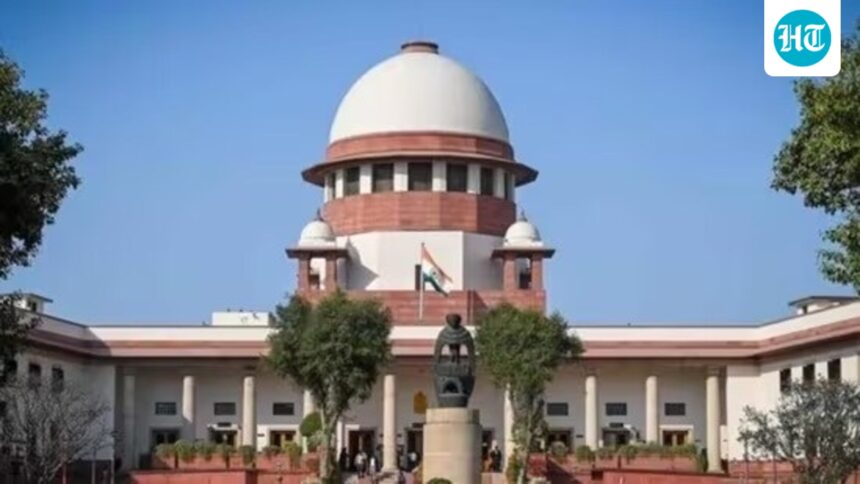
The Supreme Court on Friday responded to whether offensive language amounts to the crime of obscenity under the Criminal Code, saying it is possible, but only under very specific circumstances.
A bench of Justices Sanjay Karol and Vipul M Pancholi held that offensive language and obscene language, however offensive or uncivilized, will only amount to obscenity if they are lewd, attract lustful interests, and tend to corrupt or corrupt those to whom they are exposed.
The court made the observation while partly allowing the appeal of a man convicted of obscenity for using the words “son of a bitch” and other vulgar expletives during an altercation over a land dispute.
“Let us be clear, from a legal standpoint, obscenity is not synonymous with ‘vulgarity’, ‘abuse’ or ‘profanity’. The mere use of obscene words, profanities and vulgar language, no matter how obnoxious or uncivilised, cannot be equated with obscenity… Vulgar or offensive words may evoke a feeling of revulsion, revulsion or shock, but that in itself does not make them ‘obscene in law’, The court noted, the Bar & Bench reported.
However, the court upheld his conviction for causing grievous hurt using a hook after finding that he had broken the complainant’s nasal bone. His sentence was reduced to imprisonment until the court stood up and ordered him to pay a fine $50,000.
About this issue
The case was against the backdrop of a dispute over a piece of agricultural land in Tamil Nadu in August 2017. According to the prosecution, an argument initially broke out between the accused, identified as Mani, and the complainant’s brother-in-law on the floor.
The complainant’s nephew was also allegedly involved.
The prosecution alleged that the accused abused the complainant by using vulgar insults and caste-based insults when he intervened in the dispute. The accused then allegedly brought a hook from his house and attacked him.
The complainant sustained injuries to his forehead, nose and thumb. A CT scan later revealed a fracture in his nasal bone.
The court convicted the accused under Sections 294 (B) (obscenity), 326 (grievous hurt) and 506 (2) (criminal intimidation) of the Indian Penal Code, besides the provisions of the Scheduled Castes and Scheduled Tribes (Prevention of Atrocities) Act.
the Later, the Madras High Court acquitted the accused of the offenses under the SC/ST Act but upheld his conviction under the IPC. Thus the case reached the Supreme Court.
What did the Supreme Court say?
the Regarding the obscenity conviction, the Supreme Court said that the law does not treat every offensive or vulgar expression as obscene.
The bench explained that for words to amount to obscenity under Section 294(b) IPC, they must be lewd, address lustful interests and tend to corrupt and deprave those who are exposed to them. It must also be proven that the speech caused inconvenience to others.
Accordingly, the court found that even if it accepted the prosecution’s allegations in full, the words attributed to Mane were merely obscene or vulgar expressions and did not meet the elements of the crime of obscenity.
“In this case, during the altercation, the appellant allegedly said, ‘You motherfucker! You son of a bitch! Are you coming to support your elder sister’s son? “Fuck you, you damned Kurutha…” Such words, no matter how offensive, unpalatable or uncivilised, do not meet the requirements of Section 294(b) IPC… Moreover, no one has the right to use such words to cause inconvenience to others in a public place, which is a mandatory element of the oath,” the apex court noted, according to the report.
The court also annulled the defendant’s conviction for criminal intimidation under Article 506 (2) of the Islamic Penal Code.
It considered that simply using threatening words during an altercation is not enough to constitute a crime unless the prosecution proves that the accused intended to cause panic or force the victim to do a certain act or refrain from doing it.
However, the court found no reason to interfere with the conviction under Section 326 IPC. It noted that the medical evidence supported the complainant’s testimony that he had been assaulted with a hook and that he had suffered a fracture to his nasal bone, which fell squarely within the definition of grievous harm.
Given that the incident resulted from a land dispute, as well as the appellant’s age, who was approximately 70 years old, and his health condition, the court modified his prison sentence until the court ascended. She also ordered him to pay a fine $50,000 in two months