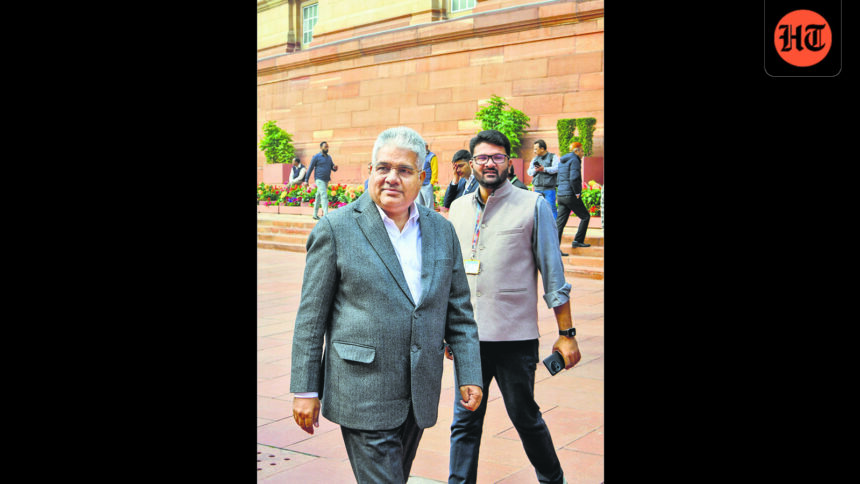
India’s Nationally Determined Contributions (NDCs) are no longer just environmental pledges but shape the country’s economic trajectory, India’s Environment Minister Bhupinder Yadav said in an interview with HT.

He added that the revised NDCs for 2031-2035 were finalized after clearly taking into account geopolitical realities, including their impact on global energy markets and supply chains. Moreover, on whether India’s NDCs could be more ambitious, Yadav said that as energy demand continues to grow rapidly, maintaining and expanding this share to 60% by 2035 requires huge investments in grid and storage infrastructure and system resilience.
Excerpts:
Congratulations on the approval of the Nationally Determined Contributions under the Paris Agreement. How do you think these revised NDCs will shape India’s growth in the next 10 years and beyond?
India’s climate commitments are no longer just environmental pledges. Through these commitments, Prime Minister Narendra Modi has provided a blueprint for economic transformation. India’s NDCs, grounded in our long-term vision of net zero by 2070, signal a decisive shift towards a cleaner, more resilient and globally competitive growth model. The NDCs are aligned with the objectives of Vixit Bharat. These are important starting points, as each gradually raises ambition while balancing development needs. Over the next decade, updated NDCs, including the recently announced targets for 2031-2035, signal a commitment to continuing a growth model under Prime Minister Modi’s visionary leadership that is cleaner, more resilient and more globally competitive.
Over the next decade and beyond, India’s NDCs are likely to shape growth through substantive initiatives including: A decisive push for clean energy. India is accelerating investments in renewable energy, especially solar and wind, while also expanding nuclear power as a stable, low-carbon baseload.
This will not only reduce emissions, but will also enhance energy security and reduce dependence on imports. The emergence of renewable energy, green hydrogen, and carbon capture, utilization and storage (CCUS) is crucial. Along with solar, wind and other forms of renewable energy, hydrogen is expected to become a cornerstone of India’s future energy system, especially for hard-to-mitigate sectors such as steel, refining and heavy transportation. This will open new industrial ecosystems and export opportunities.
As India continues to industrialize, carbon dioxide capture and storage technologies, for which there is a clause $Rs 20,000 crore has been allocated in the budget, and it will also play a crucial role in decarbonising sectors where emissions are difficult to eliminate. This would drive innovation and create new technology markets. We promote an adaptation-focused development model and enhance disaster preparedness. India’s national contributions rightly emphasize adaptation as well as mitigation. Investments in water management, climate resilient agriculture, sustainable coastal management, and early warning systems for all will protect livelihoods and ensure long-term productivity.
Expanding climate-resilient early warning systems and infrastructure will also reduce economic losses and protect vulnerable communities, making growth more stable and predictable. Technology and innovation are key enablers. From energy storage to smart grids and climate-smart agriculture, the transition will spur a wave of innovation. India’s climate strategy is rooted in pragmatism that ensures that the transition does not impact access to affordable energy or food. This remains the cornerstone of all climate action. Ultimately, India’s climate actions will create jobs, build new industries, and enhance India’s global competitiveness, while making the economy more resilient to climate risks.
At their core, India’s NDCs are not simply commitments to the world. These are commitments towards our development path. It charts a path where growth is sustainable, inclusive and secure, ensuring that as India rises, it does so in a responsible and resilient manner.
These NDCs have come at a critical time where there is conflict and fossil fuel supply chains have been severely disrupted. Why did you choose to announce it now?
India’s climate action is rooted in our strong belief in ‘green growth’. Prime Minister Modi’s vision and commitment to the country are very clear and unambiguous. Thus, we have never been in doubt about the trajectory of greener, cleaner and lower-carbon growth models.
India’s updated NDCs are the result of a broad and carefully structured consultation process among ministries, think-tanks, industry and experts. These consultations clearly took into account geopolitical contexts and their impact on global energy markets and supply chains.
Accordingly, the targets reflect India’s national circumstances, taking into account potential supply chain disruptions, the development imperative, and the fact that our energy demand will continue to grow in the coming years.
Therefore, the announcement of our NDC is the product of a clear vision and sustainable action plan and is based on careful planning, realism and a balanced approach to growth, resilience and climate responsibility. Finally, preparations for the National Dialogue Conference have just been completed, and the announcement comes naturally after its completion.
Many experts have pointed out that our NDCs are modest and that we can achieve them well before 2030. For example, we have already achieved 52% of installed capacity from non-fossil sources. What do you think?
It is important to view India’s national contributions not only in terms of what has already been achieved, but in terms of the scale, pace and complexity of the transformation ahead. It is true that India has made significant progress, already exceeding about 50% of installed non-fossil capacity ahead of schedule, and this reflects strong policy direction and ability to implement. But the next stage is much more difficult.
As energy demand continues to grow rapidly, maintaining this share and expanding it to 60% by 2035 will require huge investments in grid and storage infrastructure and system resilience. Issues such as renewable intermittency, land availability, and large-scale integration become much more complex at higher penetration levels. At the same time, decarbonizing sectors such as steel, cement and transport, which are crucial to development, is much more difficult. That’s why India is developing solutions like green hydrogen, nuclear power, and carbon capture and storage, but these technologies are still evolving and require time, financing and global cooperation.
Financing and access to technology also remain major constraints. Achieving these goals will require broad climate finance and affordable capital, as well as access to advanced technologies. We must bear in mind that the obligations of developed countries to provide the means of implementation have not yet begun in a meaningful way.
Therefore, its NDC for 2031-2035 is carefully calibrated and reflects ambition, but also realism. It is consistent with national conditions, implementation capacity, and the need to protect energy and food security.
It ensures continued progress while leaving room to enhance ambition as technology matures, financial flows improve and capabilities are strengthened. In essence, India’s approach is to walk the talk and do so in a sustainable, resilient and development-oriented manner.
Quantitative targets in NDCs focus on clean economic development, climate finance mobilization, etc. How do you think that will take shape?
India’s approach to climate action today is best understood as strategic, integrated, and forward-looking – not a set of isolated announcements, but a coherent policy architecture that links immediate action to a long-term vision out to 2070. The quantitative targets in India’s Nationally Determined Contributions (NDCs) are not just numerical targets, but signals of how the economy itself will evolve in the next decade and beyond.
India is pursuing climate action as a development strategy, grounded in its long-term low-carbon development strategy, strengthened through the first and successive NDCs, and operationalized by recent policy initiatives. The following aspects of the NDC contribution quantitative targets are important. These goals establish a shift towards cleaner economic growth. To achieve the goals of reducing emissions intensity and increasing non-fossil energy capacity that effectively decouples growth from emissions, India will continue to expand its renewable energy base while becoming more energy efficient and less carbon intensive. Over time, the goals will reshape key sectors – energy, industry and transport – towards cleaner production systems.
These goals have the potential to create a strong channel for investment. These goals provide long-term political certainty, which is critical for investors. Sectors such as renewable energy, green hydrogen, nuclear power, energy storage, and carbon utilization and storage (CCUS) are likely to see accelerated capital inflows. At the same time, sectors focused on enhancing our resilience, such as aquaponics and resilient infrastructure, are likely to attract significant public and private investment.
These goals will stimulate climate finance on a large scale. India’s approach is to combine domestic resources with international financing. Mechanisms such as carbon markets, blended finance, partnerships, including bilateral initiatives such as the Joint Accreditation Mechanism, and the recent budget announcement for the Carbon Storage and Utilization Mission, will help mobilize technology and capital, especially for sectors that are difficult to mitigate.
The goals will drive innovation and new industrial ecosystems. With the implementation of the objectives set out in the Indian National Contributions, it will stimulate the research, development, manufacturing and diffusion of clean technologies in India.
Finally, the objectives ensure balance with national priorities. This just transition is designed around India’s development needs – energy security, food security, social security, and rising energy demand. Therefore, this transformation will be calculated, ensuring that growth remains stable, inclusive and environmentally friendly.
In short, quantitative NDC targets will shape an economy that is cleaner, more resilient to climate change, and driven by investment in such a way that climate action becomes an engine of growth, rather than a drag on it.
The Global South seems to be doing more climate work especially when the West is at war. Do you think India’s NDCs carry a message for developing countries?
Yes, the Global South has been doing much more than its fair share despite its minimal contribution to historical emissions. India’s NDCs prove that climate action and development can go hand in hand. India’s approach shows that ambitious climate goals such as expanding the use of non-fossil energy and reducing emissions intensity can be achieved alongside rapid economic growth. This is important for developing countries: climate action should not come at the expense of development. Second, national conditions must remain central. Its NDCs have been carefully calibrated to suit their realities, namely high energy demand, the need for industrialization, and ensuring energy and food security. The message is that climate commitments must be ambitious, but also realistic, climate-friendly and rooted in local priorities. This indicates a trustworthy path: start with what is achievable, build capacity, and then raise ambition over time.
Third, technology and partnerships are essential. Through initiatives such as green hydrogen, carbon capture and storage, production linkage incentives for highly efficient solar PV manufacturing, batteries, and international cooperation, India is highlighting that access to technology and finance is critical. For many developing countries, this reinforces the need for stronger global cooperation policies.
Fourth, adaptation is as important as mitigation. India has a strong focus on water, agriculture and disaster resilience. It highlights a key priority for the Global South, which is protecting lives and livelihoods, not just reducing emissions. Finally, India would like to reaffirm its belief in climate multilateralism and that it is achieving this; The Global South can lead responsibly by taking meaningful climate action while continuing to advocate for equality, climate justice, and adequate financing from developed countries.
At its core, the message is that it is possible to follow a path that puts development first, climate responsible, and future-ready, and that this path can be shaped by the priorities and realities of the Global South itself.
The United States, the largest emitter of all time, has withdrawn from the United Nations Framework Convention on Climate Change. How do you think we can ensure accountability in the delivery of climate finance and technology transfer?
Well, we all have to understand that climate finance and technology transfer are a prerequisite for large-scale climate action in developing countries. Because of this undeniable fact, it has been listed as an obligation of the developed world since the beginning of the United Nations Framework Convention on Climate Change and its Paris Agreement. While the Global South is already doing far more than its fair share, developed countries are also expected, and rightly so, to fulfill their obligations to the letter and spirit of the United Nations Framework Convention on Climate Change and its Paris Agreement.
Even as global conditions evolve, our focus is on strengthening the multilateral climate framework.