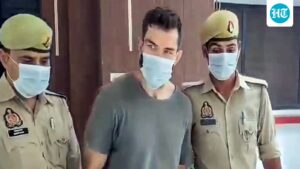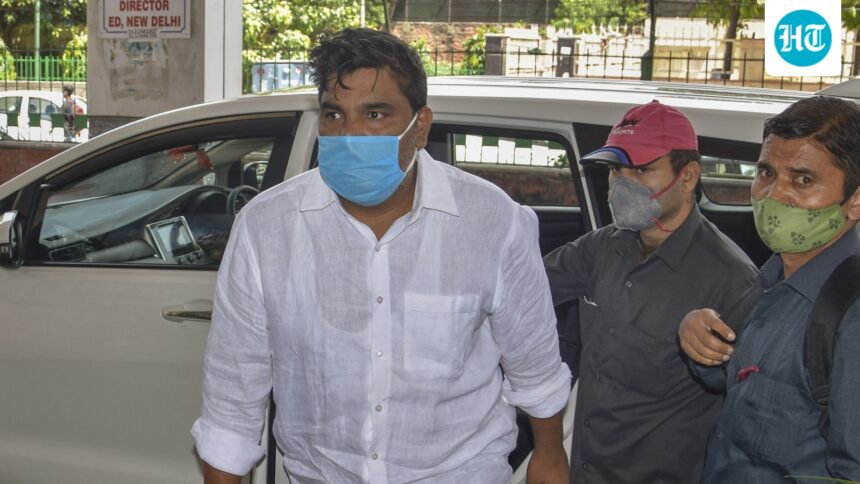
A Delhi Sessions Court on Monday convicted former Aam Aadmi Party councilor Tahir Hussain for the murder of Intelligence Bureau (IB) employee Ankit Sharma during the 2020 northeast Delhi riots, following which Hussain claimed justice was not served.
Hussain, who was present in court, collapsed when the judge issued the order, as HT reported earlier. According to a PTI report, Hussain said as he was being escorted out of the courtroom after his conviction: “Insaaf nahi hua hai (Justice was not served).”
On Monday, Hussain collapsed in court when Additional Sessions Judge Praveen Singh declared him guilty, while his lawyer tried to console him.
Read also | ‘The judge understood the father’s pain’: IB employee Ankit Sharma’s family after Tahir Hussain’s conviction
What are the charges against Hussein?
Additional Sessions Judge Praveen Singh Hussain also found guilty of promoting enmity between different religious groups and rioting, but found no evidence to support the charge of criminal conspiracy.
Four other men arrested in the case were also convicted, but not all of them were charged with murder.
Hussain was a council member of the Aam Aadmi Party at the time of the incident, but was later suspended by the party after his name surfaced in the case.
Along with Hussein, Nazim, Qasim, Javed and Anas were convicted, although not all of them were convicted of murder. The court acquitted six defendants.
Read also | Former AAP leader Tahir Hussain has been convicted in the IB officer Ankit Sharma murder case
It revived painful memories for the Sharma family
The ruling revived painful memories for the Sharma family, who were rebuilding their lives away from Delhi.
“It is very difficult to explain what our family is going through now. There is a sense of relief that the court has convicted some of the accused, but at the same time, all the painful memories have come rushing back,” a member of Sharma’s family said, according to a PTI report.
The victim’s brother said the conviction forced the family to relive the horrific moment when they first heard of Sharma’s death.
“There is sadness, there is anger, and there is a void that can never be filled. We have lost one of the strongest pillars of our family, and no sentence can bring him back,” he said.
The family members said their lives completely changed after the violence, and they decided to leave Delhi within a few months of the incident.
“We moved from Delhi just two or three months after the incident. We never felt safe staying there after what happened. We are now living in a rented accommodation in Uttar Pradesh. Our lives have completely changed. The feeling of fear still accompanies us,” he said.
Recalling the day of the incident, a family member said Sharma only went to assess the situation as part of his duty.
“My brother was on duty when they brutally killed him. He was serving the country. Intelligence Bureau officers generally do not reveal their identity, so he identified himself as a Delhi Police official.
The brother said: “His superiors asked him to go and check the situation. What was his fault? He was simply doing his duty. We believe he was targeted because of his religion, and this pain remains with us every day.”
He said the family was grateful for the conviction, but full justice would be done when all those involved in the killing were held accountable.
“We want the accused to be given the maximum punishment. Today, only a few have been convicted. We want everyone involved in my brother’s killing to face the law… They should be executed,” he said.
Read also | AAP says north-east Delhi riots convict Tahir Hussain has no association with the party since his suspension in 2020
The ruling brought back memories of the last days
A family member said the ruling brought back memories of Sharma’s final days.
“My brother’s birthday was on February 2, and after a few days we lost him. He was young and full of dreams and was thinking of getting married. The future of our entire family changed forever after that day,” he told PTI.
The case relates to an FIR registered at Dayalpur police station on a complaint by Sharma’s father, Ravinder Kumar.
According to the complaint, Sharma, who was working in the Intelligence Bureau, returned home from work on February 25, 2020, before going out again to assess the situation in the area.
When he did not return, his family started searching for him and later learned that he was attacked by a mob and his body was dumped in the Khajuri Khas drain in Chand Bagh Apulia. His body was later recovered from the drain.
Kumar claimed that his son was killed by Hussain and others who gathered in the former advisor’s office.
On March 24, 2023, a Delhi court filed charges against Hussain and 10 others.
According to the chargesheet, Hussain led the mob from his home and from a mosque near Chand Bagh Pulia on February 24 and 25, 2020, and allegedly gave the violence a sectarian color by provoking people against Hindus.
The charge sheet alleged that the mob later arrested Sharma, dragged him to Chand Bagh Pulia, assaulted him with sharp and blunt weapons, killed him and dumped his body in the drain.
The incident occurred as communal violence broke out in northeast Delhi in February 2020 during protests against the Citizenship (Amendment) Act.
The clashes, which were characterized by stone-throwing, burning, and vandalism, led to the death of 53 people and the injury of dozens.
(With inputs from Arnabjeet Sur)