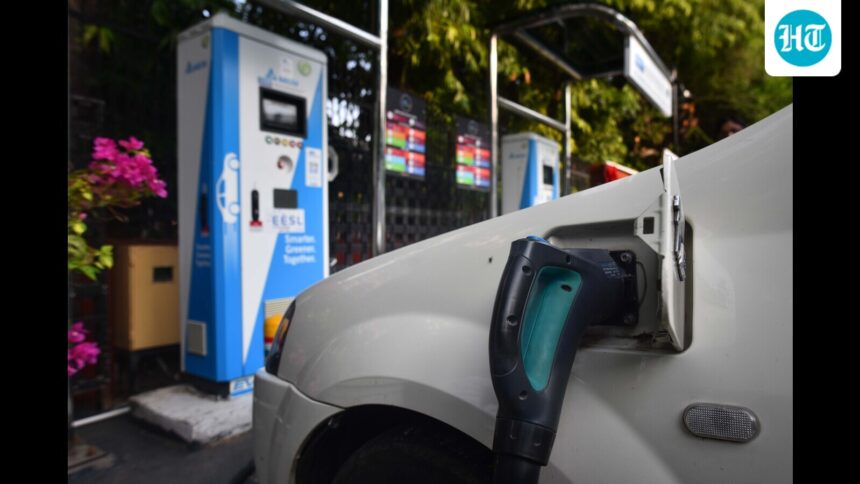
The Lok Sabha Secretariat is allocating electric cars to 40 senior staff. Convergence Energy Services Limited is developing an electric vehicle leasing model for government use, and the Federal Ministry of Finance has encouraged public sector banks and insurance companies to make the shift.

However, these initiatives lack specific goals or fixed timelines. They actually handle no more than 0.25% of all vehicles in India, with government-owned vehicles and government PSUs accounting for about 1 in every 400 vehicles on Indian roads.
This slow adoption of electric vehicles also exposes India to global energy shocks, such as those currently seen in the ongoing West Asian crisis. With India importing 80% of its crude oil needs, experts have called for a broader shift towards electrification, which not only ensures energy security but also brings co-benefits for the environment and the economy.
Even the government’s flagship schemes like FAME (Faster Adoption and Manufacturing of Electric Vehicles in India) 1 and 2, and later the existing PM e-Drive scheme, cater only to a small portion of the total vehicle base and do not match the ambition of 30% EV sales penetration by 2030 set in March 2018. For example, the schemes primarily target buses operated by state transport enterprises (STUs), which constitute only about 2%. Of the total number of buses in India.
In fiscal year 2025-2026, EV penetration was just over 8%. The global average is already 25%. Countries that have left India behind include not only wealthy European countries or China, which is considered a leader, but even Vietnam, Thailand and Indonesia, which are smaller economies, according to the International Energy Agency.
“India progressed to only about 7.6% of sales in 2024 from electric vehicles, which is far behind its target of 30% by 2030. Thus, it took almost 10 years to reach a penetration level of 7.6%, and now needs to increase this share by more than 22% in the next five years alone,” said the Niti Aayog August 2025 report.
For a start, Sherif Qamar, associate director at the Energy and Resources Institute, called for an end goal to electrify every government department, with mandatory reporting on achievement, rather than open guidance. “If such a target is given to all central and state government departments, the signal will be very clear to the private sector as well as citizens.”
He said India Post provides a case study on cost-driven adoption as he led research that provided tangible evidence that India Post’s adoption of electric vehicles results in significant cost and environmental savings.
One pilot showed that operating costs for electric vehicles were three to four times lower than diesel equivalents in terms of total cost of operations, including maintenance and fuel. Therefore, the department is now moving towards electrifying its fleet. Approximately 10% of its owned light commercial vehicles are currently being purchased. He said that the guidelines guiding central ministries to purchase electric vehicles have been in place for years, but they were not taken seriously, resulting in a marginal share of electric vehicles in the government fleet.
But experts like Amit Bhatt, managing director of the International Council on Clean Transportation in India, said the Center needs to look beyond demand-side incentives and support programs and adopt more efficient policy tools. The most obvious among them are zero-emission vehicle (ZEV) mandates that require automakers to sell a minimum number of zero-emission vehicles.
While subsidy schemes such as FAME or PM E-DRIVE rely on government spending, ZEV forces automakers to invest in electric vehicle research and development (R&D) decades earlier than they otherwise could, creating a predictable long-term market signal, said Anumita Roychoudhary, executive director of research and advocacy at the Center for Science and Environment.
Bhatt also said that concerns regarding scarcity of charging infrastructure will also be taken care of indirectly by the manufacturers themselves once there is a mandate to run EVs on roads.
Among ZEVs worldwide, the ZEV program introduced by the California Air Resources Board in 1990 is an exemplary model. Despite the lack of initial targets, the program was reversed in several US states and later guided by broader regulatory approaches based on mandatory EV sales targets rather than subsidies alone.
The other key policy lever missing is a coherent average fuel efficiency (CAFE) standard for businesses, they said. The new CAFE-III standards, which become effective from April 2027, have not yet been notified. Worse still, the draft standards reward hybrids and flex-fuel vehicles with compliance credits, which critics see as a regressive departure from a clear decarbonization path focused on electric vehicles.
In the absence of regulatory mandates like ZEVs or CAFE standards, indirect restrictive regulations like ICE phase-out plans have already shown success, Bhatt said. “We have seen this during the shift to CNG for cars and other 3-W plants in Delhi-NCR and now the same for electricity.” Even commercial buses in inter-state operations in north India have seen e-buses only to bypass state monopolies on multiple routes, he added.
Demand incentives have already stimulated the market, but they cannot do the job of scaling it up, Roychoudhury said. “Crucially, stringent fuel efficiency standards for passenger cars, without allowing super credits or hybrid technologies to ease the burden of compliance, is a necessary next step.” For this to work, she added, a “right to charge” regulation is needed that removes practical and legal friction around access to home and public charging.
Even the Niti Aayog report of August 2025 said that the lag in adoption of electric vehicles is no longer just an energy security or public health concern; It represents a missed opportunity for India to establish itself as a global hub for electric vehicle manufacturing, batteries and clean mobility exports. Even Amitabh Kant, former head of the government think tank and a G20 sherpa, has been outspoken in his Hizb ut-Tahrir columns. Commenting on the CAFE dilemma, he said: “Countries that act now will seize manufacturing, innovation and market leadership.”
A spokesman for the Ministry of Heavy Industries said that the government is not considering obligating manufacturers to sell a minimum percentage of electric cars to manufacturers or any other scheme to encourage the adoption of electric cars due to the West Asian crisis.