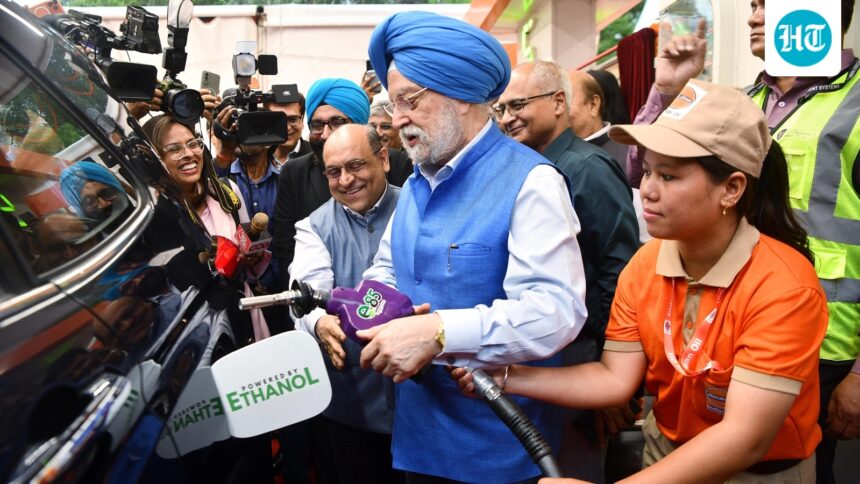
India’s Ministry of Petroleum and Natural Gas (MoPNG) on Sunday rejected reports that Bhutan has refused to import India’s E20 gasoline, asserting that no Indian Oil Marketing Company (OMC) has ever offered to export the fuel to the Himalayan kingdom and that there is “no proposal” for such exports.

“Allegations that Bhutan rejected an offer to import E20 gasoline from India are untrue,” the ministry said in a “fact check” posted on its official social media accounts. “No such offer has been made by Oil Marketing Companies (OMCs), and there is no proposal to export E20 gasoline to Bhutan. Please rely only on official information from MoPNG and OMCs,” she added.
The clarification came after reports from the Botanicals newspaper said that the country’s government has asked Indian public sector fuel suppliers to continue supplying regular gasoline instead of E20 fuel blended with ethanol, due to concerns over storage and fuel processing infrastructure.
The report was later amplified by political leaders and social media users in India, with the Congress citing it while attacking the BJP-led Center over its ethanol blending programme.
The ministry’s statement also came amid a broader public debate about E20 gasoline after complaints from some motorists about mileage and maintenance – claims rejected by the government and the auto industry.
In response to the Ministry’s fact-checking circular Bhutanese Editor Tenzing Lamsang said the newspaper stood by its reporting, saying it was based on written and verbal responses from Bhutanese government officials.
In a post on X, he also noted that the Indian Oil Ministry “has been a great partner of Bhutan which constantly supplies fuel to Bhutan.”
“Regular gasoline order”
To support the newspaper’s report, Lamsang shared what he said was a written response from Bhutan’s Ministry of Commerce.
The document, which was not signed by any named official, states that Bhutan “does not import E-20 gasoline fuel” and details concerns about gasoline blended with ethanol, noting that ethanol is hygroscopic and can absorb water, which could affect fuel quality and vehicle performance in the event of contamination.
She also says the condition of many underground storage tanks maintained by fuel dealers can present challenges for handling ethanol-blended fuel.
The reply also adds: “In view of these concerns, Public Sector Undertakings (PSUs)/OMCs of India have been asked during technical meetings to continue supplying regular MS to Bhutan as long as this fuel remains available in the Indian market.”
He adds that Bhutan has also requested advance notice before India moves to higher blend ethanol or fully ethanol-based gasoline so that fuel traders can upgrade their storage infrastructure and fuel processing systems.
However, the document does not explicitly state that Indian OMCs have made a formal offer to export E20 gasoline to Bhutan.
There was no direct response from the Bhutan government amid the controversy as of the evening of July 5.
Separately, India’s Ministry of Information and Broadcasting also defended the E20 rollout, saying the fuel was only introduced after “extensive laboratory, vehicle and field testing.”
The government has confirmed that ethanol blending follows internationally accepted standards. It does not automatically void vehicle warranties, and has not led to evidence of widespread engine failures attributable to E20.
The exchange comes as the center faces increasing scrutiny over its pioneering ethanol blending program.
At a press conference on Saturday, automakers confirmed that E20-compliant vehicles had undergone extensive testing and rejected claims of widespread fuel-related engine damage.
Oil Minister Hardeep Singh Puri also accused “vested interests” of spreading misinformation, while reiterating that any move to increase ethanol blending to more than 20 per cent would follow stringent testing and stakeholder consultations.
Road Transport Minister Nitin Gadkari, seen as the face of the E20 movement, has repeatedly said that some “lobbyists” are behind the opposition to ethanol, which is made from sugarcane. He said that the E20 initiative benefits farmers and enhances India’s energy security because it imports most of its crude oil needs.
India has achieved its target of blending ethanol into gasoline by 20 percent ahead of schedule in 2025, positioning the program as a key pillar of its strategy to reduce crude oil imports and support farmers by increasing ethanol production.
Protest in Jantar Mantar
Also on Sunday, a group of motorists, consumer activists and civil society members staged a protest at Jantar Mantar in Delhi against the nationwide rollout of E20 petrol.
Protesters demanded an independent technical review of the ethanol blending program and looked for an option for consumers to purchase regular gasoline alongside E20.