India on Monday rejected a Canadian media report linking Indian officials to the killing of Khalistani separatist Hardeep Singh Nigar in 2023, and called for such sensitive matters to be dealt with through “legal processes without public comment.”

The Globe and Mail, citing two anonymous sources, one in national security and the other in law enforcement, reported on Sunday that two officials previously posted to the Indian Consulate General in Vancouver were involved in the June 2023 killing of Najjar.
India “categorically rejects allegations of involvement in cross-border violence or organized crime,” P Kumaran, secretary for the east in the Ministry of External Affairs, said at a press conference.
Such allegations are “baseless, politically motivated and not supported by credible evidence despite repeated requests,” Kumaran said. “India believes that concerns of this kind should be addressed through credible law enforcement and judicial processes, and not through generic or politicized narratives,” he added.
Kumaran said that the criminal investigation into the Al-Najjar case is proceeding in accordance with established legal procedures, and the procedures have entered the pre-trial stage, after which they will move to the trial stage before a full jury.
“Canadians have an established legal procedure and will act in accordance with that procedure. India has consistently maintained its commitment to the judicial process,” he said.
He added: “We believe it is best to allow matters that are sensitive to jurisdictional considerations to proceed through existing legal processes without public comment.”
The Globe and Mail report named former visa officer Kanwaljit Singh, who collected information about Najjar from the diaspora using his role to facilitate the operation. He was monitored by the Canadian Security Intelligence Service (CSIS) as an undercover agent of the Research and Analysis Wing (RAW), the report said.
The other official mentioned in the report is Manish, who was the consul general in Vancouver and is now the envoy to Cyprus.
Singh was among six Indian officials and diplomats expelled by the Canadian government in October 2024 for their alleged involvement in the violence.
The information collected by the two officials was passed on to former RAW agent Vikash Yadav, who passed it on to Lawrence Bishnoi’s gang who allegedly organized the killing, the report said.
Yadav, a former CRPF officer who was seconded to the foreign intelligence agency, was removed from his post after the US Department of Justice appointed him to the case against Indian national Nikhil Gupta, who recently pleaded guilty to charges related to a conspiracy to kill Sikhs for Justice leader Gurpatwant Bhannon in New York.
Both Al-Najjar and Bannon have been designated as terrorists by India. Bannon was the organizer of the so-called Khalistan referendum, and at the time of his death, Najjar was its Canadian coordinator.
India and Canada have an ongoing dialogue on security, law and order, and National Security Advisor Ajit Doval visited Ottawa last month for talks. “We have nothing to worry about in this regard,” Indian High Commissioner Dinesh Patnaik told the Hindustan Times last month. “We want to work with the Canadians to bring the perpetrators to justice.”
Pointing out that the criminal case involving four Indian nationals accused of Nigar’s murder is ongoing and no evidence of an Indian connection has been provided so far, Patnaik said: “If there is any evidence that the Americans want to provide to the Canadians, that’s fine. If the Canadians have evidence, that’s fine. As I’ve always said, if we find that there are elements within the Indian establishment that have done something wrong, we will take action ourselves.”
Relations between India and Canada were strained after former Canadian Prime Minister Justin Trudeau claimed in September 2023 that there were “credible allegations” of a possible link between Indian agents and Najjar’s killing. India rejected these accusations, describing them as “ridiculous” and “motivated.”
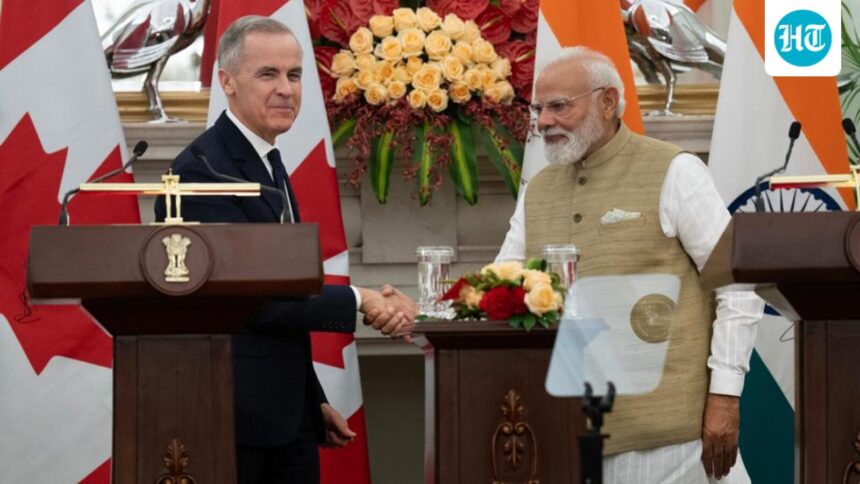
A statement issued by the Canadian Prime Minister’s Office following Prime Minister Mark Carney’s meeting with Prime Minister Narendra Modi said the leaders agreed to “strengthen bilateral cooperation in the field of security and law enforcement,” including issues of mutual interest such as the illegal flow of drugs and transnational organized crime networks.
Carney “also stressed that Canada will continue to take action to combat transnational repression,” the statement said.
Kumaran also said that the two prime ministers reaffirmed their commitment “to rebuild strategic trust, strengthen institutional cooperation and anchor the relationship on mutual respect, sovereignty and democratic values.”
Kumaran said senior officials from India and Canada are discussing cooperation in the field of security and law enforcement, and the meeting held in February led to the formulation of an action plan for cooperation on national security and law enforcement issues.