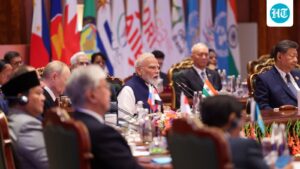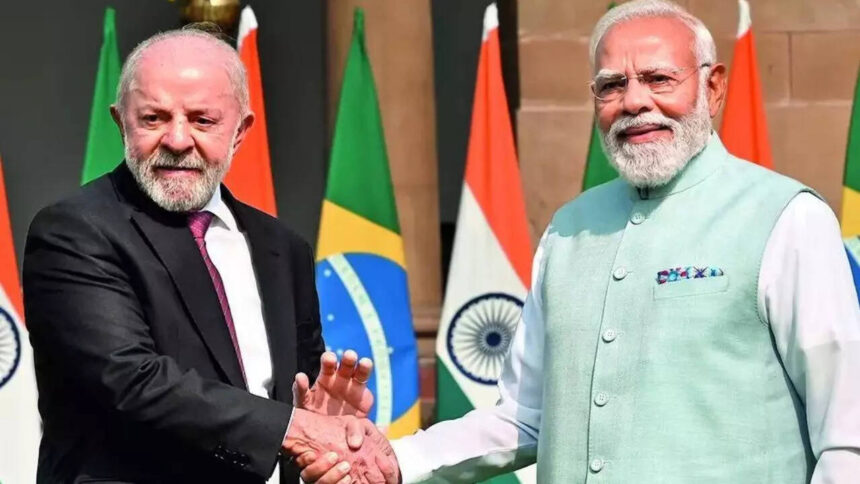
NEW DELHI: An agreement for cooperation in the field of rare earths and critical minerals, a bilateral trade target of $30 billion by 2030, and South-South solidarity in technology, which, according to Prime Minister Narendra Modi, must be comprehensive and serve as a bridge for common progress, were among the highlights of Modi’s bilateral meeting with Brazilian President Luiz Inacio Lula da Silva.Modi said the critical minerals agreement, which is likely to reduce dependence on China, was a big step towards building resilient supply chains. Notably, the leaders discussed the US Supreme Court’s ruling striking down global tariffs imposed by President Donald Trump, and agreed that both sides needed to study its implications.“So, we will be in a wait and watch mode to see how the administration will respond to this ruling, whether any further steps will be taken and consider the ramifications on our trade,” MEA Secretary P Kumaran said at a press conference.Lula referred to trade unilateralism in his remarks, and also said that in a turbulent world, the two sides should strengthen and deepen their strategic dialogue. “India and Brazil are crucial voices in the United Nations, the World Trade Organization and the G20,” the President said, stressing at the same time the importance of BRICS cooperation.Modi and Lula focused on energy transition, defense and security cooperation, which the Prime Minister said was an excellent example of mutual trust and strategic harmony.
“We will continue to strengthen this win-win partnership further,” the Prime Minister said in his media statements. In total, India and Brazil signed 9 agreements, including one in the field of mining for the steel supply chain. They also announced that Brazil will extend work visas for holders of regular Indian passports to 10 years.Modi said that expanding India’s trade agreement with Mercosur (a South American trading bloc) will further strengthen economic cooperation and that bilateral cooperation in the field of technology and innovation is important for both countries as well as the entire Global South.
“We are also prioritizing our cooperation in areas like artificial intelligence, supercomputers, semiconductors and blockchain,” Modi said, adding that energy cooperation too has been a strong pillar of the relationship, and there is now increasing cooperation in renewable energy, ethanol blending and sustainable aviation fuel.“As democracies, we will continue to advance the priorities and aspirations of the Global South.
“When India and Brazil work together, the voice of the Global South becomes stronger and more confident,” the Prime Minister said. In his remarks, Lula said that this was a meeting of a digital superpower with a renewable energy superpower.Brazil joined India in strongly condemning cross-border terrorism, along with the Pahalgam terror attack and the “terrorist incident” at the Red Fort. According to a joint statement, the leaders reiterated defense as a key pillar of the India-Brazil strategic partnership and stressed the possibility of co-design and co-production by linking India’s Atmanirbhar Bharat with the Brazilian defense industrial base.As expected, there was a strong focus on UN reforms, especially the Security Council, including its expansion into permanent and non-permanent membership categories, which the two countries are working towards within the framework of the G4 that also includes Japan and Germany. The joint statement said that the leaders reaffirmed their commitment to mutual support for their countries’ permanent membership in the expanded Security Council, and India welcomed Brazil’s support for India’s candidacy for a non-permanent seat in the Security Council for the period 2028-2029.Kumaran said that regarding vital minerals, Lula gave a detailed presentation on important critical minerals and rare earth reserves in Brazil. “He said that only 30% of its reserves have been explored and there is a lot of scope for prospecting, processing and utilization of the minerals as well. He said that Brazil will appreciate India’s partnership. So, we will go ahead with this,” the official said.