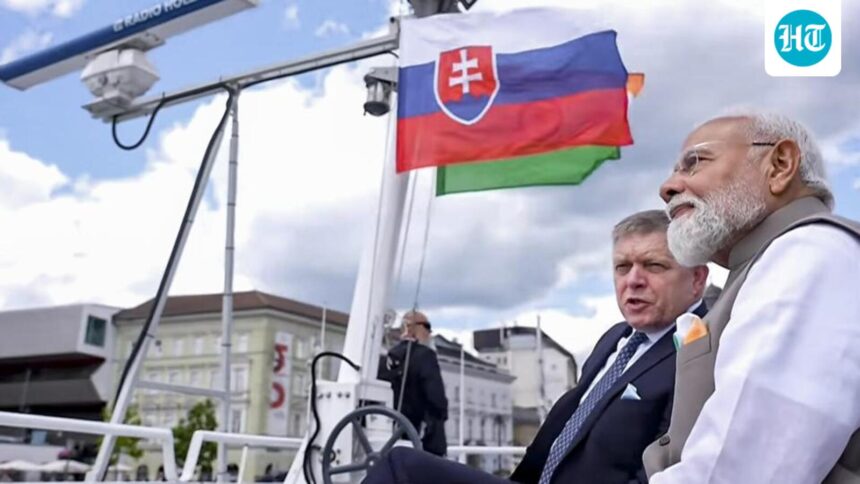
India and Slovakia on Monday raised their ties to a comprehensive partnership and concluded agreements on cooperation in defence, labor mobility, digital technologies and cybersecurity, as Prime Minister Narendra Modi and his Slovak counterpart Robert Fico held talks to strengthen ties.

Modi, the first Indian Prime Minister to travel to Slovakia since the country’s independence in 1993, said the improvement in relations reflects the trust and common priorities between the two countries. He stressed the possibility of cooperation with Slovakia in areas such as automobiles, railways, aerospace, advanced manufacturing and artificial intelligence.
Slovakia is the second stop of Modi’s nearly week-long visit to Europe, and he is scheduled to return to France to attend outreach sessions for the G7 summit in Evian and to hold bilateral meetings with several world leaders, including US President Donald Trump, on June 16-17.
“I express my special gratitude to the Prime Minister for Slovakia’s support in finalizing the India-EU FTA. We will work towards its early implementation so that industries, startups and businesses of both countries can benefit maximum,” Modi said, speaking in Hindi in a joint media interaction with FICO.
Modi also pointed out the possibility of enhancing cooperation between India and Slovakia in the areas of defence, space and civil nuclear energy. He added that the letter of intent on defense cooperation signed by the two sides will give new impetus to joint development, joint production and cooperation between the defense industries of the two sides.
Noting that India launched Slovakia’s first satellite in 2017, Modi said civil nuclear energy is a priority area for both countries. He said: “We stressed the need to strengthen cooperation between industries and experts in both countries in this sector.”
The memorandum of understanding on labor migration concluded by the two countries will promote mobility of professionals and skilled workers, and Modi said that a memorandum of understanding on social security will also be finalized soon.
Fico said the two sides have a common vision on three main issues – sovereign foreign policy, compliance with international law, and the importance of multilateralism. He said that Slovakia supports the reform of the United Nations and supports the inclusion of India in the expanded Security Council as a permanent member.
While welcoming the conclusion of negotiations between India and the European Union on “one of the most ambitious free trade agreements”, Fico said Slovakia’s automotive sector would benefit from the trade deal. He also sought Indian investments, especially for public-private partnership projects.
Other agreements concluded by the two sides include a memorandum of understanding on digital technologies focusing on artificial intelligence and digital public infrastructure, a memorandum of understanding on quantum communications and protection of critical infrastructure focusing on cybersecurity, a memorandum of understanding on cooperation in higher education, and an agreement between the Indian Institute of Technology in Delhi and the Slovak Technical University for cooperation in scholarships and research collaboration.
The two sides also agreed to form a joint working group to combat terrorism and hold a consular dialogue. According to a joint statement, Modi and Fico supported concerted global efforts to combat terrorism in a sustainable manner, and called for strong and decisive action against terrorist entities and their agents, sponsors and supporters. They also stressed the importance of holding perpetrators, organizers and sponsors of terrorist acts accountable.