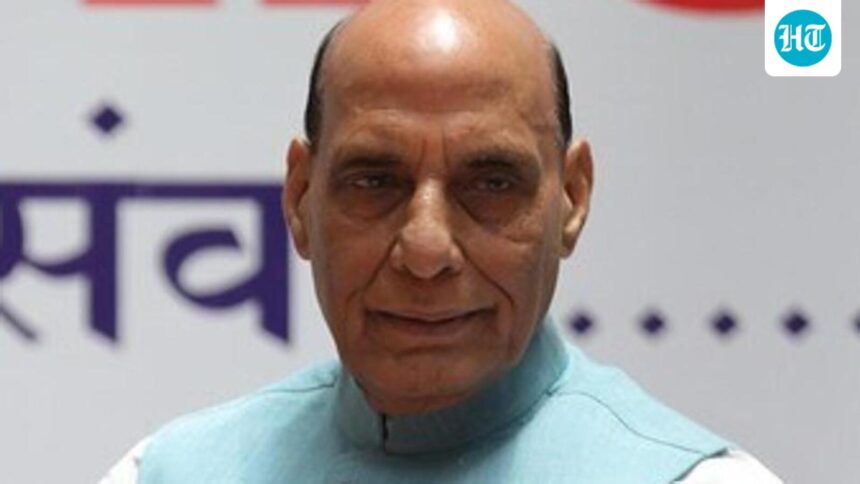
This week, India and Germany are likely to sign a defense industrial cooperation roadmap to strengthen bilateral military ties during Defense Minister Rajnath Singh’s next official visit to India from April 21-23.

“Discussions will focus on enhancing defense industrial cooperation, strengthening military-to-military engagements and exploring opportunities in emerging areas such as cybersecurity, artificial intelligence and drones,” the Defense Ministry said on Sunday.
Indian Defense Minister visits Germany after seven years; Nirmala Sitharaman visited the country in February 2019 when she took charge.
Singh’s visit comes when $The 70,000-crore 75I project to build next-generation conventional submarines in the country is nearing completion.
Mumbai-based Mazagon Dock Shipbuilders Limited (MDL) and Germany’s thyssenkrupp Marine Systems (tkMS) will build six advanced submarines under the P-75I command to enhance the Navy’s underwater capabilities.
Read also: MDL gets submarine contracts beyond its value $1 lakh crore in FY 25-26
The first P-75I submarine will be delivered to the Navy seven years after signing the contract, with the rest to be delivered at a rate of one submarine per year. These advanced submarines, a variant of the HDW Class 214 vessels, will come equipped with air-independent propulsion (AIP) systems.
AIP increases the submarine’s underwater endurance and reduces the risk of detection. As part of the contract, tkMS will transfer the submarine’s design and technology to India, enabling the goal of self-reliance in the defense manufacturing sector to be achieved.
During the three-day visit, Singh will hold bilateral talks with his German counterpart Boris Pistorius and other senior leaders. The Defense Ministry said an “executive arrangement for cooperation in training for UN peacekeeping operations” was also likely to be signed.
She added in a statement that “the visit will provide an opportunity to review ongoing defense cooperation initiatives and identify new ways of cooperation between the defense industries in both countries,” noting that the two countries share a strong and multifaceted strategic partnership, based on democratic values, the rule of law, and a shared commitment to a rules-based international order.
India is also likely to join a global consortium to develop a sixth-generation fighter jet – the world’s most advanced – as the Indian Air Force (IAF) does not want to lag behind in deploying this capability to counter future air threats, as HT had previously reported.
The Indian Air Force, the world’s fourth-largest, has focused on two global consortia – the UK, Italy, Japan/France, Germany and Spain – in the hope of joining forces with one of them to develop sixth-generation fighter jets.
Read also: India and Germany are finalizing 19 agreements including a roadmap for defense industrial cooperation
The UK, Italy and Japan are part of GCAP (Global Air Combat Programme), while France, Germany and Spain have come together under FCAS (Future Combat Air System) to develop a “system of systems” that will operate across five domains – air, land, sea, cyber and space – with the sixth generation fighter as its core platform. The next generation combat air capability will be rolled out gradually and is expected to be deployed by 2040.
The proposed cooperation with Germany in the field of drones and cyber domain comes at a time when India is preparing to initiate far-reaching military reforms to ensure that its armed forces are prepared to meet future battlefield challenges. The creation of a drone force stands out among a host of goals that India seeks to pursue and achieve by 2047 when the country celebrates the centenary of its independence.
The roadmap, Defense Forces Vision 2047, aims to transform the army into a world-class force. It seeks to establish a Cyber Command, Space Command, Cognitive Warfare Task Force and a National Air Defense Shield under the Sudarshan Chakra Mission as the character of warfare is rapidly evolving due to technological advancement.