New Delhi: India on Thursday called for an “early end” to the wars in West Asia and Ukraine amid growing concerns over the expansion of the Iran-US conflict, with Prime Minister Narendra Modi saying New Delhi will support all efforts to restore peace as no issue can be resolved through military hostilities.

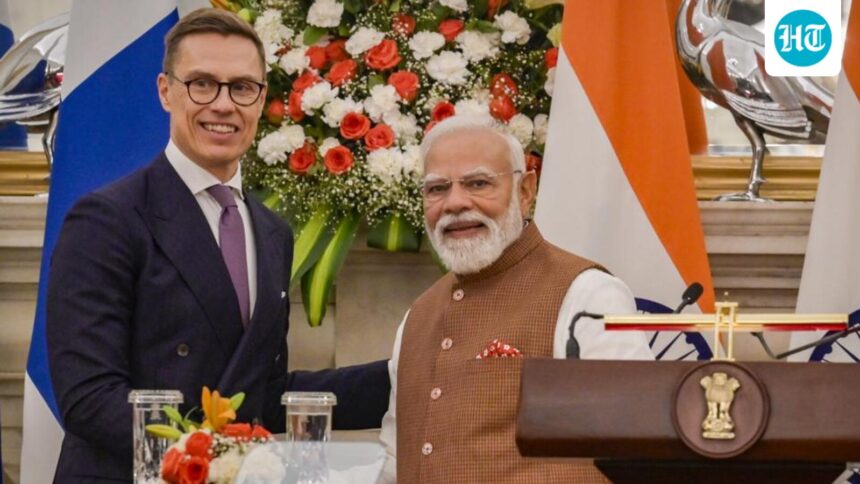
Modi’s statements came after his talks with Finnish President Alexander Stubb, who stressed the need to end the Russian war against Ukraine and ensure peace in line with United Nations principles. The two leaders met in New Delhi as the US-Israel war with Iran entered its sixth day, with both sides carrying out strikes that exacerbated tensions across West Asia.
“We agree that no issue can be resolved through military conflict alone. Whether it is in Ukraine or in West Asia, we will continue to support every effort aimed at ending the conflict early and restoring peace,” Modi said, noting that India and Finland believe in the rule of law, dialogue and diplomacy.
Modi said that the world is going through a period of instability and uncertainty amid conflicts in Ukraine and West Asia, and that growing cooperation between India and Europe “lends new strength” to global stability and development.
Calling for reforms in global governance and supporting India’s bid for a seat on the reformed UN Security Council, Stubb said: “For us, Russia’s war of aggression against Ukraine has continued for a very long time – four years. We have agreed that ending the war is in everyone’s interest, and that lasting peace can only be peace that respects the principles of the United Nations.”
The two sides signed a Memorandum of Understanding on Migration and Mobility Partnership to facilitate the movement of talent, including enhancing access to internships and post-study work opportunities for Indian students, and agreed to double bilateral trade by 2030 by leveraging the India-EU Free Trade Agreement concluded in January. They also decided to begin negotiations on an extradition treaty and a mutual legal assistance treaty.
Finland has emerged as a new destination for Indian professionals, especially in the field of technology and innovation, and the Scandinavian country is home to 33,000 Indians, most of whom work in the IT and technology sectors. However, two-way trade in goods declined from $2.02 billion in 2022-2023 to $1.31 billion in 2024-2025. Major Finnish companies such as Nokia, Kone Elevators, Wartsila and Ahlstrom have manufacturing facilities in India.
Modi said that the India-EU trade agreement will enhance trade, investment and technology cooperation between India and Finland, and elevating bilateral relations to a “strategic partnership in digitalization and sustainability” will enhance cooperation in advanced technology sectors such as artificial intelligence, 6G communications and clean energy.
The two sides also agreed to deepen cooperation in the areas of defence, aerospace, semiconductors and critical minerals, and Modi said the partnership between two democratic and responsible nations will contribute to trustworthy technologies and resilient supply chains. He also highlighted the work done by Finnish companies in India in the past. “Nokia mobile phones and telecom networks have helped connect millions of people across India. Together with Finnish architects, we built the world’s highest railway bridge over the Chenab River. In partnership with Finland, we set up the world’s largest bamboo-to-bio-ethanol refinery in Numaligarh,” he said.
India, as one of the fastest growing economies and with a foreign policy shaped by a “practical and realistic global vision”, demonstrated the importance of “strategic prudence and maintaining autonomy”, Stubb said. In a turbulent world, it is India and its friends in the Global South that will determine the direction in which this goes [evolving world] “The system will work,” he said.
The two sides also renewed a memorandum of understanding covering cooperation in the field of sustainability, including waste-to-energy solutions, green hydrogen, and small hydropower plants, and finalized another memorandum of understanding on cooperation in the field of statistics. They decided to establish a joint task force on digitalization focusing on cooperation in new and emerging technologies such as 6G, quantum communications and quantum computing, establish a joint task force on 6G research, and establish a consular dialogue between the foreign ministries of the two countries.