“When the floods came, no one helped us. It is true that the local party (Trinamool Congress, or TMC) arranged emergency supplies, but those living in other districts got them through corruption, even though we were the worst affected.”

In Rajbanshi village on the banks of the Jaldaka river in Mainaguri district, an elderly woman tells us in detail about the horrific floods that occurred in the last monsoon that led to losses of property and livestock. They live on what historian Debjani Bhattacharya has described as “liquid land” – an area that could be called land and water, but which the government must classify as one or the other. Unfortunately, the Jaldaka River is an active river with banks moving rapidly towards their village, and floods are likely to continue regularly. The woman’s grandson, who returned from Mumbai from his construction job, quickly joined in to cast his vote, saying: “The TMC is corrupt and did nothing for us when the floods hit. We need to vote as Hindus and vote for the BJP.”
The elderly woman had a skeptical look on her face and interrupted her grandson, saying: “Don’t listen to him. No one votes for the BJP here. We have never even seen them before.”
While the TMC leads the local panchayats, both the Member of Legislative Assembly (MLA) and Member of Parliament (MP) belong to the BJP. But upon further investigation, we found that no one – not even the grandson – could name the MLA or MP. The young man from Mumbai once again tried to convince his family that “Muslims in the city are putting a lock on the mandir.” But even this new path doesn’t cut through the ice. They cannot understand this new “Hindu-Islamic” language.
While television studios and social media are full of grand narratives, Hindu-Muslimism, electoral lists, and industrialization, a significant portion of the Bengali rural population still votes on the local political economy. The panchayat is the center of political life and voters evaluate the party’s ability to meet their needs. It is a big challenge for the BJP. Even voters fed up with the junta will never vote for a party they cannot name or see; Parties must meet the basic needs of their voters.
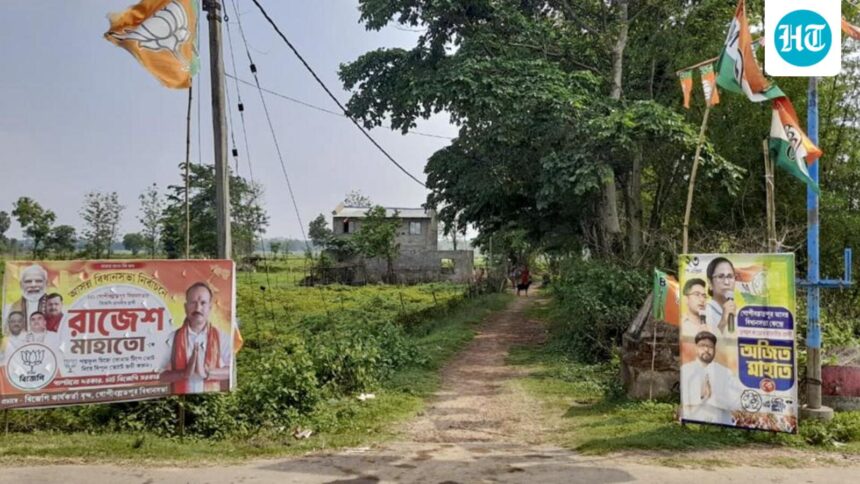
Unlike cities like Siliguri and Jalpaiguri decorated with ‘Jai Shri Ram’ flags, saffron signs are noticeably absent in many rural areas. In our travels, the language of BJP supporters was tinged with Hindu nationalism, but for many rural residents where Hindus and Muslims live peacefully alongside each other, it is meaningless. It is also difficult to convince many social groups such as the Rajbanshis, who define themselves in ethnic terms and share culture and language across religions.
Nearly 500 kilometers away in Kalyani constituency, in villages a few kilometers north of the university city, we face similar river problems. Over the past few decades, the Hooghly River has been moving at a reasonable pace, eating away villages and “resurfacing” lands that were once submerged. In the early 2000s, the previous leftist government allocated land to farmers whose former lands in these areas had been swallowed up by the river. But the party retained control of the land and it could only be sold informally among local villagers. The TMC government has been active in slowing the movement of the river so that some settlement on its banks is possible. Here, access to territory and the ability to cope with an unpredictable environment was provided through sophisticated party networks. The massive presence and familiarity with the TMC party network continues to be a major advantage for the party.
If our visit to Mainaguri gave a picture of abject poverty, the villages in Kalyani look very different. The land here is very fertile, producing at least three crops a year, and people grow tomatoes, parwal (pointed gourd), cauliflower, and a variety of other vegetables. None of the people surveyed reported irregular delivery of cash benefits like Lakshmir Bhandar across party lines. But outside the most vulnerable villages, money ( $1500 per month) doesn’t seem to make much difference.
Five years ago, when we traveled to these areas, Chief Minister Mamata Banerjee and her plans were on the tips of everyone’s tongues. Whether people support the TMC or not, cash schemes are rarely the first thing voters mention today. Prime Minister Narendra Modi won a landslide in 2019 around Laparthian voters, but he has not received as much electoral benefit in 2024, and Banerjee’s monetary schemes appear unlikely to have the electoral impact they had five years ago. As one participant in Kalyani told us, “All parties now promise benefits, and voters, regardless of which party they support, get the benefits. But this focus on benefits prevents parties from addressing the real issues facing farmers.”
It is clear that the TMC is facing opposition to positions in many pockets and has already dropped a number of well-known faces from its list of candidates to address the issue. Instead of Banerjee’s image, the TMC’s presence in the daily lives of citizens and its problem-solving networks are its strongest selling point. Almost all participants visited the Dwar Sarkar (government at doorstep) camp set up by the TMC – allowing the party to reach out to citizens even when the state cannot do so.
The BJP seems to have realized that his absence on the ground is a problem. Perhaps the intensified Special Review (SIR) exercise and large-scale paramilitary deployment in West Bengal in preparation for the elections may make a difference and help the party.
It remains to be seen whether this is enough to defeat the TMC.
Bhanu Joshi is a visiting assistant professor at Ashoka University. Nilanjan Sircar is an Associate Professor at Ahmedabad University. The opinions expressed are personal.