The India Meteorological Department (IMD) said on Friday that monsoon rainfall over the country is likely to be below normal at 90% of the long period average (LPA), with a model error of ±4%, downgrading its earlier forecast of 92% of the long period average issued in April.

The country’s average monsoon rainfall from June to September, based on data from 1971 to 2020, is 87 cm.
However, according to the forecast probabilities released by the IMD, there is a 60% probability of a “deficient” monsoon (below 90% of the LPA), a 24% probability of a “below normal” monsoon (90-95% of the LPA), a 14% probability of a “normal” monsoon (96-104% of the LPA), and a 2% probability of an “above normal” monsoon (105-110% of LPA), and zero probability of an “excess” monsoon (above 110% of LPA).
“Forecast probability is not the only factor. We have issued 90% LPA forecasts based on the total amount of rainfall we are likely to receive during the season. So we are looking at dynamic factors as well,” said M Ravichandran, Secretary, Ministry of Earth Sciences.
Also Read: Concerns over monsoon deepen as rainfall forecast drops to 90% of normal
It is of greater concern for the agriculture sector as monsoon rainfall in the southwest of the country over the core monsoon zone (MCZ), which includes most of the country’s rain-fed farmland, is also likely to be below normal at less than 94% of LPA.
Less than normal rainfall in central and southern India
The IMD said rainfall is likely to be normal in northeastern India (94-106% of LPA) and below normal in central and southern peninsular India (below 94% of LPA) and northwest India (below 92% of LPA).
During June-September 2026, below-normal monsoon rainfall is likely over most parts of the country, except for some areas in northwest and northeastern India, eastern parts of the southern peninsula and adjoining east-central India, and isolated pockets in eastern India, where normal to above-normal rainfall is likely.
“Below normal rainfall may lead to challenges for agriculture, water availability, hydropower generation, and ecosystem sustainability, as well as increased risks of drought, heat stress, and pressure on drinking water resources. To reduce these impacts, strategies could include effective water resource management, strengthening water conservation practices, agricultural contingency planning, enhancing drought monitoring and use of IMD early warning services, and strengthening preparedness measures in sectors particularly vulnerable to shortfalls,” IMD warned.
Also read: Severe June, above-normal heatwave days, rainfall forecast drops further: IMD key forecast
Although it was earlier expected that June rainfall would not be affected by approaching El Niño conditions, the IMD in its updated forecast said the average rainfall in the country during June 2026 is likely to be below normal at below 92% of LPA.
During June, below-normal monthly rainfall is very likely over most parts of the country, except for some parts of northwestern India, northeastern India and the southern peninsula, along with isolated pockets of central India, where normal to above-normal rainfall is likely.
“We can expect weak El Niño conditions to emerge as early as June,” Ravichandran said.
Neutral El Niño-Southern Oscillation (ENSO) conditions are currently shifting towards El Niño conditions over the tropical Pacific, the IMD said.
The latest climate model predictions indicate that El Niño conditions are likely to develop during the southwest monsoon season. Neutral Indian Ocean Dipole (IOD) conditions currently prevail over the Indian Ocean and are likely to persist through the monsoon season. In India, El Nino is associated with harsher summers and weaker monsoons.
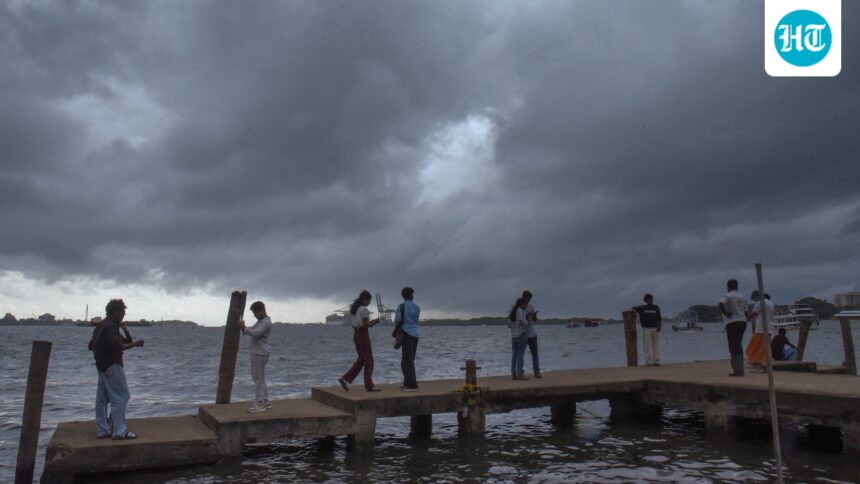
The IMD’s extended range forecast now shows largely dry conditions over Kerala between May 28 and June 4, with only marginal improvement expected between June 4 and 11.
Rainfall is expected to increase after June 11, according to the latest forecasts. Two factors are likely to delay or weaken the onset of monsoon over Kerala – a cyclone developing over the western Pacific Ocean, which pulls significant moisture away from the Arabian Sea and Bay of Bengal, and cyclonic circulation over the Lakshadweep region limiting rainfall over Kerala.
The monsoon usually arrives in Kerala around June 1. On May 15, the IMD forecast that the southwest monsoon would dominate Kerala on May 26, with a model error of ±4 days.
Read also: Satellite images show a huge cloud belt over northern and central India; Delhi is bracing for more rain
“We expect the monsoon to gradually advance to more parts of the Arabian Sea and the tip of peninsular India over the next week. Most of the rain is now falling over the ocean and not on the mainland. So we have not announced the start of the monsoon over Kerala yet,” Ravichandran said.
The monsoon remains crucial to India’s economy, as nearly half of the country’s cultivated area lacks irrigation facilities. The rainy season also replenishes reservoirs that support power generation, industries and drinking water supplies.
This year’s monsoon will be particularly important as farmers also face concerns about possible disruption to fertilizer supplies due to conflict in West Asia.
June is hotter
The IMD also warned of a particularly hot June. Many parts of Uttar Pradesh, Haryana, Punjab, Bihar, Odisha, Chhattisgarh, Gujarat and Andhra Pradesh are expected to witness higher than normal heatwave days, along with isolated areas in Maharashtra, Telangana, Himachal Pradesh and Tamil Nadu. However, heatwave days are likely to be below normal in Rajasthan and Jharkhand.
Some of these areas are expected to witness between five and six days of heat waves during the month of June.
“These areas are normally expected to witness three days of heatwaves. But we expect two or three additional days of heatwaves in June,” said M Mohapatra, Director-General of the International Institute for Management Development.
The IMD warned that the increased probability of heatwaves during June 2026 could significantly impact public health, water availability, energy consumption and basic services.
Vulnerable groups, including older adults, children, outdoor workers and people with pre-existing health conditions, remain particularly vulnerable to prolonged exposure to extreme heat.
Sustained high temperatures may also place additional stress on infrastructure and resource management systems.
In view of the expected conditions, state governments and district administrations have been advised to take preparedness measures, including ensuring operational readiness of cooling shelters, availability of safe drinking water, and strengthening health surveillance and emergency response systems.
The IMD said it will continue to issue weekly and long-range forecasts, along with early warnings and impact-based forecasts, to help authorities prepare for heatwave conditions. The public has also been advised to stay informed of official forecasts and take necessary precautions such as staying hydrated and avoiding exposure during the afternoon peak hours.