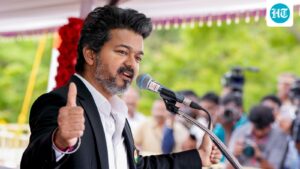
When C Joseph Vijay addressed his party’s second state conference in Madurai last August, he made clear his disdain for alliances, at least in their current form at the time. “You don’t need to join any slave alliance.” He announced to a large crowd. He said that if his TVK party allys with anyone at all, “it will not be a selfish alliance, it will be an alliance based on self-respect.”

He chose to run alone in the April 2026 assembly elections, and on 10 May became Prime Minister, making some interesting history – his government is the state’s first post-election coalition government, cobbled together after a tense week of negotiations with parties he did not campaign with, some of whom actively campaigned against him.
It seems like a paradox, but the math means it has to happen.
TVK – founded by a star actor who had a clear idea in his film about becoming prime minister in 2026 – won 108 seats, becoming the largest single party in the 234-member assembly.
Ten seats shy of a majority, Vijay had to do what no winning party leader in Tamil Nadu had to do since the Dravidian era began in 1967; He had to go look for support after the votes were counted.
Fear of President’s rule, ‘BJP through the back door’: How ‘Thalapathy’ Vijay got the support he needed to become Tamil Nadu Chief Minister
For the first time in seven decades
The 2026 elections resulted in a hung assembly for the first time in the state’s history, with no party or pre-election coalition obtaining a majority.
And every government formed in Tamil Nadu since 1967 — whether by the DMK or the AIADMK, either alone or with coalition partners — has been supported by a pre-election coalition that collectively crossed the majority mark before a single vote was counted.
This is no longer the case. In the many decades that Dravidian parties have been in power, even when the senior member, DMK or AIADMK respectively, gets a majority on its own, it would give space in the government to other partners before the elections.
The period between the linguistic reorganization of Madras State in 1956, when Tamil Nadu was thus formed, and the beginning of Dravidian politics in 1967 did not provide any coalition precedent either. The 1957 elections – the first after reorganization – saw a comfortable victory for the Congress led by K Kamaraj. In 1962, Kamaraj, whom Vijay cited among his idols, won again.
This election remains the latest in which Congress has formed a majority government in the state. Both of them constituted a single-party majority. No post-election negotiations and no coalition.
Hence, what makes 2026 so different is not just the numbers, but how Vijay got there.
What vijay said before the elections
The TVK entered the elections completely alone and as recently as March 18, Vijay dismissed all speculations about the entry of any of the two major alliances, the ruling DMK-Congress led alliance, and the main NDA rival to the AIADMK and BJP as well as others.
“A lot of people are spreading rumors that we are part of one team or the other,” Vijay said in March. “But now they have realized that we belong only to the people.”
After the result, when it was forced to seek support which it said it would not need, the Congress, part of the rival DMK-led Secular Progressive Alliance during the elections, moved first with five MLAs. This was followed by the Consumer Price Index (CPI) and the Consumer Price Index (M). The VCK and IUML, both still officially part of the DMK-led alliance, held out until May 9 before offering support. Most of them said they wanted to keep the BJP and its allies out of the country, and did not want President’s rule either. This means that TVK plus five parties as a ruling coalition.
“Our relations with the DMK will not be affected due to our stand, but it will help Vijay form the government and also prevent President’s rule in the state,” VCK president Thul Thirumavalavan said.
What got vijay’s numbers
This last concern was real. The outgoing council’s term officially ended on May 10, the same day they were eventually sworn in. No government by then would have intended president’s rule, not as a political threat but as an automatic constitutional consequence. It also allegedly means “BJP ruling from the back door” as it is the ruling party at the Centre.
So the coalition that gathered around Vijay was driven as much by this common concern as by any common conviction.
Final tally: TVK’s actual 107 seats – Vijay won two constituencies and one must be vacated – plus Congress (5), CPI (2), CPI(M) (2), VCK (2) and IUML (2), totaling 120. Previous majority.
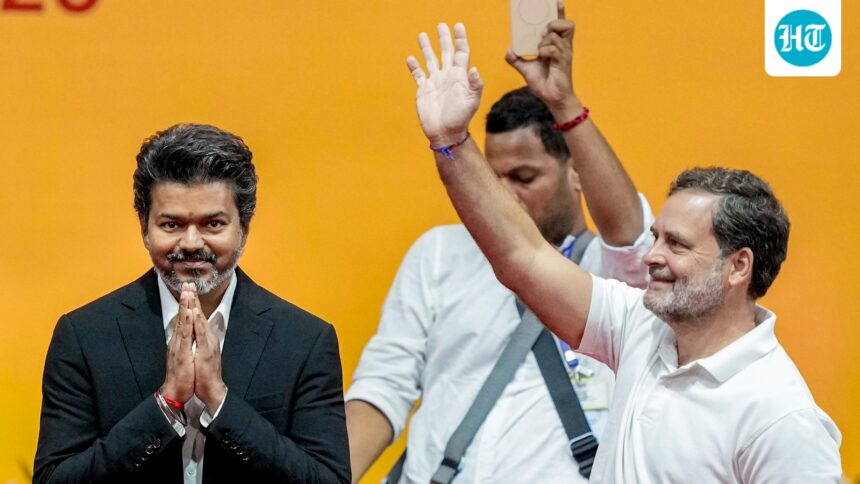
Rahul Gandhi, the Leader of the Opposition in the Lok Sabha, whose Congress was the first to move, attended the swearing-in at the Jawaharlal Nehru Indoor Stadium in Chennai. On X, he posted pictures with Vijay and wrote: “Tamil Nadu has chosen. A new generation. A new voice. A new imagination. My best wishes to Tiru Vijay – may he fulfill the hopes of the people of Tamil Nadu.”
Speaking after taking the oath of office, Vijay thanked his allies before directly addressing the people.
“I will not deceive people with false promises. I will only do what is possible,” he said.
After four rounds of meetings with Governor R V Arlikar, Vijay took oath and now has to prove his majority in the House by May 13.