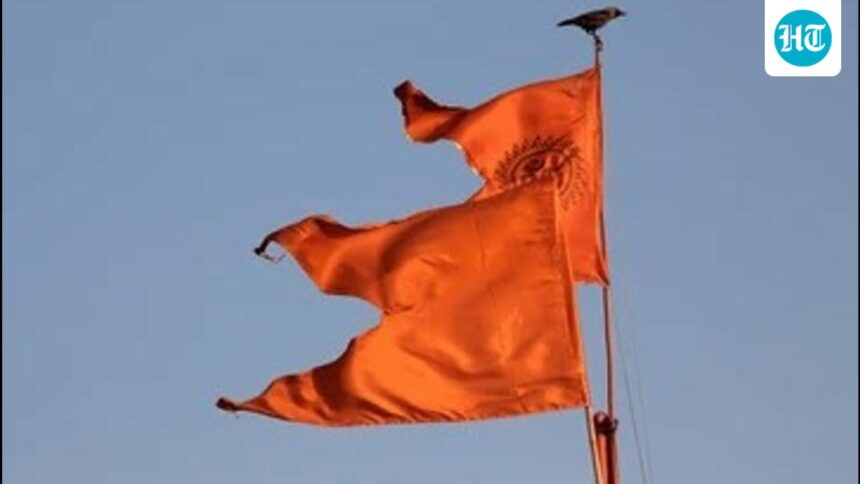
There is a debate these days about the word “Hindu”. Alternatively, some people prefer Sanatan Dharma – eternal faith. Both are true, but I want, in particular, to respond to those who say that there is no such word as “Hinduism,” and that therefore Hinduism itself, and the civilization that was its result, is not an ancient idea but a relatively recent one.

In my opinion, such a claim seems obvious at first glance. If a people with verifiable philosophical vision, religious practice, social norms, kinship rules, creative expression, political thought, ethnic overlap and geographical location, has been aware from time immemorial of its unified identity and can distinguish itself from others on this basis, does the name tag change the reality of its existence? Most of the world’s ancient religions, which are identified as such today and given labels to describe them, were not, at the time of their origin, self-conscious of – or concerned with – the name by which future generations would know them.
Historical evidence clearly shows the recognition of a people called “Hindus” by outsiders. Upinder Singh bears witness to this in his great book “The History of Ancient and Early Medieval India.” It is important to remember that Dr. Singh is not a far-right demagogue. She is a professional with impeccable credentials and is the daughter of Manmohan Singh, the former Prime Minister of India.
Dr. Singh writes that the words “India,” “Hinduism,” and “Hindustan” come from the Indus or Indus River. Ancient Chinese sources refer to the land of Shinto, Greek texts mention India, and Persian manuscripts describe the Hedo as one of the countries subject to the Achaemenid king Darius I. These terms initially referred only to the lower Indus Valley, but their connotations expanded rapidly. For Megasthenes, who visited the court of Chandragupta Maurya in the 4th century BC, “Hinduism” meant the entire Indian subcontinent. She argues that when exploring the ancient history of South Asia, it is necessary to ignore modern political borders and treat the Indian subcontinent and its many regions and sub-regions as a single canvas.
Nevertheless, American Indologist Wendy Doniger condescendingly asks: “If we agree that there is something worth naming, what will we call it?” The main objections to calling it Hinduism or to calling the people concerned Hindus are that these were not always the names Hindus used for themselves or their religion and that they were geographical names. But even she cannot ignore the historical evidence. Even if Hindu is not a “local word” – as she describes it – she admits that it comes “from a word meaning ‘river’ (sindu) which was used by Herodotus (in the fifth century BCE), the Persians (in the fourth century BCE), and the Arabs (after the eighth century) to refer to all who lived beyond the great river in the northwest of the Indian subcontinent.” Her conclusion is that “it is not uncommon for one culture to take a word from another culture to designate a concept for which the original culture had a concept but not a word.” Hindus have defined themselves as such, regardless of where the word appears.
But still other scholars claim that even if the word “Hindu” existed, and the civilization were verifiably associated with it, why should it be called Hindu, and not Buddhist, or Jain, or any other name, since it is not called “Hindu”? This is the argument of those who believe that accepting the fact of the existence of a dominant Hindu civilization would encourage a Hindu renaissance and thus be inimical to “secularism.” In my view, this is a somewhat immature argument based on factual and historical validity.
Amartya Sen, for example, takes this fear to unsustainable levels. According to him, the dominant religion in India has been Buddhism for nearly a thousand years. The fact that Buddhism, and indeed Jainism, were remarkably enlightened branches of Hinduism, is one of the many examples of great heresy that Hinduism itself allows. Philosophically, Hinduism and Buddhism had so much in common that Adi Shankaracharya, who is rightly credited with reviving Hinduism in the 8th century AD, was described by his Hindu critics as a “thief” Buddhist. Sen argues that Nalanda University was a Buddhist university, but Xuanzang, a Chinese traveler who studied at Nalanda, says that the Vedas and Hindu philosophy were studied and taught there, and that several Hindu kings were among its patrons.
But it is unfortunate that Sen’s strenuous attempts to refute the claims of Hindu civilization, despite being a Sanskrit scholar, sometimes take on laughable proportions. Panini, the great grammarian who lived in the fourth century BC, was, as he says, an Afghan because his village was on the banks of the Kabul River! Doesn’t Sen know that large parts of modern Afghanistan were at that time part of the Indian Empire and closely integrated with Hindu civilization?
It is true that signs of Hindu superiority in modern times are wrong; But the way to confront it is not to deny the name Hinduism, Hinduism, or Hindu civilization.
(Pavan K Varma is an author, diplomat and former Member of Parliament (Rajya Sabha). Views expressed are personal)