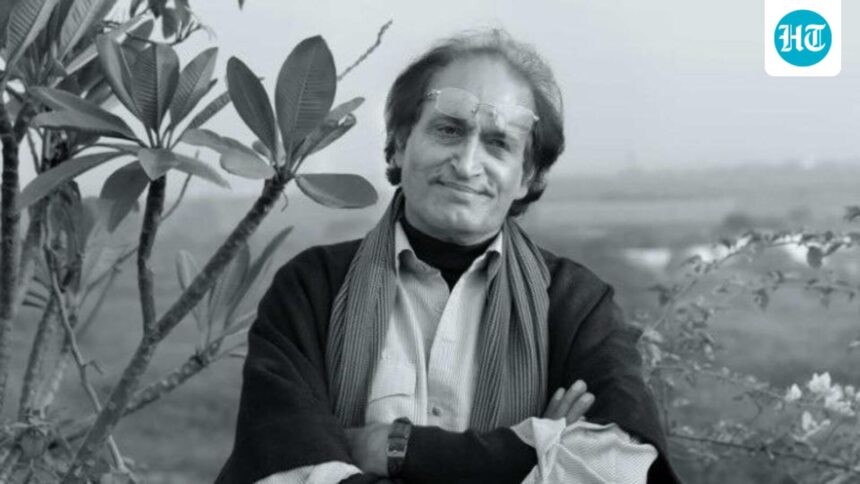
Photographs only show a version of the truth and objectivity, and what appears in the frame is often just as important as what does not. With the death of Raghu Rai, India has not only lost a photographer but also a way to remember itself. More than just documentation; His photographs serve as an evolving archive of the republic; Its power and splendor, the ruptures and the silence. An ordinary, unrecorded life. The idea of photography as a long, accumulated record – almost a parallel history – is at the heart of how this medium has developed around the world, as well as in India.

Photography is an instrument of power
As Europe entered the era of industrialization, it was accompanied by an increasing drive to monitor, classify, and impose order on the world. This was, as Nathaniel Gaskell and Deva Gujral point out in their book Photography in India: A Visual History from the 1850s to the Present, an “impetus” often framed, condescendingly, as an effort to “bring light” to unfamiliar places. This mindset extended to the cataloging of the peoples, cultures, and natural environments encountered through colonial expansion. The camera proved to be an ideal tool for this project. Racism not only flowed into the eyes of the colonizer, but imprinted itself indelibly on the annals of the colonial project as well as on the minds of Indians who began to crystallize their societies intellectually in unprecedented ways.
Sudhir Mahadevan explains this further in Archives and Origins: Material Cultures and Vernaculars of Photography in India. By the 1990s, he writes, “scholars had turned their attention to the discursive norms that, under British rule, regulated photography as a source of knowledge and an instrument of governance.” Scholars have begun to examine how photography was institutionalized as a means of knowledge production and an instrument of governance within the British Empire.
Some colonial-era images, such as those associated with figures such as Maurice Vidal Portman Humphrey, did little, for example, to conceal the patriarchal attitudes underpinning their production. These images often displayed or framed their subjects in ways that reinforced narratives of European authority and benevolence, as Gaskell and Gujral note, portraying the colonial figure as a civilizing presence among supposedly “primitive” societies. Even when this intention was not explicitly stated, the visual language and accompanying captions frequently reproduced a savior mentality, positioning the photographer or colonial agent as an enlightened intermediary rather than an entrenched participant in a highly unequal system. Some images such as those of the Madras Famine of the 1870s are labeled “dehumanization” today, and Willoughby Wallace Hopper was present in Myanmar, Madras and elsewhere arranging dead and dying children, women and men against imperial symbols whether buildings or execution trenches. His works were sold and collected when the emaciated and famine-stricken Indians became “objects” in the empire’s possession.
Read also: History City | Tamil Nadu: A Brief History from Presidency to Tamilkam
However, to look at them all uniformly would be reductive; James Waterhouse developed cartography and astrophotography, while John Marshall helped shape archaeological photography globally. Marshall’s work, in particular, reflects a depth of engagement that at times transcended the boundaries of the colonial framework in which he worked.
Photography arrives in India
Photography reached India as soon as the invention was announced in Europe. By 1839, this idea had already been discussed at the Asiatic Society in Calcutta, and the Bombay Times published a detailed description of the process developed by the French artist and photographer Louis Jacques Mandé Daguerre. The British quickly adopted it to document and classify the societies they ruled; First under the East India Company and then under the Crown in the period following the Mutiny of 1857. Even when not overtly intended as imperial propaganda, photography became deeply rooted in, and instrumental to, the colonial project.
The first decades of the camera in India, as Gayatri Sinha points out in her edited book Perspectives: Defining Photographic Moments in India, saw the emergence of the photo studio. This period also saw the arrival of itinerant photographers from abroad, along with efforts to visually commemorate the events of 1857. Among the most striking figures was Felice Beato, often considered one of the first war photographers. Beato approached the medium with a sense of theatricality, at times staging or reconstructing scenes of violence, using human remains as stark and unsettling props, to produce images that blur the line between documentation and dramatic re-enactment.
Early scholarship by J. Thomas, Ray Desmond, and others focused on identifying timelines, key dates, and overall shifts in the development of the medium. These works were largely descriptive, and focused on documenting, cataloging and recording the early trajectory of photography.
Points out another rich source of information, Mahadevan notes, “Newspaper advertisements from publications such as Bengal Hurkaru and Friend of India provide a revealing glimpse into how photography entered daily life in colonial India. Importing companies such as Thacker, Spink and Company marketed photographic equipment alongside an eclectic mix of European goods – cheese, cutlery, clothing, wine, books and novelties – within a growing consumer market catering to the needs of colonial populations. In this context, photography initially emerged not so much as a serious medium as an As a curiosity: a scientific novelty or even a toy. The availability of cameras with everyday goods, albeit still expensive, underscores how smoothly photography was positioned in its early years not yet as an art or a discipline, but as part of a broader culture of imported curiosities.
New trends emerge
By the late nineteenth century, the dominance of photography had given way to pictorialism, a style that emphasized the manufactured image over mere mechanical capture, and encouraged photographers to see themselves as artists. In India, one of its principal practitioners was Shapur Bahidwar, a Bombay-based photographer, whose carefully staged and focused studio photographs reflected the theatrical sensibilities of the British pioneer Henry Beech Robinson. Bhedwar’s membership in Linked Ring also reflects his involvement in international photographic discussions of art and science. By the mid-twentieth century, photography had spread beyond elite practitioners to include amateur photographers throughout India.
At the same time, portrait photography was expanding rapidly. While studios had been located in coastal cities such as Bombay, Madras and Calcutta since the 1840s, the turn of the century saw increasing demand from Indian clients eager to assert status through photographic likeness. Previous images largely served colonial officials, merchant elites, and royalty: groups who could use dress, posture, and location to project authority, even within the constraints of colonial rule. Over time, as cameras became more accessible, the practice spread to the urban middle classes and eventually to small towns.
While studio photography is often artifice-based, the Scenes from India genre has positioned itself as a more accurate visual record of the Indian subcontinent’s landscape and built environment. Meticulously composed but framed as objective, these images were widely circulated, shaping how India was seen within its borders. And outside. The field attracted a diverse range of practitioners: figures such as John Murray, Abbas Ali (famous for his work in Lucknow), John Edward Sachy, William Baker and John Burke were active in northern India. In Bengal, Sukumar Ray, father of Satyajit Ray, became a pioneer in photography after returning from England where he trained in photography and lithography. In the south, Linnaeus Tripp documented the Madras Presidency, and Raja Din Dayal emerged as one of the most accomplished Indian photographers of the period, producing a wide range of works from Secunderabad and Bombay.
Read also: History City | Pre-colonial roots of Christianity in India
Gayatri Sinha identifies the early twentieth century as a formative moment in the emergence of photojournalism in India. She argues that the increasing presence of crowd images in newspapers disrupted previous colonial visual regimes that depicted Indians as static and classified subjects. In turn, these new photographic representations captured movement, assembly, and collective presence, providing a more dynamic and politically charged visual language.
The eventual arrival of the Kodak Brownie, introduced by Eastman Kodak, marked a crucial shift in making photography accessible to a much wider audience. As the company sought to attract new users, women emerged as a key target audience, to whom the camera was aggressively marketed as both a practical tool and a tool for entertainment, helping to expand participation in photography beyond its previously more exclusive circles.
HistoriCity by Valay Singh is a column about a city in the news based on its documented history, legends, and archaeological excavations. The opinions expressed are personal.
HistoriCity by Valay Singh is a column about a city in the news based on its documented history, legends, and archaeological excavations. The opinions expressed are personal.