All the five constituencies with the highest percentage of deletions from pre-separation to post-separation in West Bengal were in the Muslim-majority districts of Murshidabad and Malda, an analysis of deletions in the state’s controversial ‘logical inconsistency’ category linked to the poll on Thursday showed.

The Election Commission of India (ECI) announced earlier this week that nearly 2.71 million of the six million people classified under the “logical inconsistency” category have been removed from the rolls. These people can appeal their exclusion in the courts, but most of these 19 forums were not fully operational by the time the lists were frozen for the second phase of the elections on Thursday. Phase one listings were already frozen earlier this week.
Bengal goes to the polls in two phases on April 23 and 29. The Trinamool Congress is hoping to secure a fourth consecutive term by defeating the BJP, Congress and the Left.
What are the five seats with the highest percentage of deletion?
The seats that witnessed the highest deletions of voters from the pre-separation list to the post-separation list are Samserganj (31.7%), Lagola (23.2%), Raghunathpur (18.4%), Mothabari (18.3%), and Bhagabangola (17.4%). Except Muthabari in Malda, all other seats are in Murshidabad district. The TMC is ahead in two of these seats and the Congress in three in the 2024 Lok Sabha elections, the elections closest to the Special Intensive Review (SIR). The TMC led in 190 of the state’s 294 seats in the 2024 Lok Sabha elections, not a very different result from the 2021 Assembly elections, when it won 213 seats.
The seats with the least number of deletions from pre-arbitration list to post-arbitration list are Manbazar (0.03%), Onda (0.04%), Kashipur (0.1%), Jhargram (0.1%), and Chatna (0.1%). These seats are distributed across Purulia, Bankura and Jhargram districts in the western part of the state. Four of these seats were led by the TMC and one by the BJP in the 2024 Lok Sabha elections. This showed that the deletions were not linked to party-level winners. This is certainly to be expected when one party wins a nearly two-thirds majority.
Read also | Nandigram to Bhabanipur, 5 key seats that will decide the West Bengal elections
The overall percentage of delistings in the pre-SIR phase to the post-separation process was higher than the margin of victory in the 2024 Lok Sabha elections in 154 constituencies. But the two numbers are not related. In other words, the percentage of deletions in the SIR process cannot be predicted from the AC-level margin of victory in the 2024 Lok Sabha elections. This is true even when considering only deletions in the separation phase, where deletions exceeded the 2024 margin of victory by 48 seats.
To be sure, these classifications can differ from the eliminations under the adjudication process as a proportion of the electorate established under this process. However, simply looking at this number can be misleading as to the net impact of SIR on voter power in Assembly seats, because unlike the pre-segregation portion of SIR, segregation was not applied uniformly across seats in the state.
A more detailed analysis of the data showed that seats that elected at least one Muslim member in the 2011, 2016 or 2021 Legislative Assembly elections had a significantly higher share of voters placed under judicial segregation. Since there is no voter demographic in terms of number of seats, extrapolating these numbers to the impact of SIR on voters in a given community is only a guideline and not a specific indicator.
Number of deleted voters in Bhabanipur?
At Chief Minister Mamata Banerjee’s residence in Bhabanipur, at least one in four voters were removed. There were 206,295 voters in the seat before the SIR. While 44,470 names were dropped in the draft list, another 2,342 names were dropped in the final list after the hearing process. Another 3,893 voters’ names were deleted after the ruling, taking the total number of deletions in Bhabanipur to 50,705, IEC data showed.
Read also | Assembly elections: record turnout in Assam and Puducherry; Kerala is witnessing its highest levels in decades amid one-phase polls
Banerjee won the seat in the by-election by a margin of 58,832 votes. She is now facing off against the BJP’s Suvendu Adhikari.
Election Commission of India officials said 6,006,675 questionable voter claims were being adjudicated, and judicial officers appointed by the Calcutta High Court disposed of 5,984,512 cases. The fate of the remaining 22,163 people remains unknown at press time.
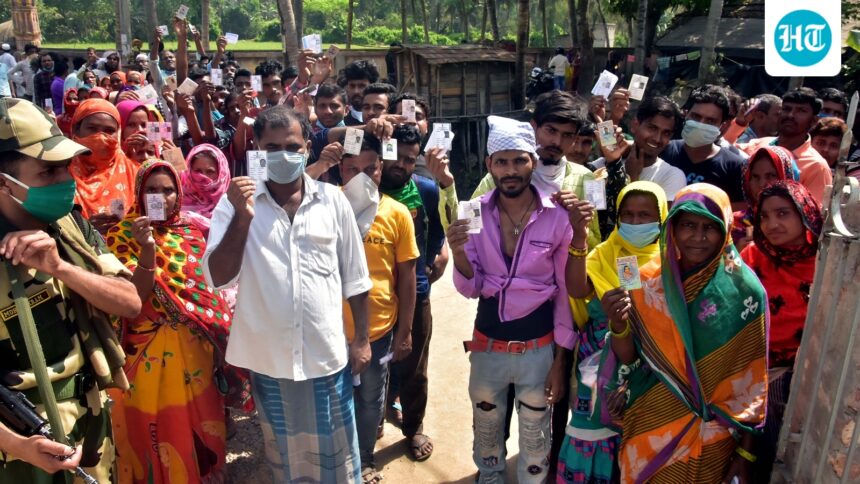
People whose names were removed after the rulings continued to queue in front of provincial government offices to submit documents, even though the 19 appeals courts are not yet fully operational. “The courts have not started functioning yet. The infrastructure, from which the retired judges will work, is almost ready. Two stenographers have to be appointed,” said a senior ICEC official. The above official also said that some of the cases referred by the Supreme Court to the courts have been disposed of on an urgent basis.
“One of them was Subrabuddha Sen, grandson of Nandalal Bose, who adorned the original Constitution of India with ornaments and illustrations. Mehtab Sheikh, the Congress candidate for Farakka seat in Murshidabad district, whose name has been omitted, has also been restored,” the official said.