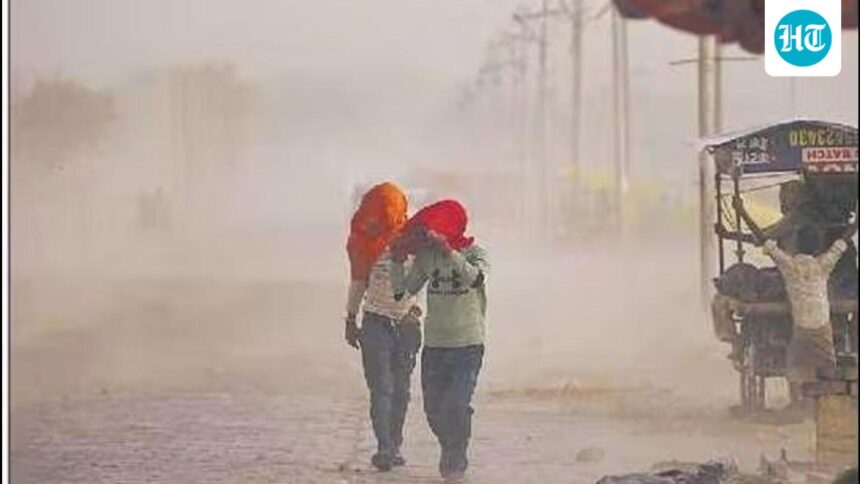
What hit Uttar Pradesh this week, killing at least 111 people in 25 districts, was not a single storm, but a collision of weather systems that normally should not be in the same place at the same time. A typical winter system from the west, which should have already retreated for the season, was meeting moisture drawn inland from seas on either side of the Indian subcontinent, on a land surface hidden for weeks of intense summer heat. This combination, with this timing and this intensity, is part of what scientists say is an emerging pattern of pre-monsoon thunderstorms that are becoming more frequent and more violent as the climate warms.

The immediate cause, as IMD Director General M Mohapatra pointed out on Thursday, was a transient western disturbance exacerbated by an unusually strong moisture incursion from the Bay of Bengal. But the physics of why the combination produced 130-kph winds — gusts typically associated with tornadoes, not inland thunderstorms — passed through multiple layers of the atmosphere above UP on Wednesday afternoon.
The Western Disturbance is an eastward-moving low pressure system that sweeps across northern India in winter and spring, pulling moist air across the region at upper levels. When it meets warm, moisture-laden air rushing inland from the Bay of Bengal at low levels – above a land surface heated to more than 40 degrees Celsius – the atmosphere becomes deeply unstable. Warm surface air rises rapidly; As it cools, the water vapor it carries condenses into a cloud, and the condensation releases latent heat that further accelerates the air’s rise. This self-reinforcing process – convection – is the driver of every thunderstorm. On Wednesday, the ingredients driving such a phenomenon came together in UP.
“Extreme temperatures are rising due to global warming, coupled with the increased ability of the air to hold moisture. We are now seeing massive clouds, with the cloud top reaching up to 16 kilometers high. These are cumulonimbus clouds that have the potential to cause massive thunderstorm activity. It is not surprising that wind speeds will rise to 130 kilometers per hour in some areas,” said Mahesh Palawat, vice president of climate and meteorology at Skymet Weather.
Sixteen kilometers is approximately the upper limit of the troposphere over India, which is the weather-bearing layer in the atmosphere. Cumulus clouds that reach this height collide with their ceiling and represent the most powerful storm systems the atmosphere can produce.
The wind damage was caused by what meteorologists call a squall line — a coherent, sustained line of severe thunderstorms that swept northwestward toward the east. M said. Rajeevan, former secretary, Ministry of Earth Sciences, said the system had distinctive features.
“It could be a line of thunderstorms called a squall line. They are severe thunderstorms with strong winds and lightning. Most of the deaths are caused by lightning. Storm lines can be predicted at least 12 to 24 hours in advance. Then we can do nowcasting using radars. But the real problem is that these systems are short-lived and have a small spatial scale. So forecasting is a bit difficult. Most of the problem is due to sending timely warnings and responding before that is the most challenging part,” he said.
What turns ordinary thunderstorms into an organized squall line is wind shear — the change in wind direction and speed with height. Without it, a thunderstorm would collapse within an hour, suffocated by its own downdraft. With strong shear the storm tends. Updraft and downdraft are separate; The system can maintain itself for several hours and travel hundreds of kilometers.
On Wednesday, the contrast between upper-level westerly winds brought by westerly disturbances and lower-level easterly winds carrying moisture from the Bay of Bengal served as shear that organized the storms into a single line.
Experts confirmed that the conditions that led to Wednesday’s storm are becoming more common.
“Thunderstorms are becoming more intense due to strong convection. As the average temperature rises, there is more moisture due to higher water vapor trapping capacity, and hence more intense thunderstorms,” said OP Sreejith, scientist and head of the Climate Monitoring and Forecasting Group at IMD.
He added that exposure is also on the rise — with more people working outdoors falling into the path of these increasingly violent storms.
The physics behind Sreejith’s point is straightforward. Warmer air can hold more water vapor — roughly 7% more for every degree Celsius of warming, a relationship known as the Clausius-Clapeyron equation. As average temperatures rise, the air over India carries a greater load of moisture; When a trigger like the Western Disturbance causes moisture to rise and intensify, the storms it produces are more active, dumping more water in shorter bursts, than storms that a cooler atmosphere would have generated.
Last year presented an almost identical situation. “In May last year, we witnessed intense dust storms and similar thunderstorms, with wind speeds reaching 100 kilometers per hour,” Palawat said. At least 56 people in three states died in incidents linked to a thunderstorm that swept across vast swathes of northern India, HT reported on May 22 last year.
“As temperatures rise, we should expect thunderstorms to be more violent,” Rajeevan said.
Thunderstorms and lightning have emerged as among the deadliest severe weather hazards in India. More than 2,500 people die from lightning strikes every year, according to an analysis by the Council on Energy, Environment and Water (CEEW).
The research center found that recorded lightning strikes rose from about 14.8 million in 2019-2020 to 18.5 million in 2020-2021, a 34% jump in one year, which is primarily attributable to extreme weather events caused by global warming, along with depletion of water bodies, deforestation and environmental degradation.
The challenge, as Rajeevan points out, is not the science of forecasting. It’s the gap between radar and field.