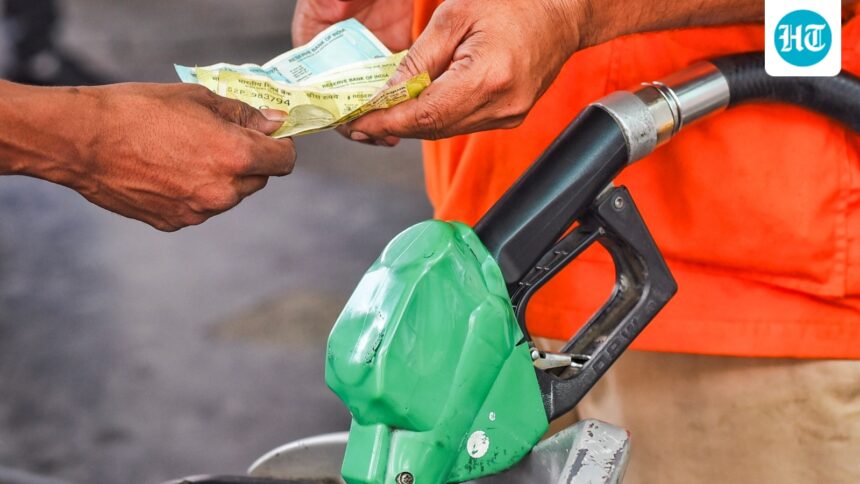
State-run oil companies raised gasoline and diesel prices by a percentage $3.3 per liter across the country on Friday, while Indraprastha Gas Ltd (IGL) increased compressed natural gas (CNG) prices by $2 per kg in and around Delhi – the first revision in retail fuel prices since conflict in West Asia sent international crude oil to its highest levels in several years.

In Delhi, retail outlets of public sector oil companies are now selling petrol $97.77 per liter and diesel at a price $90.67. IGL sells CNG at a price $79.09 per kg in Delhi, $80.70 in Noida, $84.12 in Gurugram, and $88.44 in Ajmer. Due to local fees, pump prices vary by city: Gasoline $108.74 in Kolkata, $106.68 in Mumbai and $103.67 in Chennai; Diesel is $95.13 in Kolkata, $93.14 in Mumbai, and $95.25 in Chennai.
The elevation provides only partial relief. Government officials and company executives said oil marketing companies would still lose an estimated amount $10-12 per liter of gasoline and $38-40 per liter on diesel, as global crude oil prices continue to rise. The price of benchmark Brent crude, which was at $72.87 a barrel on February 28 – the day the conflict erupted in West Asia – rose 62% to $118.03 by April 29. It has since retreated slightly and was trading at $108.55 a barrel on Friday although the figure was still 2.37% higher than $105.72 on Thursday – a change that highlights the volatility in energy prices.
Meanwhile, the Indian rupee fell to successive record lows $95.74 to the dollar on Friday – down more than 6% since the beginning of the year – as higher crude oil import costs drive continued demand for dollars.
Prashant Vashisht, Senior Vice President and Associate Group Head of Corporate Ratings at ICRA Ltd, said: “The modest rise in retail prices $3 per liter of petrol and diesel provides limited relief to oil marketing companies. ICRA estimates that at a crude oil price of $105-$110 per barrel, taking into account average motor fuel price differentials over the past 10 years, oil marketing companies incur a loss of approx. $500 crore per day on sale of auto fuel and domestic LPG, even after accounting for fuel price hike. Accordingly, oil marketing companies will need to reconsider retail prices if crude oil prices continue to rise.
Friday’s increase in retail prices was the first since April 2022, when prices were raised in the wake of Russia’s war in Ukraine. Between the end of March and April 6, pump prices increased by approx $9 per litre, often in daily increments of 80 paise.
The government had previously intervened on March 27, reducing customs duties on gasoline and diesel by 10%. $10 per liter – a move that costs the exchequer $14,000 Crores per month or $1.68 million crores annually.
This relief has proven insufficient as the conflict prolongs and the blockade of the Strait of Hormuz continues to disrupt global energy supply chains. At an inter-ministerial press conference on May 8, Oil Ministry Joint Secretary Sujata Sharma said the total monthly recovery shortfall for petrol, diesel and cooking gas had reached Rs. $30,000 Crores.
The timing of the rise has been under scrutiny. The Assembly elections concluded in the last week of April, and company executives have indicated that a modest price increase will follow once the polls are over.
Crude oil companies are losing together, Petroleum Minister Hardeep Singh Puri said on Tuesday $1,000 crore per day, and that one quarter of losses at prevailing crude oil price levels would likely wipe out their entire bottom line for 2025-26.
Prime Minister Narendra Modi on Sunday urged a series of measures including fuel conservation, work-from-home practices and restrictions on travel and imports, as rising global energy prices pressure the country’s foreign exchange reserves.
Some states issued notices to government departments this week to restrict travel, avoid physical events and shift meetings online, while also asking them to work from home two days a week, with half the staff in offices.
An unexpected tax on gasoline exports; Diesel, lower ATF duties
Separately, the government on Friday also imposed a windfall tax of… $3 pounds per liter on gasoline exports – for the first time since the start of the West Asian crisis – while reducing the export tax on diesel to $16.5 per litre $23, and on aviation turbine fuel $16 per litre $33 as of Saturday.
Export duties, which were first imposed on March 26, have been revised several times as the government sought to balance domestic fuel availability with refinery companies’ profit margins. Diesel export duties alone have swung sharply – from $21.50 at the front, it rose to $55.50 at the April 11 review, before being gradually eased.
According to PTI, the Finance Ministry said the duties are aimed at discouraging exports and ensuring domestic availability of petroleum products at a time when high global crude oil prices are making exports more profitable than supplying the domestic market.
The opposition strikes
Members of rival parties to the Bharatiya Janata Party criticized the increase. Tamil Nadu Chief Minister C Joseph Vijay described the increase as “unacceptable”, saying it would hurt the poor, those who use two-wheelers and small cars, and vehicle operators taking loans. He also accused crude oil companies of not passing on the benefit when crude oil prices declined in the past, while they were making profits.
The Congress directly targeted the Prime Minister. He described the party’s official handling of Opposition leader Rahul Gandhi said that the people will pay the price for the government’s mistakes, warning that “the Indian people will pay the price for the government’s mistakes.” $3 shocks have already arrived, and the rest of the “fasoli” will be paid in installments.”
DMK president and former Tamil Nadu MK Stalin said the increase, which came on top of the May 1 hike in commercial cylinder prices, had put the livelihood of ordinary people in doubt. “How will the Union government protect people from this?” he asked. Punjab Finance Minister Harpal Singh Cheema described the BJP as “anti-farmer and anti-people”, pointing out that the diesel price increase came a day after the rice support price (SSP) was increased by just 0.1%. $72 per quintal. “By nominally raising the MSP and raising diesel prices the very next day, the BJP government has robbed the farmers of their due compensation,” he said.
Samajwadi Party chief Akhilesh Yadav shared a cartoon of himself riding a bike – his party’s symbol – with a sign that read, “Use less benzene.” N: Prime Minister.
The BJP backed down. Party spokesman Pradeep Bhandari accused the Congress of seeking a political opportunity in light of a global crisis. He noted that India’s 3.5% increase in fuel prices was lower than similar increases in many countries, and that prices remained stable for 76 days despite Brent crude exceeding $100 per barrel.