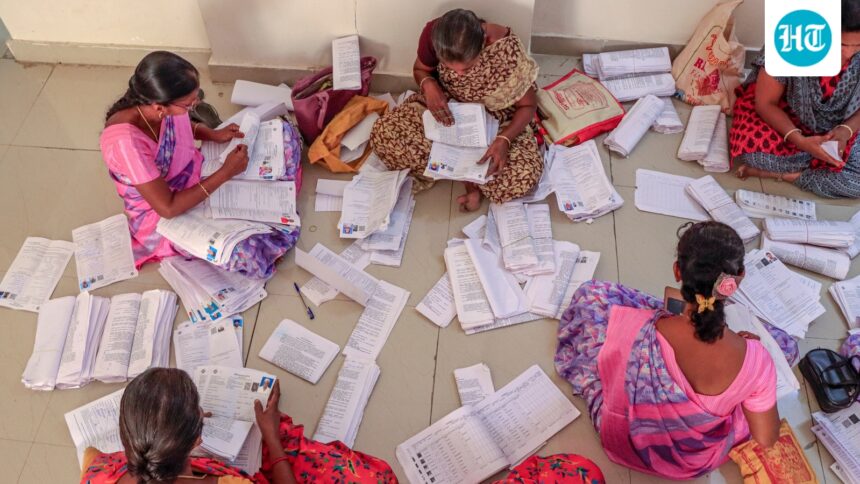
The Supreme Court will on Wednesday deliver its ruling on petitions challenging the validity of the Special Intensive Review (SIR) conducted by the Election Commission of India, in what will be the most significant judicial review of the structure of electoral rolls in the country since the Constitution came into force.

A bench comprising Chief Justice of India Surya Kant and Justice Joymalia Bagchi on January 29 reserved the ruling after hearing arguments on several dates spread over nearly three months.
The group of petitions, led by the Association for Democratic Reforms (ADR) and People’s Union for Civil Liberties (PUCL), along with appeals from opposition leaders Manoj Kumar Jha, KC Venugopal, Mahua Moitra and political activist Yogendra Yadav, challenges both the legality and practical framework of the SIR exercise initiated by the Poll Committee in Bihar and later extended to several other states and union territories, including West Bengal.
The petitioners argued that the timing, manner and scale of the exercise, conducted shortly before Assembly elections in multiple states, resulted in widespread disenfranchisement and transformed the Election Commission into a de facto citizenship verification authority without legal backing.
The ruling assumes political and constitutional significance because assembly elections in several states, including West Bengal, have already been conducted on the basis of revised electoral rolls prepared in the wake of the SIR exercise.
By the time West Bengal voted in April this year, more than 9.1 million names, equivalent to about 11.88% of the state’s total voters of 76.6 million, had been deleted from the rolls under the process, according to data submitted to the court during the hearings.
The appeal before the Supreme Court revolves around whether the Election Commission has the power under Article 326 of the Constitution, Section 21(3) of the Representation of the People Act 1950 and the Voter Registration Rules 1960 to do what the petitioners described as reconstructing the electoral rolls afresh.
The SIR process, which was first initiated in Bihar through a notification dated June 24, 2025, asked voters who could not be traced to the 2002 or 2003 electoral rolls to submit documentary evidence linking them to people on those old rolls. Initially, the Election Commission of India specified 11 categories of acceptable documents and later expanded the list to include Aadhaar after interim directions from the Supreme Court.
The petitioners contended that the process effectively reversed the well-established legal presumption recognized in Lal Babu Hussain v. Electoral Registration Officer (1995), under which a person whose name is actually on the electoral roll is presumed to be an Indian citizen unless the state proves otherwise.
According to opponents, the practice of SIR impermissibly shifted the burden to current voters to prove citizenship, thus creating what they described as a system of “suspensory citizenship.”
Senior advocates Kapil Sibal, Abhishek Manu Singhvi, Gopal Sankaranarayanan, Raju Ramachandran, Shadan Farasat, advocates Prashant Bhushan, Vrinda Grover and Fozia Shakeel, among others, argued that the Election Commission cannot assume similar powers to adjudicate citizenship, which constitutionally belongs to the Union government and foreigners’ courts under the Citizenship Act.
They also questioned the legal validity of the census forms used during the exercise, and argued that Section 21(3), which allows for a “special review” of electoral rolls, cannot be extended to justify a nationwide mass re-verification exercise covering multiple states simultaneously.
The petitioners also highlighted concerns about transparency, alleging arbitrary deletion, inconsistent implementation, inadequate hearing procedures, and the use of undocumented “inconsistency” software classifications in states such as West Bengal.
However, the Election Commission has defended the practice as a constitutionally mandated verification process necessary to ensure the purity of electoral rolls and prevent non-citizens from participating in elections.
While appearing before the poll panel, senior human rights advocates Rakesh Dwivedi, Maninder Singh and Dhamma Seshadri Naidu argued that the panel was only verifying citizenship for electoral purposes and not determining citizenship in the legal sense.
The IEC asserted that the practice was a “liberal” and “gentle” verification mechanism aimed at purifying the lists of dead, duplicate, migrant or ineligible voters. It emphasized that Article 326, which provides for elections on the basis of adult suffrage, necessarily obliges the Commission to ensure that only Indian citizens remain on the electoral rolls.
The committee also said that the SIR exercise could be distinguished from the conditions examined in Lal Babu Hussain because the current operation did not involve any police investigation and provided mechanisms for administrative verification at the booth level through house-to-house enumeration by officers at the booth level.
During the hearings, the bench made several important observations pointing to the broader constitutional risks involved. The court noted that while the IEC may have powers to conduct reviews of electoral rolls, these powers cannot be “unfettered” and must be consistent with the principles of transparency and natural justice.
At one stage, the bench also observed that the readings of the SIR notification did not explicitly mention the eradication of illegal immigrants as one of the purposes of the operation and sought data from the commission on whether any illegal immigrants had actually been identified through the Bihar SIR.
The court had earlier, through interim orders issued under Article 142 of the Constitution, instructed the commission to expand the list of acceptable documents by including Aadhaar, Elector’s Photo Identity Card (EPIC) and ration cards, while repeatedly emphasizing that the aim should be “mass inclusion, not mass exclusion”.
In West Bengal, where the process led to the deletion of more than 9.1 million voters ahead of the April Assembly elections, the Supreme Court additionally deployed about 700 judicial officers and later set up 19 appellate courts headed by retired Supreme Court judges to hear deletion appeals.
The ruling expected on Wednesday is likely to determine not only the legality of the exercise of SIR but also larger constitutional questions relating to the nature of the right to vote, the extent of the powers of the Election Commission under Article 324 and 326, and the procedural safeguards required before citizens are removed from the electoral rolls.
The judgment is also expected to settle an important doctrinal debate over whether the right to register as a voter is merely statutory, as was done previously in Kuldeep Nayar v. Union of India (2006), or whether it carries constitutional protection under Articles 14, 19 and 21, as shown in subsequent decisions such as PUCL v. Union of India (2003) and Anup Baranwal v. Union of India (2023).