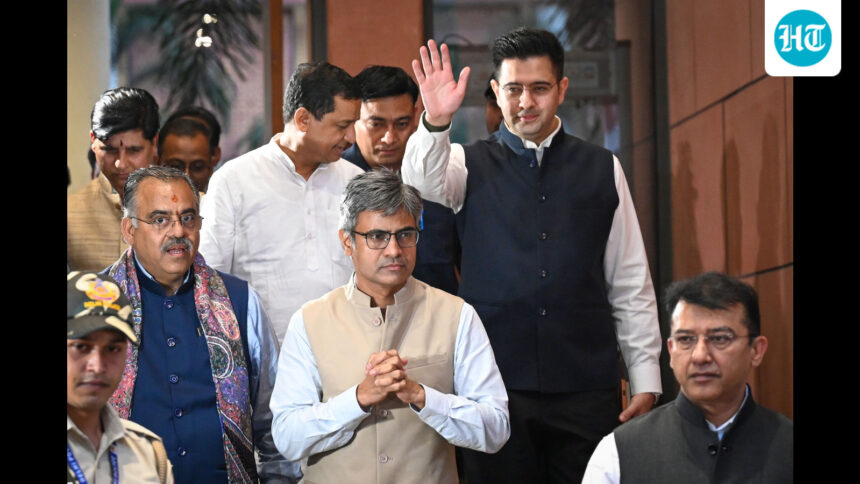
On Friday, the seventh Rajya Sabha MPs from the Aam Aadmi Party have joined the BJP and termed their move as a “merger” under Section 4 of the Tenth Schedule of the Constitution which prohibits such defections. This alleged merger of two-thirds of the members of Parliament, in the absence of a merger between the original political parties, raises an important constitutional issue related to the subversion of anti-defection laws. It is another example in a long line of disputed mergers within legislative parties, including the so-called “merger” of Telugu Desam Party MLAs with the Telangana Rashtra Samithi in Andhra Pradesh (2016), TDP Rajya Sabha MLAs with the BJP (2019), Bahujan Samaj Party MLAs with the Congress in Rajasthan (2019), and Congress MLAs with the TRS in Andhra Pradesh (2019) and Congress MLAs with BJP in Goa (2022).

The Tenth Schedule deplores the change of party loyalty and cross-party loyalty by elected representatives after being elected on the mandate of a particular political party, as this amounts to betraying the trust of voters, undermining the democratic process, and thus endangering the foundations of representative democracy.
But when two-thirds or more of a party’s elected representatives join another political party, can they claim protection from the anti-defection law by referring to a legislative party merger?
This matter will have to be examined within the legal framework of two laws, which together form a complex scheme governing political parties and the legislative party (the elected representatives of a political party in the House of Representatives). The behavior of legislators (legislative party members) towards their political party is primarily regulated by the Tenth Schedule of the Constitution, which provides for disqualification for unprincipled and immoral political defections, while the Constitution, recognition and electoral activities of such political parties are governed by the 1968 Symbols Scheme.
At its inception, the Tenth Schedule contained two exceptions to disqualification, i.e. division and merger. Since the defense of division was removed in 2004, merger remains the only exception to disqualification. It stipulates that the merger of the original political party with another political party will be deemed to have occurred only if at least two-thirds of the members of the legislative party concerned approve of such merger. If this provision is interpreted correctly, it indicates that a valid merger is based on the merger of the original political party itself; The approval of at least two-thirds of the members of the legislative party is merely a constitutional requirement to validate the merger of the primary party of the original political party within the House of Representatives.
In the absence of such merger of the original political party, the claim of merger within the legislative party cannot of itself be constitutionally protected from disqualification. The Supreme Court in Subhash Desai (2023) also held that a clear demarcation has been made between the political party and the legislative party for the purpose of merger under Article 4 of the Tenth Schedule and the two cannot be confused.
However, in an earlier judgment by Girish Chodankar (2022), the Bombay High Court, without taking cognizance of the constitutional and legislative scheme governing mergers, held that in view of the fiction contemplated by Article 4(2), merger of the original political party is not a sine qua non for invoking the exception. This ruling, despite considering Section 4 of the Tenth Schedule in isolation, did not take into consideration the provisions of the Symbols Scheme, especially Section 16 thereof, which deals with amalgamation (merger/joining) of political parties. It is worth noting that the symbol system does not envisage the integration of the party into the legislature, with the result that questions of party recognition, integration, identity, etc. can only be determined at the level of the political party, of which the legislative wing is only one part. Section 16 of the Symbols Order has been interpreted by the Supreme Court in a series of judgments, such as in Samyukta Socialist Party (1967) and All Leaders of the Hill Party (1977), which states that a merger of a political party can be validated only if a majority of the members of the political party (and not just the elected members of the legislature) accept such merger. The Court also held that the result of the merger is that the political party or political parties, as the case may be, cease to exist.
If the Bombay HC interpretation is accepted, it means that while a group of legislators are treated as having merged into another political party, the original political party continues to function outside the House as a separate entity. Thus, despite the ‘merger’ of the seven MPs into the BJP, the original political party continues to function outside the House. This interpretation is contrary to the letter and spirit of Section 4 of the Tenth Schedule, is entirely inconsistent with the Codes Order and the decisions of the Supreme Court, and, in fact, leads to mass dissidence, the mischief which is sought to be minimized by deleting the defense of dissidence from the Tenth Schedule.
The recognition of such mergers within legislative parties by the Speakers of Parliament amounts to a fraud on the constitutional anti-defection scheme. What are, in essence, divisions within the legislative party, are portrayed as mergers in order to highlight them as constitutionally valid actions. True integration must begin at the political party level and must lead to the obliteration of the original political party; However, measures like the current one create an anomalous situation where the original political party continues to be outside the House.
The interpretation of “merger” under Article 4 of the Tenth Schedule should be consistent with Article 16 of the Symbols Order, and be limited only to cases where there is a genuine merger of the original political parties. Such an interpretation would prevent unholy and unconstitutional realignments of elected representatives for personal gain from protection under the guise of political party mergers.
(The author is a senior advocate of the Supreme Court. The views expressed are personal)