There is almost nothing in common between the bustling metropolis of Minneapolis and the dusty Maharashtra village of Kasegaon in Sangli. One is a major American industrial center, a scenic city that sits on a lake and serves as the nerve center of the US Midwest. The other is a lush village 15,000 km away with barely any industry and lush green fields surrounding it. One sits 11 hours 30 minutes ahead of the other.
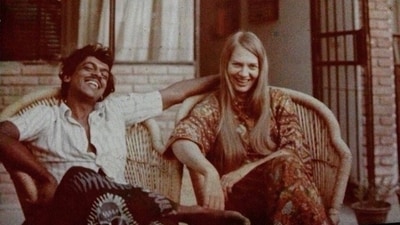
Bharat Patankar and Gayle Omved. (Image: Source)Yet, there is a common thread tying these two disparate sites – American sociologists Gail Ombedconsidered among the world’s leading color scholars. Omved grew up in a Scandinavian immigrant family in Minneapolis where his father worked as a lawyer. He taught African-American children in his neighborhood and was inspired by the fervor of student activism against the Vietnam War and the civil rights movement.
He then left Minneapolis and never returned.
amended The first to set foot on Indian soil on a Fulbright Fellowship in 1963, he carried with him the radical campus of Berkeley and the ideological fire of the American civil rights struggle. What he encountered in India’s villages—the systematic dehumanization embedded in caste—resonated with the oppression he witnessed back home. Something fundamental shifted in him during the first visit. She would go on to make India her home and place of work, marrying activist Bharat Patankar in 1976 and receiving citizenship in 1983, settling in Kasegaon.
Between these two places – the one where he was born and the one where he died in 2021 – is director Somnath Waghmar’s documentary Gayle and Bandi Yatra in India. The documentary took almost eight years to complete and has just been released. It chronicles the relationship between an American scholar and anti-caste activist against the backdrop of Minneapolis business for Maharashtra, academic prestige for grassroots action, and the transformation of a woman observing immersion.
More Read

“His position is crucial because in the post-Ambedkar era, he was a major vehicle for taking the anti-caste writing tradition global,” Waghmare said.
After his initial expedition in 1963, when Omved returned to India for his doctoral dissertation in 1970, he was already learning Marathi and combing through primary historical documents with forensic precision. His PhD thesis, Cultural Revolt in a Colonial Society: Non-Brahmin Movements in Western India, 1873–1930 documented the anti-caste movement of the early 20th century as a cultural and ideological challenge to caste hegemony.
At that time, Maharashtra was in the midst of churning – trade unions, linguistic movements, New Left formations and anti-caste groups like the Dalit Panthers were changing the social fabric of the state. He met Bharat Patankar, son of the communist freedom fighter Babuji Patankar, and activist Indumati Patankar, both veterans of the parallel government that challenged British rule in western Maharashtra. The couple got married and settled in Kasegaon.
More Read

Over the next few decades, Omvedt produced a rich body of work on caste, class and gender, including – We Shall Destroy This Prison: Indian Women in Struggle, which highlights the compound oppression of marginalized caste women, Dalits and the Democratic Revolution: Dr Ambedkar and the Dalit Movement, which examines two opposing struggles in India. Seeking Begumpura: Social Perspectives of Anti-Caste Intellectuals, which introduces readers to important figures for the anti-caste movement across India — from Rabidas to Kabir to Periyar.
Initially drawn to Marxism during his student days in the United States, Omved immersed himself in the Indian countryside, where his research focused on caste as the primary axis of oppression—a revolutionary position at a time when many theorists avoided the importance of caste divisions in Indian life.
Growing up just 15 km from Kasegaon, Waghmare had long idolized Omved and Patankar, attending their public meetings as a student. When he began filming in October 2017, he wanted to capture their lifelong activism. What he ended up documenting was something more tender and devastating: the scholar’s final years, when old age and limited mobility began to erode his brilliant mind.
“My hometown was also in Sangli and just 15 km from Kasegaon. I met him in public meetings during my graduation days when I started participating in the anti-caste movement as a student in 2010-2011,” said Waghmare.
The 80-minute film opens with a quiet morning scene — Omved and Patankar lying side by side, singing a song together. Waghmore captures the vicissitudes of their lives in old age: the way he tends to his ailing partner, thinks how the Nee once gave her a night-blooming jasmine flower during their first courtship, a devotion that endures even in memory.
“At the end of 2017, after my documentary on Bhima Koregaon, I started shooting Gayle and Bharat. It took about eight years to complete the project. Financing was a major issue. And it was a challenge to follow Gayle in her old age, and turn her voluminous writing into a story,” says Waghmare.
More Read

The film was screened at universities and film festivals across Europe and the US before playing on Indian campuses this month. It captures the radical commonality of a revolutionary life – of one who rejected both left- and right-wing understandings of India and instead offered a vision drawn from the social equality of Jyotiba Phule, the constitutional morality of BR Ambedkar and the colorless utopia of Rabidas’ Begampura.
“See there is very little video documentation on Dalit scholars, activists or leaders. So this project is also a kind of video archive for the next generation,” said Waghmare. “I got a good reception not only in the UK, Germany or the Netherlands, but also in Kolhapur where Gayle’s first book was published. I think people want to see this story, understand her life.”