In the context of the ongoing war with Iran, I wonder whether people have thought about the difference in fundamental strengths between nation-states and civilized states. In an era where geopolitical conflicts are limited solely to measures of military power or economic heft, traditional strategists sometimes ignore this difference.

The nation-state, in its modern concept, is a political construct. They are defined by well-defined borders, sovereign government, and a sense of common identity that is often consciously cultivated. But most nation-states are relatively recent creatures, emerging from the movement of history over the past few centuries – the product of treaties, wars, colonial withdrawals, and ideological movements. In fact, before the Treaty of Westphalia in the seventeenth century, “nations” did not exist as political units, but rather as cultural entities.
In contrast, the civilizational state is something much deeper and more enduring. It is not just a political arrangement, but rather a continuous series of cultural, historical and spiritual experiences accumulated over thousands of years. Its identity lies in shared consciousness – the consciousness of belonging to a tradition that transcends time. Language, literature, philosophy, ritual, collective memory and a sense of continuity form its bedrock. While the civilizational state may adopt the trappings of the modern nation-state – as India did in 1947 – its core remains rooted in an older, more flexible foundation.
Superficial foreign observers often do not realize this. The British writer John Strachey, an exemplar of the colonial mentality, wrote: “There is, and never has been, an India, nor any state in India, which possesses, according to European ideas, any kind of unity, whether physical, political, social, or religious; and there is no nation or ‘Indian people’ of which we hear so much.”
How can Strachey explain why the ancient Puranas describe, with astonishing accuracy, so extensively the sacred geography of Bharatvarsha, mentioning its mountains, rivers and tirthas across the Indian subcontinent? How can he ignore the fact that Chanakya in the 4th century BC, described Chandragupta’s Maurya empire as follows: “The area extending from the Himalayas in the north to the sea and a thousand yojanas wide from east to west is the process of the king-emperor.” If India did not exist before the British, how can one explain the four provinces created by Adi Shankaracharya in the eighth century AD, which included all of Bharat: Sringeri in the south, Dwarka in the west, Puri in the east, and Joshimath in the north?
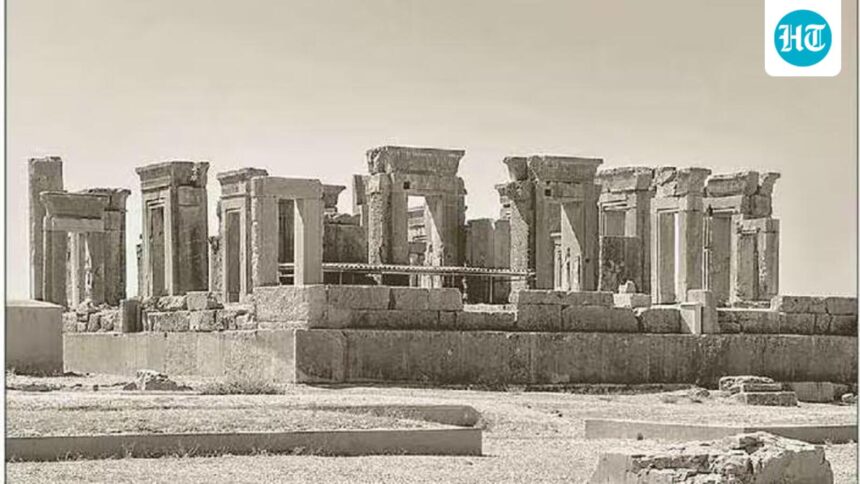
Likewise, Iranian civilization, rooted in the land of ancient Persia, is among the oldest continuous cultural traditions in human history. By 550 BC, building on previous cultural layers, the rise of the Achaemenid Empire under Cyrus the Great marked the emergence of one of the world’s first great empires, extending from the Balkans to the Indus Valley. The Parthian Empire and the Sassanian Empire also enriched Persian identity. With the Arab conquest in the seventh century, Iranian civilization absorbed new influences and reasserted itself.
The Persian language, literature and artistic traditions – from epic poetry such as the Shahnameh to complex architecture and miniature painting – bear witness to an uninterrupted continuity. Thus, Iran represents not only a nation, but a continuum of civilization, where memory, culture and identity have persisted over thousands of years.
Perhaps this is why Iran, despite ongoing economic sanctions, diplomatic isolation, and military pressure, has shown remarkable resilience. Without understanding this truth, powerful nation-states like America fall into the trap of equating power with hegemony.
Armed with superior technology and economic clout, the United States underestimated the invisible construct of resilience—history remembered not as a distant past but as a living force; Traditions that are not museum artifacts but are an integral part of daily life. A cultural identity that has survived invasions, absorbed influences, and yet retained essential continuity.
This miscalculation could lead to misguided strategic overreach, as the United States realized in Iran. India offers a parallel. Its civilization, defined by antiquity, continuity, diversity, assimilation, and pinnacles of refinement, is sashwat or eternal, and santan or immortal because of intangible factors of identity and belonging. That is why Allama Iqbal wrote in 1904: “Kuch baat hai ki hasti mitii nahin hamari, sadiyon raha hai dushman daur-e-zaman hamara” (There is something that ensures the survival of our existence; even though the world has conspired against us for thousands of years).
Pavan K Varma is an author, diplomat and former Rajya Sabha MP. The opinions expressed are personal