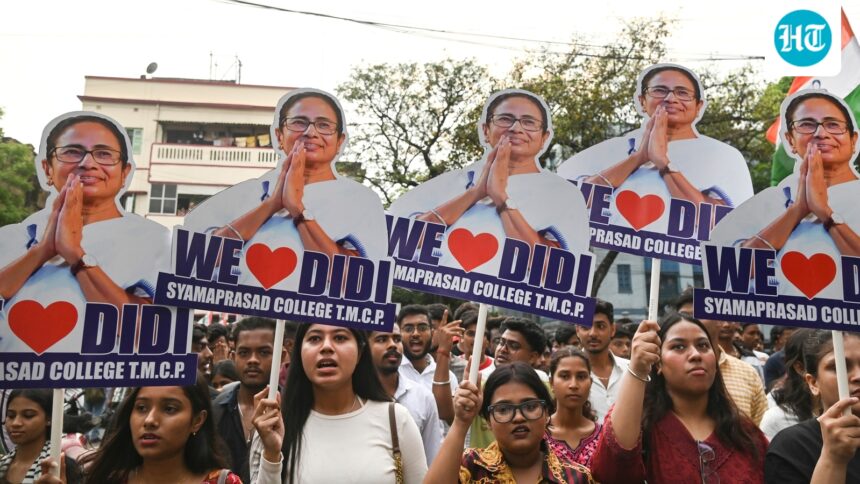
Prime Minister Narendra Modi got a clear response from Chief Minister Mamata Banerjee on Sunday after he took up the issue of women’s reservation at the BJP’s election rally in West Bengal and again claimed – as he did in his ‘address to the nation’ the previous night – that the state’s ruling Trinamool Congress (TMC) had blocked in the Lok Sabha a bill for a 33% quota in Parliament and assemblies.

CM Mamata Banerjee stressed that reservation for women as such is not up for discussion – it has already been passed with cross-party support in 2023.
“What we fundamentally oppose is the practice of demarcation [redrawing the country’s electoral map] Banerjee said in a post on X.
She emphasized that her party, the TMC, has the highest percentage of female representatives elected in both Parliament and the state legislature.
“In the Lok Sabha, 37.9% of our elected members are women. In the Rajya Sabha, we have nominated 46% of the members who are women. The issue of opposition to women’s reservation has never been raised or raised,” she said.
She further wrote: “It is extremely unfortunate that the Prime Minister chose to mislead the nation rather than address it honestly.”
“What we fundamentally oppose is changing Babasaheb Ambedkar’s constitution, dividing this nation and usurping power through fraud, by redrawing political lines to give greater representation to BJP-ruled states at the expense of others. This is an assault on federal democracy. We will not watch this happen in silence,” she added. Gerrymandering is a term used to change electoral districts in a way that benefits a particular party.
Read also | Why is the women’s quota not implemented in the current House of Representatives, which consists of 543?
She pointed out that the demarcation move – which was defeated because the BJP-led NDA did not have a two-thirds majority in Parliament – came three years after the 2023 women’s quota was passed.
“If this government is really serious about this noble cause, why did it wait almost three years after passing the Women’s Reservation Bill on September 28, 2023? Why is it in such a rush to pass it when several states are in elections? And why associate it with delimitation? The Trinamool Congress has stood for women for decades. We will continue to do so. But we will not be lectured on a subject that the ruling regime neither understands nor respects,” she added.
She challenged the Prime Minister that he must “have the courage (to address the nation) from the floor of Parliament, where you are being scrutinized, challenged and held accountable.”
She described his one-way rhetoric as “cowardly, hypocritical, and tongue-in-cheek.”
She claimed that Modi could now “feel the power slipping through his fingers”: “And you are willing to go to any extent to hold on a little longer. That’s all it was.”
What did Prime Minister Modi say?
Earlier, PM Modi had said in Bankura, “The women of Bengal wanted 33% reservation. Modi ensured it. The women of Bengal wanted it implemented from 2029. Modi also made efforts to make it happen. But TMC did not want more daughters of Bengal to become MLAs and MLAs because daughters of Bengal were challenging the ‘Maha Jungle Raj’. So, TMC, along with Congress, conspired and blocked the law providing 33% reservation for women.” From traffic.”
The government wanted to increase the number of LS seats to 816, from the current 543, with a new demarcation and 33% of the resulting additional seats reserved for women. The opposition said implementation could take place now as well, on the current number of 543, simply by removing the demarcation link from the original Quota Act 2023.
What is the demarcation link?
The 33% reservation for women in the Lok Sabha and state assemblies is already a law, ever since Parliament unanimously passed the Nari Shakti Vandhan Adhinyam Act in September 2023.
It was only notified in the Gazette this week, on 16 April 2026, even as debate over the timetable for its implementation through the Amendment Bill was ongoing.
This amendment bill failed to pass the two-thirds majority test in the Lok Sabha and hence never reached the Rajya Sabha. The relevant bills on delimitation and application to UTs were never introduced once the parent bill failed.
The quota for women is already Article 334A of the Constitution of India. But this law, as written, cannot yet be implemented. It is linked to a specific sequence – first the new population census must be completed, followed by a delimitation exercise to reallocate and redraw electoral districts; Only then does the reservation enter into force.
Under this original timeline, implementation would not be possible before 2034 at the earliest, as the first step, the final census, has only just begun. The requirement of census, then delimitation and then quotas was not something the opposition had asked for, Congress parliamentary party leader Sonia Gandhi wrote in a newspaper article on April 13.
“In fact, Leader of the Opposition in Rajya Sabha, Mallikarjun Kharge, has strongly demanded implementation of the reservation clause from the 2024 Lok Sabha elections itself. For reasons best known to it, the government has not agreed to this,” she wrote.
Even the Congress and the DMK, the ruling party in poll-bound Tamil Nadu, sought a new or old bill to bring into effect the 33% quota within the current 543-seat configuration.
Prime Minister Modi did not respond to this request.
During the three-day special session earlier this week as well, the government did not present a constitutional argument as to why reservation could not be implemented in the existing 543 seats. A mathematical explanation was provided instead. Home Minister Amit Shah’s argument in the Lok Sabha was that if 33% reservation was implemented on Tamil Nadu’s existing 39 seats, only 13 seats would be reserved for women, leaving 26 seats open to all. If the number of these seats increases to 59, 20 seats will be allocated to women and 39 seats will remain open. The government’s issue is essentially more seats open to everyone, and more seats reserved for women as well.
Congress leader Priyanka Gandhi, in her speech, called for “courage” among male MPs at the prospect of losing some of their seats if reservation is implemented in the current numbers.