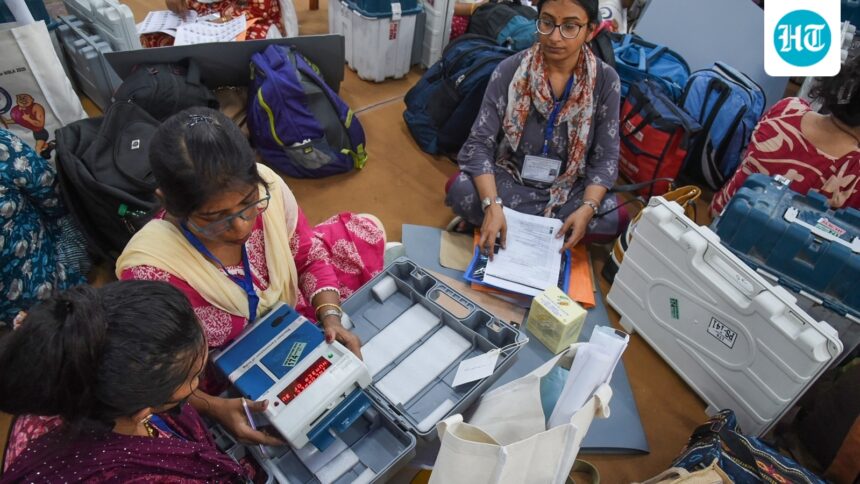
The results of the 2026 assembly elections in the states of Assam, Kerala, Tamil Nadu, West Bengal and the union territory of Puducherry are set to be known soon, after months-long spirited campaigns by political parties.

The Election Commission of India will count the votes for the 2026 Assembly elections on May 4 (Monday).
When will the vote counting start?
The assembly elections in Assam, Kerala, Tamil Nadu and Puducherry were voted in one phase between April 9 and April 23, while West Bengal voted in two phases.
The first phase of voting in West Bengal took place on April 23 and the second on April 29.
The ECI is expected to start counting at 8am, with early trends expected shortly after the count begins and a clearer picture of the results likely to emerge later in the day.
As protocol, postal ballots are opened first for counting, followed by electronic voting machines.
Follow here to get live updates on 2026 Assembly elections
Besides the Assembly elections, votes will also be counted in the by-elections for eight Assembly seats across six states.
How are votes counted?
Vote counting in India follows a well-defined procedure overseen by the Election Commission. The process begins with the postal ballot, which is cast by groups such as service voters, election officials, and people with disabilities. It is first calculated and officially recorded.
The counting of votes recorded in electronic voting machines (EVMs) begins after about 30 minutes. Electronic voting machines display the total votes obtained by each candidate when the result button is pressed in the presence of officials and representatives of political parties.
Read also | Triple blow for Mamata Banerjee ahead of Bangladesh election results
Where are you watching?
The official results can be followed on the Election Commission website (eci.gov.in).
What are the risks?
In West Bengal, Chief Minister Mamata Banerjee faces a crucial test as the Trinamool Congress looks to retain its dominance in the face of a determined campaign from the Bharatiya Janata Party (BJP), making it a prestige battle with national implications.
In Tamil Nadu, the ruling Dravida Munnetra Kazhagam party aims to consolidate its hold, while the All India Anna Dravida Munnetra Kazhagam (AIADMK) seeks a revival, even as the BJP tries to expand its presence.
Kerala presents its familiar contest between the Left Democratic Front and the United Democratic Front, with Chief Minister Pinarayi Vijayan trying to break the rotating voting pattern in the state, while the Congress-led United Democratic Front is looking to return to power.
In Assam, the Bharatiya Janata Party, led by Prime Minister Himanta Biswa Sarma, aims to defend its stronghold amid a challenge from a rising opposition alliance.
On the other hand, coalition calculations in Puducherry remain a key element in a fragmented political landscape, with national and regional players vying for control.
Read also | Assam exit poll shows big lead for BJP, Himanta Biswa Sarma government headed for another term
Latest developments in the House of Representatives elections
Security was tightened outside the strong room at Netaji Indoor Stadium in Kolkata ahead of the counting of votes on May 4.
The move follows allegations from the Trinamool Congress that the BJP, in “active collusion” with the Election Commission of India, is trying to open polls without the presence of accredited party representatives.
The DMK-led alliance is poised for a comfortable win in Tamil Nadu, as predicted by a majority of exit polls, including Chanakya.
The pollster also expected the BJP-led NDA to win in Assam and give the edge to the Congress-led United Democratic Front in Kerala, with the LDF narrowly trailing.
Exit polls for the 30-seat Puducherry assembly point to a clear advantage for the NDA, with most agencies forecasting it to be in the lead, often approaching or exceeding the halfway mark.