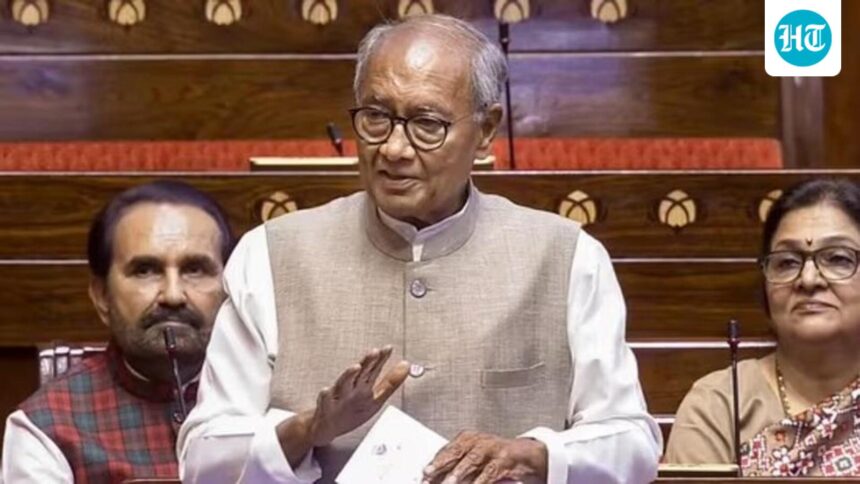
Congress member and Chairman of the Parliamentary Standing Committee on Education, Digvijay Singh, wrote to Prime Minister Narendra Modi on June 5, warning that the Central Board of Secondary Education (CBSE) order mandating third language teaching for Class IX from July 1 “is likely to create serious disruption” and risks a repeat of the On-Screen Marking (OSM) class that has afflicted millions of students across the country.

Singh sent a statement signed by a group of concerned parents to the Prime Minister, describing the mid-session introduction of the three-language policy as “surprising” and “indefensible”. Parents had earlier written to the Singh Committee on June 5, demanding complete repeal of the compulsory policy for current ninth-grade students.
“Sudden implementation of this policy mid-session — without adequate teachers, textbooks or a transition period — is likely to lead to serious disruption, not unlike the chaos we witnessed during the hasty implementation of CBSE’s OSM system, which adversely affected thousands of students across the country,” Singh wrote in his letter to Modi.
The discrepancy at the heart of the dispute has been documented in CBSE’s own records. The Board’s governing body in December 2025 upheld the Curriculum Committee’s recommendation that schools continue with the existing scheme of studies especially with respect to languages till the release of graded textbooks for languages by NCERT. The Committee noted that textbooks for regional languages stipulated under the 2023 National Curriculum Framework were not yet available.
The textbooks remain unpublished today.
Despite the decision, CBSE issued a circular on May 15 directing all affiliated schools to make the three languages, designated R1, R2 and R3, compulsory for Class IX from July 1.
“From July 1, 2026, for Class IX, the study of three languages will be compulsory, with at least two of them being indigenous Indian languages,” the circular said.
With no materials ready for secondary school, the council asked schools to use R3 textbooks as a temporary solution, citing a “75-80% overlap in core language competencies” between the two stages, a justification that school principals have publicly questioned.
The May 15 directive also came in clear contrast to CBSE’s phased rollout plan announced on April 2, just six weeks ago, which envisaged implementation starting with Class 6 in 2026-27 and reaching Class 10 only by 2030-31.
Schools have already acted in accordance with this framework, conducting language mapping exercises and informing parents of the changes, with a clear understanding that the upper grades will be brought in year after year. The sudden reversal left schools with almost no time to rework schedules, hire language teachers or acquire appropriate course materials.
“Most schools have already implemented the three-language policy for class VI. We were told that it will be implemented gradually, especially because there has been no change for classes 7 to 10,” the principal of a Delhi school told HT, requesting anonymity.
Students had already studied foreign languages as R2 until the summer vacation and appeared for regular examinations under the previous framework before the May 15 circular completely changed the conditions.
“The sudden change in policy as per the CBSE circular issued on May 15 has put all of us in a dilemma. Students who studied a foreign language till Class VIII will now have to switch to a native language in Class IX for which no textbooks are available and the syllabus has not been prescribed,” the principal said, adding that asking Class IX students to use Class VI textbooks would “dilute proficiency and learning outcomes.”
The parent statement, signed by CA Chandni Gupta, Pavan Puri, Sarah Paul and Pooja Puri, noted that thousands of students have studied French, Spanish, German, Japanese and other foreign languages since the sixth grade.
They claimed that the new requirement would force them to abandon subjects in which they had invested years of effort and acquired real skill.
The representation also raised clear concern about the reclassification of English as a foreign language within the new framework.
“English has suddenly been classified as a foreign language, while we do business, provide professional services, and conduct commerce around the world using English. English has given our country and professionals an advantage and continues to do so,” the parents wrote.
The disruption is most severe in the southern and northeastern states, where Hindi is not the first language, and local tribal languages often do not appear in the list of mother languages recognized by CBSE.
Students in these states study English as their primary language along with their mother tongue and the requirement to choose two native Indian languages puts them in a very difficult situation.
Sanskrit has emerged as the default R3 option for many schools, but school principals report an acute shortage of qualified teachers and suitable textbooks, conditions that Singh pointed out would “defeat the very purpose of promoting this beautiful language”.
“We have a mix of multiple languages in our classrooms and we are only left with teaching Sanskrit. We cannot forcibly remove French and German teachers,” a principal of a private school in Gurugram told HT, requesting anonymity.
“There was no consultation with school principals before the rollout. It was announced just a week before the vacation. Many parents are thinking of switching to other boards due to confusing CBSE policies,” the principal added.
Parents also argued that Classes IX and X are crucial board exam years and adding a new compulsory language would directly reduce the time available for other subjects.
“Students will have to pass internal assessment tests in both Classes 9 and 10 in order to get promotion. This will put an additional burden on the children,” the representative said, pointing out that NCERT textbooks for other Class 9 subjects themselves were made available long after the sessions began and that the Social Sciences textbook was still not available.
The matter is already before the Supreme Court.
On May 27, a bench headed by Chief Justice Surya Kant agreed to examine a batch of petitions challenging the policy, observing that there appeared to be “issues of difficulty, inconvenience and logistical support” that required immediate attention.
The main petition was filed by 19 parents and teachers from Delhi, Gurugram, Noida and Chennai, arguing that the May 15 circular represents a sudden reversal of CBSE’s stated position and a disruption of the academic planning that schools and families are already doing. The matter will be heard in the second week of July.
Singh noted that the timing was indefensible, noting that the court’s ruling was only scheduled to be issued on July 15, after schools were already supposed to begin implementation on July 1.
He urged Modi to immediately suspend the policy for current ninth-grade students, allow those already studying foreign languages to continue without interruption, and ensure that future language policy changes are introduced only from lower classes with an adequate transition period. CBSE and the Bharatiya Janata Party (BJP) are yet to respond to Singh’s letter.