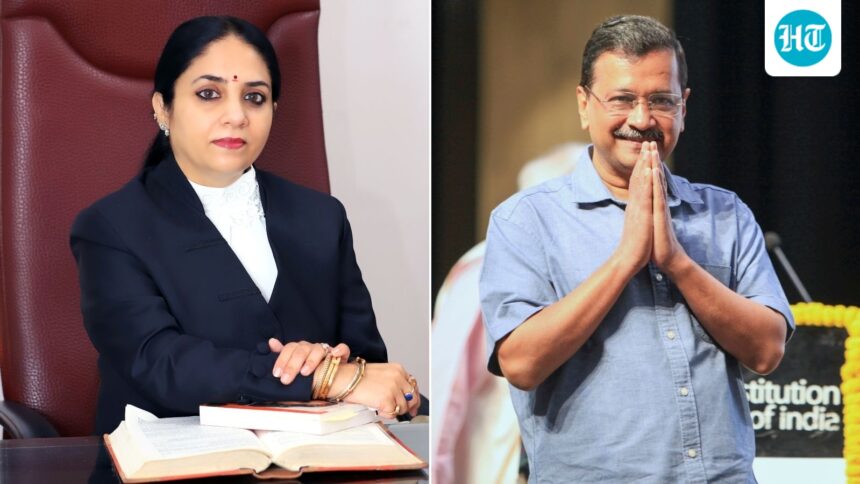
Delhi High Court judge Swarana Kanta Sharma on Monday refused to back down from hearing the liquor police case, involving AAP organizer Arvind Kejriwal and others.

“Personal concerns were not able to cross the threshold of fear of bias. The recusal should emanate from the law and not from the narrative, and this is a crucial moment for the court,” Suwarana Kanta Sharma said, even as she rejected the application filed by former Delhi Chief Minister Kejriwal and five others seeking her recusal from hearing the CBI appeal against the lower courts’ order.
Kejriwal, AAP’s Manish Sisodia and 21 others were released by the trial court on February 27 in the tax policy case.
She added: “If this court decides to step down, it will be a surrender and a signal that institutions including the judge and the court can be bent, shaken and changed. The motion to respond is denied.”
“I have faced situations where my impartiality and dignity were challenged. The natural instinct was to step aside without listening to the requests,” Swarana Kanta Sharma said while pronouncing the order.
She added that she chose to listen to the arguments out of fairness.
While deciding Kejriwal’s application seeking her disqualification from hearing the liquor policy case, Jurissis Sharma said the “dismissal will have deeper ramifications.”
The Supreme Court judge was delivering the ruling on petitions filed by Arvind Kejriwal and others seeking her removal from the liquor policy case.
The former Prime Minister virtually appeared before the judge through video conference and urged her to record his response to the written submissions submitted by the Central Bureau of Investigation (CBI).
Even as Kejriwal maintained that the registry’s refusal to record his reply was a “miscarriage of justice”, Justice Sharma noted that since he was not represented by counsel, the court had done its “utmost” in his favor when it allowed him to file his additional statement last week, even after reserving the order on the recusal issue.
The judge said that as per the rule of record, a party must personally obtain permission from the court to file anything, and since the present case is not “exceptional”, the same practice is followed.
She added that in law, there is no concept of filing a “rejoinder” to the other party’s written submissions, and that she would allow Kejriwal to submit his submissions as written submissions instead, so that he does not feel that he has not been heard.
“You are saying that you respect me. I respect every litigant. The court’s ruling will not change for anyone, so I will treat it as written submissions. I will put it on record. I grant leniency to Mr Kejriwal,” the judge said.
Solicitor General Tushar Mehta appeared in court for the CBI and opposed Kejriwal’s request to file a rejoinder. Mehta said that pleadings are not recorded anywhere in the country after court order is reserved.
He also said that there was no concept of filing a rejoinder to a written submission and the court should do what it would do to any ordinary litigant.
In his latest filing, Kejriwal said the CBI did not question that Justice Sharma’s children are on central government committees and receiving privileged work through the “advocate general-led litigation structure”.