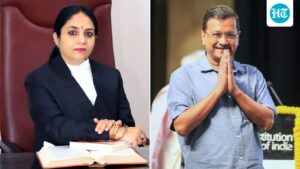
Mere fear of not getting relief from the court cannot be a reason for disqualifying a judge from the case, Delhi High Court judge Swarana Kanta Sharma said on Monday, as she dismissed the disqualification petitions filed by AAP chief Arvind Kejriwal and others in the liquor policy case.

“Resignation must deviate from the law, not from the narrative.”
“If this court decides to step down, it will be an act of surrender and a signal that the institution including the judge and the court can be bent, shaken and changed. Ruling that the motions to recusal are denied, it also said: “Personal concerns have not been able to cross the threshold of fear of bias.” The response must depart from the law, not from the narrative; “This is a decisive moment for the court.”
She made a number of arguments in her order as to why she did not withdraw from the case even when Kejriwal expressed “fear of bias”.
She stressed that the judge “cannot abdicate judicial responsibility in the face of allegations,” and that personal attacks on the judge are in fact “attacks on the institution itself.”
She said in this case that the response file “did not arrive accompanied by evidence, but rather arrived on my desk loaded with defamation, insinuations, and doubts about my integrity.”
She added: “Judges are obligated to be disciplined in their positions, and if they stoop to such defamation, it will not only be an attack on the individual judge, but on the institution. Today it is this court, and tomorrow it will be another court.”
She noted that disqualification would lead the public to believe that the judge leans towards a particular party or ideology.
She added: “A litigant cannot judge the integrity of the judiciary. A litigant cannot judge a judge without any substance. I urge this court to withdraw solely on the basis of perceived bias. If it accepts that, it will set a worrying precedent.”
She added: “The matter today is not a dispute between opponents, but rather between me and the opponent. The allegations and insinuations, even if they are continuous and loud, cannot replace the evidence required for deterrence. If a response is permissible, the judicial process will not remain independent, but rather subject to allegations.”
For attending the RSS event
Regarding Kejriwal’s argument that there were concerns of bias on the basis that the judge attended four programs of the Akhil Bharatiya Adhivakta Parishad (ABAP) — an organization he said was allied with the RSS and followed a “particular ideology opposed to the ideology of the Aam Aadmi Party (AAP)” — she said ABAP events were professional gatherings of lawyers, not political functions, and noted that several judges had attended such programs in the past.
The court also noted that plaintiff had “selectively” posted records of her involvement, stressing that such interactions are part of maintaining a “healthy relationship” between the tribunal and the union.
The judge said that this relationship extends beyond the courtrooms and includes informal engagements, which cannot be reduced based on the perceptions of the litigants.
The judge warned against opening the “gates” of mistrust, and said such arguments could discourage judicial participation in professional forums.
She stressed that impartiality is supposed to be in the judge’s interest, and although it is rooted in ethics, it cannot be questioned for flimsy reasons.
She said: “The organization’s tasks were not political in nature, but rather were programs organized by a group of lawyers where professional discussions took place.”
“The judiciary cannot be made to be placed in an ivory tower. The gates of the courts cannot be open to sow seeds of mistrust in these cases only. This would lead to intellectuals refusing to attend panels of lawyers and they would be forced to withdraw from public disclosure. Impartiality is a presumption in favor of the judge and impartiality is not a legal requirement but an ethical requirement,” the judge said.
What Kejriwal asked, and why
The controversy arose when Justice Sharma presided over cases linked to an alleged Delhi excise policy (liquor sales) scam.
After a lower court discharged Kejriwal and 22 other accused on February 27 this year — concluding that the CBI materials did not even constitute a case worthy of trial — the CBI challenged the order in the Supreme Court, and Justice Sharma, at the first hearing of the CBI petition on March 9, stayed the lower court’s directions on departmental action against a CBI officer. It also described some of the lower court’s observations as “prima facie erroneous.”
Kejriwal later argued in her court that this order had been passed, after listening to the CBI for just five minutes and without hearing its side even once.
Earlier, when the case was before the trial court, the bench had rejected the bail petitions filed by Kejriwal, fellow AAP leaders Manish Sisodia and Sanjay Singh, and Telangana politician K Kavitha, as the CBI and Enforcement Directorate built a case.
The alleged RSS “link”.
In his petition demanding her recusal, the AAP leader raised several objections against the judge. The most political accusation was that Justice Sharma attended four events organized by the Akhil Bharatiya Adhivakta Parishad, a body of lawyers affiliated with the RSS, the ideological parent of the Bharatiya Janata Party, the political rival of the AAP and the ruling party at the Centre.
He told the court directly: “This case is political.” When Justice Sharma asked her if he thought she followed this ideology, Kejriwal turned the question back to her: “Do you follow it?” She said she just wanted his claims to be properly recorded.
In his additional affidavit, Kejriwal alleged a conflict of interest because Justice Sharma’s son was appointed as a Group A counsel representing the Center before the Supreme Court, while her daughter was appointed as a Group C counsel and also appeared as an advocate for the Center before the Delhi High Court.
He pointed out that the work was allotted to both of them by a “structure” led by Solicitor General Tushar Mehta, who is arguing the CBI case before Justice Sharma.
Kejriwal had applied for transfer of the case on March 11. When that was denied two days later, he, Sisodia and four others filed disqualification petitions specifically with the judge.
A former government tax officer and social activist before entering politics in 2012, Kejriwal appeared in court to defend himself.
His first argument for why the judge should withdraw the ruling was that the court’s sweeping order — reached after reviewing 40,000 documents — had effectively been overturned in five minutes. He also cited the Supreme Court’s ruling in Ranjit Thakur v. Union of India, arguing that actual bias need not be proven; “Fear of bias” is sufficient reason to step down.
What the CBI said at the counter
The CBI strongly opposed this petition and Solicitor General Mehta called it a “dangerous precedent”. He said judges routinely handle bar association events regardless of political affiliations.
Regarding her children being government-certified lawyers, the agency said they have not handled or assisted in the tax case in any capacity, and are independent practitioners not associated with any senior lawyer.
Justice Sharma reserved her order last week, accepted Kejriwal’s additional statement, and scheduled the sentencing for Monday, April 20, after recording some additional documents.
In the final part of his presentation of arguments, Kejriwal this week appeared before the judge via video conference, urging her to record his response to some written submissions submitted by the CBI.
59039]The judge said there was no concept of filing a “rejoinder” to the other party’s written submissions, but she would allow Kejriwal to submit his submissions as written submissions instead, so that he did not feel he had not been heard.
“You are saying that you respect me. I respect every litigant. The court’s ruling will not change for anyone, so I will treat it as written submissions. I will put it on record. I grant leniency to Mr Kejriwal,” the judge said.
Kejriwal said in his latest filing that the controversy over her children working as lawyers for the central government was not objected to by the CBI. “Once these facts are acknowledged, the prosecution cannot be allowed to evade legal consequences and all the CBI’s insinuations against it are completely irrelevant,” the former Delhi chief minister asserted.
“Instead of meeting the substance of the plea of conflict of interest, the CBI has chosen to resort to speculation, attribution of motives, rhetorical panic and outrageous allegations against the applicant, all of which are beyond the scope of the limited case that arises for consideration. It is extremely unfortunate that the CBI is willing to discredit the entire judiciary in order to bring this matter before just one judge,” Kejriwal alleged.
SG Mehta had earlier urged Justice Sharma to file a contempt case against Kejriwal and others for seeking her recusal.
The government’s lawyer described the concerns raised by Kejriwal and others as “fears of an immature mind” and told the court that it was a matter of “institutional deference”; And that Justice Sharma should not give in to pressure because her rejection of the “baseless allegations” would set a bad precedent.