For the BJP, which achieved a massive victory in Bengal, the glimmer of hope in Kerala is seen as another springboard for building in the southern state, where it otherwise remains a distant player behind the Congress-led United Democratic Front (UDF) which defeated the CPI(M)-led Liberal Democratic Front (LDF) this time.

The ruling Center Party won three seats in the 140-seat Kerala Assembly and has since planned a 13-point policy agenda that it said will shape its strategy in the state ahead of the next Lok Sabha elections in 2029.
The Hindutva-led party’s agenda focuses on strengthening support among backward communities within the Hindu community, while also seeking to reduce its past outreach to minority groups, especially Christians.
Kerala is one of India’s most religiously diverse states, with Hindus making up about 55% of the population, Muslims about 27%, and Christians about 18%. This is a level of minority presence that far exceeds the national composition of approximately 80% Hindus, 14% Muslims, and 2% Christians. This means more difficult terrain for the RSS-BJP ecosystem that talks about “Hindu nation” and Hindutva as a “cultural identity”.
Focus on backward classes within Hindus
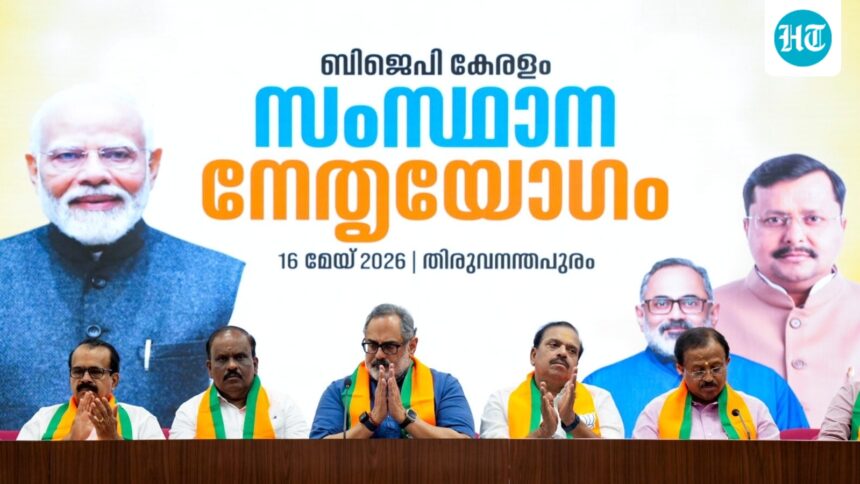
The BJP’s new agenda is part of a policy decision adopted at the state core committee meeting on Saturday, news agency PTI reported on Sunday. The meeting was chaired by state unit chief Rajeev Chandrasekhar.
According to sources cited by PTI, the party document does not clearly define new outreach initiatives towards minority communities. The party, especially with Christians, made attempts to build closer relations ahead of the April council elections.
However, it has now moved away from attempts to build institutional bridges with the church leadership, amid the bishops’ increasing alignment with the Congress-led United Democratic Front, the source was quoted as saying.
The shift, which is somewhat unofficial, came in the wake of the Catholic Church’s strong opposition to the Centre’s move to introduce the controversial Foreign Contribution (Regulation) Act (FCRA) Amendment Bill, 2026, in Parliament, according to party insiders.
This bill, which aims to regulate and potentially stifle the flow of foreign funds into Indian organisations, has put the BJP on the defensive during the election campaign in Kerala.
Book a major play
Meanwhile, the BJP’s new agenda places greater emphasis on backward Hindu communities, especially through its stance on OBC reservation.
The party plans to emphasize that OBC quota should not lead to any religious reservation, such as Muslims who can be considered among the backward.
“Religious reservation under the guise of OBC reservation should be completely abolished,” the decision said, according to the news agency report, and that reservation policies should be limited to OBC, SC/ST and EWS categories.
Among Hindus, the party is known to be trying to strengthen its outreach to key social groups, including the numerically significant Ezhava community, which remains a crucial support base for the state’s two main left parties, the Communist Party of India (Marxist) and the Communist Party of India.
What Chandrasekhar said
The party’s resolution also stated that no group should get preferential treatment through “appeasement” – a claim centered around the alleged preferential treatment of Muslims by the Congress and the Left – and emphasized the need for equal opportunities for all Malayalis.
“The BJP will not allow backward caste reservation to be converted into religion-based reservation,” Chandrasekhar said, highlighting the issue as part of the party’s efforts to expand its outreach among backward Hindu communities.
“If the state government, under pressure from the Muslim League and the Jamaat-e-Islami, adopts appeasement policies, the BJP will strongly oppose it,” Chandrasekhar said.
Basic Hindutva position
The resolution also reiterated the party’s core Hindutva stance by raising the issue of entry into the Sabarimala temple and calling for a review of the temple’s properties and assets.
The party called for legal action in connection with the alleged “Sabarimala gold looting”, sought a CBI investigation, and demanded withdrawal of all cases registered during protests against women’s entry into Sabarimala.
The BJP also called for a review of the properties and assets of temples, increased investment in schools and colleges, and measures to protect children from the influence of “religious fundamentalist, terrorist and drug organisations”.
What do the numbers say?
The party called itself a “third alternative” to the CPI(M)-led LDF and Congress-led UDF, claiming that voters had accepted the emergence of a new political force.
In its post-poll assessment, the party said the BJP-led NDA won three constituencies, came second in six others, and secured around 30,000 votes in Kerala.
Despite winning three seats, the BJP did not register a significant increase in vote share – 11.4% in 2026 versus 11.3% in 2021 – and is well short of its 20% target for an alternative emergence at the moment. The victories came from state president Rajeev Chandrasekhar in Nemom (4,978 votes), Muraleedharan in Kazhakoottam (428 votes) and BP Gopakumar in Chatthanur (4,398 votes).
The BJP polled 16.68% in the 2024 Lok Sabha elections and 14.6% in the 2025 local body polls.
In 2016, O Rajagopal won Nemom, becoming the first BJP MLA in Kerala’s history. In 2021, it lost this single seat and suffered a decline in vote share, leaving the party without seats. The 2026 result for three seats on almost the same vote share as 2021 showed the BJP’s votes gradually gathering in its pockets.
The state BJP leadership expressed its gratitude to voters across the state, saying their support helped the NDA achieve what it described as an important milestone in its growth in Kerala.
The Congress-led United Democratic Front came to power with 102 of the 140 seats, marking the strongest mandate for the alliance since 1977, ending a decade of UDF rule. The Congress alone won 63 seats, while the ITU won 22 seats. The LDP’s seats were reduced to 35 seats, with 13 ministers losing their seats.