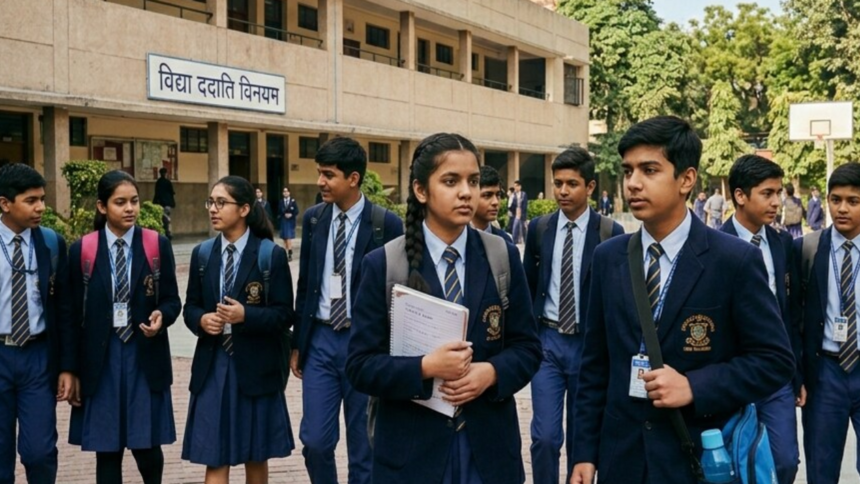
The new framework requires students to study three languages, at least two of which must be Hindi.

A new mandate of the Central Board of Secondary Education (CBSE) requires students of class IX and X to study Three languages have drawn criticism from opposition leaders.

The new framework obliges students to study three languages, R1, R2 and R3, with the requirement that at least two of them be national. The third language will be assessed internally by the schools and not through the Class 10 board examination.
The decision has led to sharp reactions, especially in Tamil Nadu, where opposition to the three-language formula has a long political history.
“There is no doubt about the trilingual format.”
DMK leader TKS Elangovan said Tamil Nadu would not accept any change in its long-standing bilingual system. “They cannot change the system followed in Tamil Nadu. They can implement it anywhere but not in Tamil Nadu. We have a system that we follow strictly and there is no doubt that there is a trilingual formula in Tamil Nadu,” he told PTI in Chennai.
Tamil Nadu has historically opposed the three-language formula, saying it places an unfair burden on non-Hindi-speaking states and undermines regional linguistic identity. The state has followed a two-language policy, Tamil and English, for decades.
Congress leader Surendra Rajput criticized the Center for bringing in the change without consultation. “All the new measures are being implemented through dialogue under a democratic regime. Since the BJP came to power, the dialogue process in democracy has ended. An authoritarian regime has been imposed,” Rajput told PTI.
He claimed that decisions are increasingly being made unilaterally without debates in Parliament or consultations with the public, MPs or education stakeholders.
He added: “In a democratic system, the participation of all stakeholders is essential in such decisions. The public was not consulted, and there was no discussion in Parliament or with MPs. Decisions taken without discussion can be dangerous. We will study the matter in detail, and only after that will we issue a detailed statement.”
The policy change has already begun to impact schools in some areas.
In April, CBSE schools in Puducherry have reportedly dropped French from the 2026-27 syllabus. This is because the revised three-language framework only allowed one slot for a foreign language, which was occupied by English in most schools.
Puducherry DMK women’s wing coordinator Tr Gayathri Srikanth questioned the impact on students and teachers. “If French is removed from CBSE schools under the three-language policy, who is responsible for the students who studied French from classes 1 to 5 and are now facing disruption? Who is responsible for French teachers in private schools who are facing job loss?” she wrote on X.
Under the revised structure, Students can choose Indian languages like Hindi, Sanskrit, Bengali, Assamese, Tamil, Telugu, Kannada, Malayalam, Marathi, Gujarati, Odia, Punjabi and Urdu as their third language. Foreign languages including French, German, Spanish, Japanese and Russian can only be studied if the students are already learning two Indian languages.
CBSE said the changes are aimed at implementing NEP 2020 and National Curriculum Framework for School Education (NCF-SE) 2023 more effectively and encouraging students to study Indian languages alongside English.
The board has clarified that students will not be barred from appearing in Class 10 board examinations based on their performance in the third language.

Anita Goswami is a Senior Content Producer at Hindustan Times, where she primarily covers Indian and international news. With four years of experience in the field, she has led coverage of Indian general elections, Assembly elections, and national polls in the US, Canada, Bangladesh and Nepal. Its reports cover world wars and major events, including Operation Sindoor, the overthrow of Sheikh Hasina, and the Mahakumbh Mela. It verifies the facts and uses clear sources to ensure the accuracy of the reports. As a former Editor-in-Chief at Storytailors, she has managed teams to produce high-quality content for networks such as NDTV, Profit, CNBC-TV18, Upstox and News18. Her work has appeared on NDTV, Meaww and Global Pulse. Throughout her tenure, Anita has collaborated with and received mentoring from leading industry experts. When she’s not reading, Anita can be found outside or at a bakery. Areas of interest: Indian political history, international elections, historical policy analysis, global conflicts, cultural events, Formula 1, art, media ethics, reporting on social and political change over time.Read more