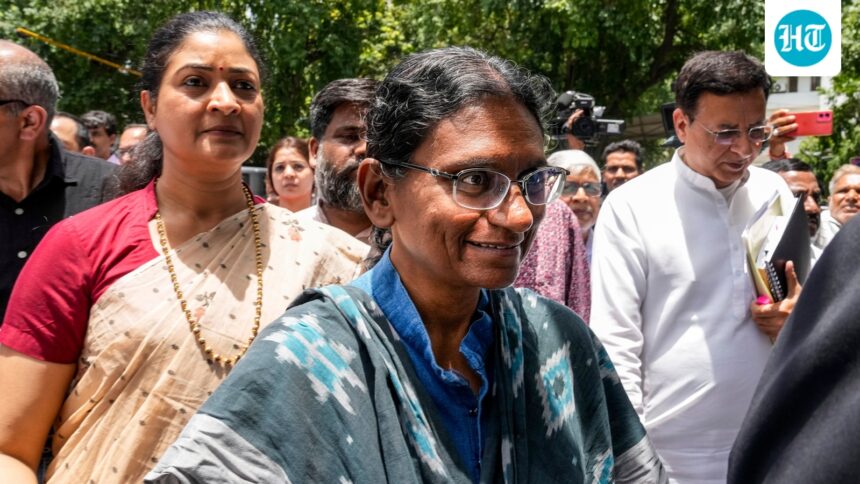
The Election Commission is yet to take a decision on the Congress’ request to quash the rejection of Meenakshi Natarajan’s nomination for the Rajya Sabha elections from Madhya Pradesh even as the state party unit prepares to move the Supreme Court on Thursday against the Returning Officer (RO) order.

“Congress will move the Supreme Court against this injustice. If necessary, we will meet the President of India to raise the issue of constitutional crises created by the BJP,” Madhya Pradesh Assembly Leader of Opposition Umang Sengar said.
A delegation of senior party leaders, including KC Venugopal, Jairam Ramesh, Abhishek Singhvi, Vivek Tanka, Randeep Surjewala, Bhupesh Baghel and Deepa Dasmunshi, along with Natarajan, met the commission and demanded that the decision be reversed.
After his meeting with EC officials, Singhvi termed the RO order “bad and completely partisan” Party MLAs in Madhya Pradesh on Wednesday staged a hunger strike in protest against rejection of Natarajan’s nomination, calling it a coordinated conspiracy under pressure from the BJP government.
Read also: BJP reveals reason for rejecting Meenakshi Natarajan’s nomination form for Rajya Sabha seat: ‘Expecting inevitable defeat’
On X, Singhvi posted a video outlining his legal objections to the order, saying: “The returning officer’s decision is really bad and completely partisan.”
Speaking to reporters, Natarajan said: “This is a sabotage of democracy… We still have full faith in constitutional institutions. That is why we are fighting this battle.”
After the Congress party delegation left, the Chief Election Commissioner (CEC) and Election Commissioners (EC) sat in an enlarged internal meeting to decide whether to intervene or not, but by night no decision had been taken, leaving the June 9 rejection in place, and the three BJP candidates, Tarun Chugh, Rajneesh Agrawal and Mahesh Kewat, were set to be declared elected unopposed on the three state seats.
Senior Election Commission of India (ECI) officials who attended the deliberations said the commission worked on the issue from beginning to end – the provisions governing the Election Act, the line of Supreme Court rulings on disclosure, and the precedents set by the previous Rajya Sabha and other electoral contests.
Also read: ‘Action is illegal, no case against Meenakshi Natarajan’: Congress after EC meeting on RS nomination
Natarajan’s nomination was rejected on Tuesday after BJP leaders, including Rajya Sabha candidate Mahesh Kewat and party general secretary Rahul Kothari, filed an objection, alleging that Natarajan had concealed details of a case pending in a Hyderabad court in her election affidavit. The RO upheld the objection, ruling that it had filed an incomplete form and failed to disclose the court summons issued in connection with a rape case against a Congress leader in Telangana in 2022.
European Commission officials said the discussion was based on Article 36 of the People’s Representative Act, which governs the audit.
Under section 36(2), the registry operator may reject a nomination on limited grounds – failure to comply with section 33 or 34, or disqualify the nominee. Article 36(4) then prohibits rejection “on the ground of any defect not of a fundamental character”, while the requirement of Article 36(5) allows the candidate, once an objection has been raised, to be given sufficient time to refute it “not later than the next day but after the date fixed for scrutiny”. Section 36(6) requires the officer to record in writing the reasons for any refusal.
The Congress argued that Natarajan was merely a respondent and not an accused, and no FIR pursued her response.
In Bhopal, Congress leaders began an indefinite fast at Roshanpura Square to protest and held demonstrations across Madhya Pradesh. Youth Congress workers in Bhopal visited the office of the Chief Electoral Officer on Wednesday. When they found the gate closed, they hung the uniform of the Rashtriya Swayamsevak Sangh (RSS) on the gate before leaving.
Congress Rajya Sabha MP and senior advocate Vivek Tanka, who examined the nomination papers before submitting them, said a returning employee cannot reject the nomination without giving the candidate a meaningful opportunity to address the deficiency.
Madhya Pradesh Chief Minister Mohan Yadav defended the regional office’s decision. “If anyone has a criminal case pending in any court, it should be disclosed in the affidavit so that every voter is aware of all relevant details. I welcome the decision,” he said.