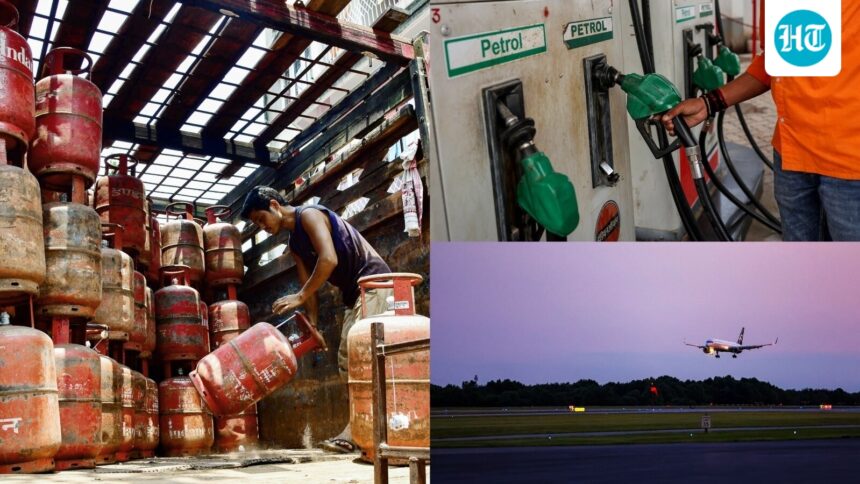
As tensions in the US-Iran war eased, fuel prices across various industries – commercial LPG, gasoline, diesel and aviation turbine fuel – fell on Wednesday, bringing much-needed relief to consumers and businesses.

These developments came after US negotiators, Jared Kushner and Steve Witkoff, held positive discussions in Qatar. Bloomberg quoted a senior Trump administration official as saying that technical talks with Iran are moving forward.
Since February 28, the global energy crisis caused by conflict in West Asia has sent oil prices around the world soaring. Tensions in the Strait of Hormuz, a critical oil corridor, have disrupted global energy supplies, including to India.
India also witnessed a rise in the prices of LPG, petrol, diesel and jet fuel. The easing of tensions has led to significant price cuts –
The price of commercial LPG has fallen by more than $180
Prices for commercial liquefied petroleum gas (LPG) used in hotels and restaurants have fallen $$183.50 per 19kg cylinder on Wednesday, news agency PTI reported.
After the first such price reduction this year, the cost of a 19kg commercial LPG cylinder is now prohibitively expensive $Oil companies said 2,930.
Commercial LPG prices reached an all-time high last month when the rate $3,113 per 19 kg cylinder.
Commercial LPG prices are revised on the 1st of every month based on the average of the previous month’s benchmark prices.
Commercial LPG prices by city today (per 19kg cylinder):
New Delhi – $2,930
Chennai – $ 3,106
Hyderabad – $ 3,191
Kolkata – $ 3,081.50
Mumbai – $ 2,885.50
Bengaluru – $ 3,021
(Data from goodreturns.com)
Nayyara reduces gasoline and fuel prices
Nayara Energy, India’s largest private fuel retailer, has reduced petrol prices by $5 per liter and diesel at a rate $3 over its national network on Wednesday.
The revised rates have reportedly come into effect at more than 7,000 Nayara Energy fuel stations across the country. However, pump prices may vary across states depending on local tariffs and duties, including value added tax (VAT).
Petrol and diesel prices from public sector fuel retailers remained unchanged.
Notably, Nayara was also the first fuel company to raise prices at the height of the US-Iran war – in March.
Check petrol and diesel prices by city (per litre):
New Delhi:
- Gasoline – $102.12
- Diesel – $95.20
Chennai:
- Gasoline – $107.76
- Diesel – $99.55
Hyderabad:
- Gasoline – $115.69
- Diesel – $103.82
Kolkata:
- Gasoline – $113.51
- Diesel – $99.82
Mumbai:
- Gasoline – $111.21
- Diesel – $97.83
Bengaluru:
- Gasoline – $111.68
- Diesel – $99.56
(Data from goodreturns.com)
Reducing aviation fuel prices $5/litre
The price of aviation turbine fuel (ATF) or jet fuel has reportedly dropped by $5 per liter on Wednesday, representing another major relief amid slumping global oil prices.
Jet fuel costs now $110 liters in New Delhi, news agency PTI reported, citing industry sources.
This is also the first such reduction in jet fuel prices since the West Asia crisis sent ATF prices soaring.
Jet fuel prices initially rose on April 1, as the Indian Oil Corporation (IOC) showed a rate $2,07,341.22 per kiloliter, an increase of 114.55 percent over $96,638.14 per Kuala Lumpur, Delhi.
However, the government was asked to intervene in the ATF price hike to influence oil marketing companies to mitigate the increase for domestic scheduled airlines.
The final price of jet fuel for domestic airlines in Delhi has been revised to $1,04,927 per Kuala Lumpur.
The situation in the Strait of Hormuz
Given the 14-point memorandum of understanding signed between Iran and the United States and the easing of tensions following the recent talks in Qatar, oil tanker traffic is reportedly showing signs of recovery.
Crude oil prices have also fallen in recent days as hopes for a permanent end to the conflict grow.
On Wednesday, Brent crude oil traded above $73 a barrel, while WTI approached $70.
Samantha Dart, co-head of global commodities research at Goldman Sachs Group, pointed to the US-Iran conflict and said: “We expect this to happen by the end of July.”
“Once cross-Strait flows return to normal, we are expected to experience excess supplies,” Dart added.
It is worth noting that Iran said it has exported more than 40 million barrels of oil since the United States lifted its naval blockade on Iranian ports, with Russian shipments rising to record levels.