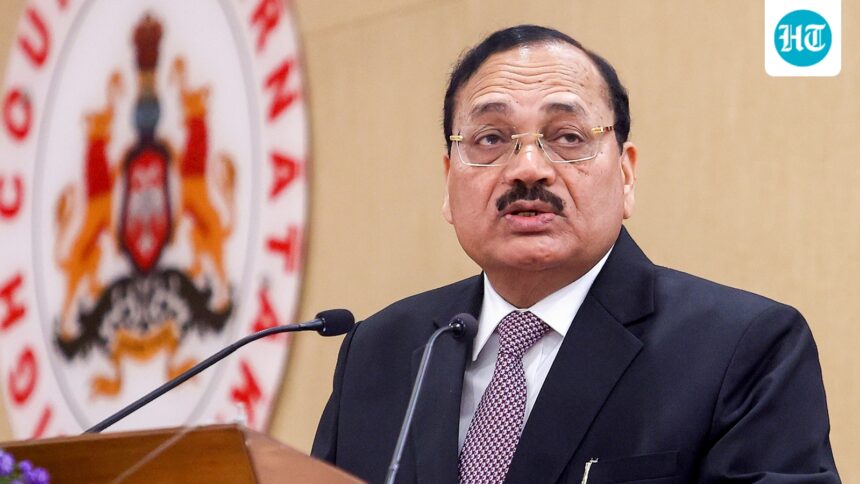
Chief Justice of India (CJI) Surya Kant has written to the chief justices of all 25 high courts, calling for urgent action to fill growing judicial vacancies and urging them to prioritize the promotion of women judges as part of a broader drive for diversity in constitutional benches.

In a letter sent last week, the ICJ highlighted the scale of vacancies in the senior judiciary and stressed the need for Supreme Court bodies to expedite recommendations, not only for existing positions but also for positions that are likely to arise in the near future.
According to data presented by Union Law Minister Arjun Ram Meghwal before Parliament, 309 posts (27.5%) remain vacant in the High Courts against a blocked strength of 1,122 judges as of February 10, underscoring the urgency pointed out by the ICJ. The communication stressed that the appointments process, which requires inputs from the state government, Intelligence Bureau, Supreme Court Collegium and Union government, is inherently time-consuming, making early initiation by the high courts crucial.
Read also | ‘No one dares’: CJI warned of criminal contempt action after brother summoned by litigant’s father
Against this backdrop, Justice Kant urged the chief justices to ensure that recommendations are not delayed, warning that any delay at the Supreme Court level has a cascading effect on the entire appointment process.
It is worth noting that the letter clearly focused on improving gender representation in the higher judiciary. She called on Supreme Court panels to pay special attention to identifying and recommending suitable female candidates for promotion – an area where representation still lags behind.
Official figures show that only 116 of the 813 serving judges in the Supreme Court are women, representing just 14.27%. In the Supreme Court, there is currently only one female judge.
The IJC’s intervention comes amid growing concern about the gender imbalance in constitutional seats, even as there has been a marked improvement in the representation of juniors in the judiciary.
In a noteworthy suggestion, the ICJ has asked the higher courts to expand their search for talent where local candidates are not readily available. If it is not possible to identify suitable female candidates within the Supreme Court’s territorial jurisdiction, colleges should consider female advocates from that state who currently serve on the Supreme Court.
The CJI noted that several qualified women lawyers from different states are actively practicing in Delhi and could be considered for promotion in the high courts of their home country.
The move signals a shift towards a more flexible, pan-India approach to judicial appointments, specifically aimed at addressing the persistent underrepresentation of women.
The letter reflects themes the CJI has repeatedly expressed in recent public engagements. Speaking on March 8 at a national conference on women in law, he said: “The moment to take measured action is not in the future – it is now. Consideration for appointment of suitable and worthy women to the bar should not be the exception, but the rule.”
He also advised the High Court Colleges to “expand the area of consideration” to include women human rights defenders practicing in the Supreme Court when suitable candidates within the locally specified age group are not available.
Read also | The Supreme Court agrees to consider the request to raise the national emblem above the dome of the court from an administrative perspective
While the ICJ highlighted the need for more female judges, it also pointed to deeper structural challenges within the legal profession.
At an event organized by the Supreme Court Bar Association last week, he called for 50% representation of women in the government’s composition of lawyers and legal aid committees, along with the establishment of a financial support group for female lawyers during their early years of practice and maternity leaves.
He noted that although women now make up more than half of law students and a large proportion of new entrants to the Bar, there is a sharp decline as careers progress, driven by factors such as lack of mentoring, irregular working hours, and limited institutional support.
CJI Kant has consistently argued that improving representation on the bench requires strengthening the pipeline at its source. He said: “Rising is not a simple or immediate process. It requires taking care of the pipeline from its very source. If the pipeline is narrow at its source, the seat cannot be wide later.”
It is encouraging that women now constitute about 36.3% of the workforce of judicial employees at the regional level, which indicates that the base of the pyramid is gradually expanding.
Recent developments indicate gradual progress. The Supreme Court bench has recommended the transfer and appointment of Justice Lisa Gill of the Punjab and Haryana High Court as Chief Justice of Andhra Pradesh. The move has been approved by the Centre, making her the third woman chief justice and the first woman chief justice of the Andhra Pradesh High Court after the retirement of current Justice Dheeraj Singh Thakur on April 24.
The recommendation of the Supreme Court bench on Justice Gill was to implement its new policy under CJI Kant, whereby the bench had decided that the judges earmarked to become Chief Justices of the High Courts would be transferred to their new High Courts in advance, preferably two months before the vacancy arises. The decision signals a decisive policy shift aimed at ensuring a smoother transition of leadership in the High Courts, and aims to enable the new Chief Justices to familiarize themselves with the administrative and judicial performance of their new courts before taking charge.