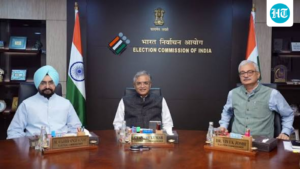
V Umashankar (archive photo)
New Delhi: Mere campaigns or awareness campaigns will not be enough to reduce violations of road traffic rules and road accidents; Instead, “certainty of implementation” will have a greater deterrent effect, Union Road Transport Minister V Umashankar said on Thursday while sharing details of the recently notified e-challan rules.
Speaking while issuing the New Delhi Road Safety Declaration at the National Road Safety Forum held at the Indian Institute of Technology in Delhi, Umashankar asked whether the juvenile (referring to a recent case in Delhi) did not know that he was underage and should not be driving a car, or whether the car owner who modified a tourist bus – resulting in the death of more than 20 people in a fire – did not know that such modifications were illegal. “Forty-five percent of the deaths were caused by motorcyclists or people riding two-wheelers. We find that most of these deaths occurred because the rider was not wearing a helmet. Doesn’t he know that wearing a helmet is good for him?” Notice. “Awareness is not enough – what we need is organized action at the district level, backed by certainty in implementation and supported by strong institutions,” said Umashankar. “When compliance becomes a habit and accountability becomes certain, road safety will move from intention to impact.”
” Road safety is now firmly on the global agenda, with strong political and media interest, said Mats-Ake Beilin, Global Leader of the WHO Decade of Action for Road Safety. “Our responsibility is to go beyond awareness and ensure consistent, evidence-based implementation so that no country is left behind in preventing road traffic deaths,” he added. The New Delhi Declaration on Road Safety, aligned with the WHO Decade of Action for Road Safety, states that India has the highest number of road deaths globally, and that vulnerable road users – such as pedestrians, cyclists, two-wheelers, temporary workers and rural communities – are the most affected.
Despite numerous initiatives, the absence of coordinated, institutional-led action has had limited impact at the national level.
“The declaration addresses this gap by adopting a safe system approach and putting human life at the center of all mobility decisions,” the statement said. The declaration, led by the Bharat Association of Road Safety Volunteers (BARS), an organization with members from diverse fields, laid out five pillars of action: strengthening road safety management through leadership at all levels; Promote open crash data, annual public reviews, dedicated funding, and strengthen implementation; ensuring safer vehicles and fleets; Promote safer road users and improve post-accident response; And create a safer driving environment.Participants included representatives from ministries, WHO and other multilateral agencies, civil society, academia, industry bodies, original equipment manufacturers, technology innovators and youth groups.