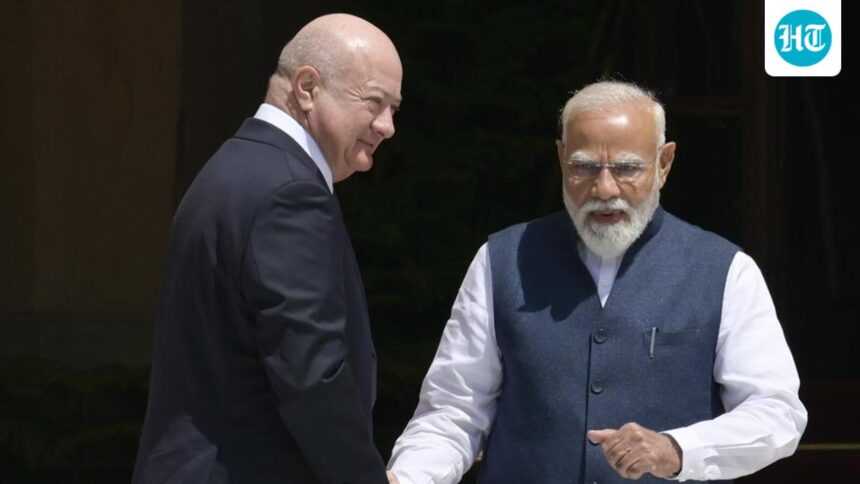
India and Austria on Thursday agreed on measures to enhance cooperation in defence, counter-terrorism, trade and mobility of professionals, with Prime Minister Narendra Modi and Austrian Chancellor Christian Stoker stressing that problems cannot be solved through conflicts in West Asia and Ukraine.

Stocker, the first Austrian chancellor to visit India in more than four decades, is accompanied by a 60-member business delegation, signaling Vienna’s intention to boost trade and investment ties by building on the India-EU free trade agreement that is expected to be signed later this year.
“By combining Austria’s expertise with India’s speed and scale, we will ensure reliable technology and supply chains for the entire world. We will strengthen our partnerships in defence, semiconductor, quantum and biotechnology,” Modi said in a joint media interaction with Stocker.
Speaking in Hindi, Modi said: “The entire world is going through a very dangerous and tense situation, and it affects all of us. In such a tense global environment, India and Austria agree that military conflict cannot solve problems. Whether in Ukraine or West Asia, we support stable, sustainable and lasting peace.”
Stoker said he and Modi shared the view that conflicts can only be resolved through negotiations, and stressed that stability, trust and reliable partnerships are a “strategic imperative” in an era of geopolitical turmoil. He said: “Power centers are changing, new alliances are being created, and conflicts are becoming more complex.” “That is why India is a reliable partner and is valued by Austria.”
“We support a rules-based global order, not a world where might is right,” Stocker added.
Besides launching a dialogue on cybersecurity, the two sides signed a letter of intent on military cooperation to strengthen the defense industrial and technology partnership by building on the India-EU defense and security partnership reached in January. It will also facilitate dialogue and training on defense policies.
Another letter of intent on establishing a joint counter-terrorism working group would enhance strategic cooperation in countering extremism and extremism, disrupting terrorist financing links and channels, including through the United Nations and the Financial Action Task Force (FATF), and preventing the exploitation of emerging technologies for terrorism.
Both sides condemned all forms of terrorism, including cross-border terrorism. Modi and Stoker strongly condemned the terror attack in Pahalgam and the terrorist incident near the Red Fort last year and sought coordinated global efforts to combat terrorism.
Modi and Stocker also indicated their intention to strengthen trade and investment ties by building on the conclusion of negotiations on the India-EU trade deal. Modi described the two countries as reliable partners in infrastructure and innovation, pointing to the role played by Austria’s experience in tunneling in the construction of the Delhi Metro and the 10,000-foot Atal Tunnel.
“Indian talent has the potential to boost innovation and productivity in Austria. In 2023, we signed a comprehensive agreement on migration and mobility with Austria. Now, under this agreement, we will also work to promote mobility in the nursing sector,” Modi said.
Pointing out that two-way trade has grown to about 3 billion euros and 160 Austrian companies are active in India in leading technologies such as semiconductors, renewable energies and automobiles, Stocker said India’s growth rate of about 7% per year makes it a “key strategic partner.”
The India-EU FTA will reduce trade barriers and create new opportunities for industrial cooperation and exports in the areas of engineering, electronics, chemicals and industrial services. “I believe this agreement is very important, especially in times of geopolitical challenges, because our common response to multiple crises must be coalition building,” Stocker said.
The two sides announced a fast-track mechanism to resolve the problems facing Indian and Austrian companies and investors in their respective economies. This mechanism will serve as a platform to discuss investors’ suggestions regarding ease of doing business.
Another letter of intent would expand knowledge exchange in the field of dual vocational training or apprenticeships, skills development and enhance recognition of Indian professional qualifications in accordance with Austrian standards. The two sides agreed to activate a “Working Holiday Programme” where up to 200 visas will be issued each year to participants between the ages of 18 and 30 with a maximum period of stay of one year.
The two sides also concluded an agreement on joint audiovisual production to enhance cooperation between film industries and facilitate joint film production, and a memorandum of understanding on food safety focusing on standards and exchange of best practices in food regulation to promote trade in agricultural and food products.
They launched a structured bilateral dialogue on cooperation in education to facilitate mutual recognition of qualifications and support cooperation in developing vocational education and training systems, and the “Focus on India” initiative launched by leading technical universities in Austria, including a dedicated portal to facilitate the admission of Indian students to pursue engineering and technical master’s programmes.