The census is the latest in a long list of non-instructional responsibilities assigned to public school teachers.

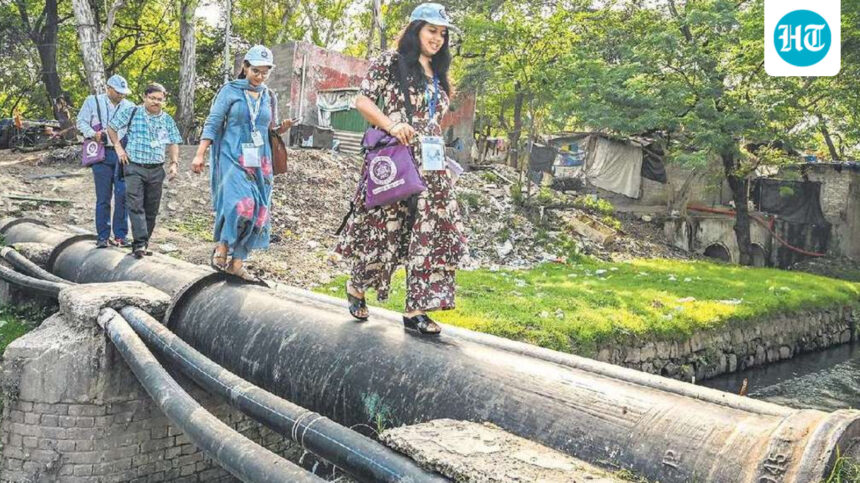
Under the blazing April afternoon sun, long after classrooms had emptied, hundreds of government school teachers fanned out across the tree-lined avenues and busy side streets of central Delhi, ID cards around their necks, phones, notebooks and forms in hand. They knocked on the doors of the shacks guarded by security personnel, the tin-roofed shacks tucked into narrow lanes – marking the start of what may be the country’s most comprehensive administrative exercise: the 2026 census.

However, for many, this was not the start of the day, but rather the second shift in a long shift. An HT team spent the afternoon escorting two census takers – one assigned to high-security VIP residences, the other to the Goji Collection near Keventer Lane – to capture the intense human efforts underpinning the census.
Also Read: Census 2027 begins: Over 700 officials to conduct door-to-door survey, dividing Delhi areas into blocks
Today’s work revealed a picture of educators as the first foot soldiers in this large-scale exercise, navigating not only data collection but also human hesitation, logistical barriers, and, in some cases, personal risk.
Vijay Singh, who participated in the 2001 and 2011 census operations, described how the process evolved. “Before, we used to carry huge records and spend up to an hour at each house. Now, with digital tools, it’s faster,” he said.
But he added that efficiency has not reduced the workload. “Our day starts at 7 a.m. and ends late at night – often extending for more than 12 hours.”
“We encounter different types of people, some of whom are aware that such an exercise is taking place, others who are aware but unwilling to share the details, and those who happily come to us and offer us water and willingly share the details,” he said.
Also Read: The map on the census portal shows Arunachal city in China, the error has been corrected
Moving between households, Singh said hesitation among residents remains a recurring challenge. He added: “People are reluctant to share details, but what we tell them is that we will go into the details that they share with us.”
The home listing phase, which began this month and continues until September 30, includes collecting detailed information on housing conditions, amenities and household assets through a table of 33 questions. These data form the backbone of policy planning and social care targeting. For the first time, this process was preceded by a 15-day self-enumeration window, allowing residents to submit their data online before the census taker visited – with the aim of reducing field burden, although its impact remains uneven.

In another part of the NDMC area, Lakshmi Agnihotri, a teacher at Kendriya Vidyalaya in the President’s Estate, began her rounds at the jhuggi group. Her day had started before sunrise, and she left her home in Bawana at 6 a.m. to go to school.
The first day itself provided a glimpse of the challenges ahead. Entering the group alone, she encountered a group of men who were hesitant at first and then became overly familiar. She later said: “These situations are difficult… Starting tomorrow, we will try to move in groups.”
Also read: Census digital mapping begins in NDMC and Delhi areas; More than 700 officials were deployed for the survey
Many homes in the group were locked down – residents went out to work and were only expected to return in the evening. The pattern is repeated across sites: absences during the day, forcing census takers to revisit households several times. Agnihotri noticed the discrepancy. “In these groups, people are generally more open when they are present.
“And in the VIP areas, access itself becomes a problem.” This problem was evident a few kilometers away, as another researcher arrived at the gates of Lutyens’ guarded huts in Delhi.
In many residences, staff questioned the purpose of the visit and were reluctant to share details. “We are facing a lot of problems in the VIP areas. At this time, many MPs and senior leaders are absent to participate in election campaigns in West Bengal, so when we visited their homes, we were asked to come back later. We will now seek appointments and then take their details,” said a census taker, who requested anonymity.
In one case, the census taker tried to reassure household staff. “If the resident self-censers, just share the SE ID. We will just verify the details,” he explained.
Mahesh Kumar Sharma, another counter who commutes daily from Gurugram to Kendriya Vidyalaya in central Delhi, noted additional restrictions. “In one association, we were asked to email and inform three days before coming for door-to-door survey otherwise we would not be allowed in,” he said.
The first day of the exercise also revealed gaps in pre-listing. Census takers found houses that had been previously identified but were empty, as well as shops and stalls that had been completely neglected. In some cases, tenants said they were on the verge of eviction, raising the possibility of a repeat when the census begins in other areas.
Tight schedules, minimum pay
For teachers like Manorama Yadav, an already demanding and routine task has been pushed to the limit. The Kendriya Vidyalaya teacher works in Rashtrapati Bhawan area, leaves her home in Rohini at 6 am and returns only around 8 pm. “I see my three-year-old son in the morning, then at night… He stays with my mother while I am away. My husband is also a teacher. We manage somehow.”
She added that her husband is likely to be deployed for the same exercise in MCD areas next month – doubling the pressure on the family.

The census is the latest in a long list of non-instructional responsibilities assigned to public school teachers. From election duties and voter roll reviews as booth level officers (BLOs) to surveys, trainings, and administrative work, teachers often find themselves juggling multiple roles during the year. While some are temporarily relieved of classroom duties, many continue teaching throughout the day before beginning fieldwork.
“Many of our colleagues also work as BLOs. We finish school by 2.30pm and then go for surveys. To be honest, the amount is very minimal. We get paid $25,000 in total – $9000 for this m Journey and $16,000 for the next one. This will be paid only after the entire exercise is over next year,” said another enumerator who also requested anonymity.
The transition from classrooms to fieldwork requires teachers to quickly adapt from managing students and lesson plans in the morning to navigating unfamiliar neighborhoods, addressing common concerns and ensuring accurate data collection in the afternoon and evening.
Singh narrated how personal commitments often overlap with official duties. Referring to a colleague whose daughter is getting married this week, he said: “He has just had two days off and will return to work after the celebrations. But despite the tension, we feel we have a sense of responsibility towards the nation. This is an adventure and we are enjoying it.”

Saloni Bhatia is a journalist with over 15 years of experience in reporting and storytelling, with a strong focus on the Delhi government and political developments in the capital. Over the years, I have closely followed political decisions, governance issues and political transitions. She started out as an entertainment journalist but then moved on to covering issues such as crime and education. Her crime-fighting experience helped her develop an eye for detail and accuracy, while educational reporting allowed her to explore the impact of policies on students, teachers and institutions. Outside of the newsroom, she enjoys reading fiction and nonfiction. She is also very interested in watching Bollywood movies.Read more