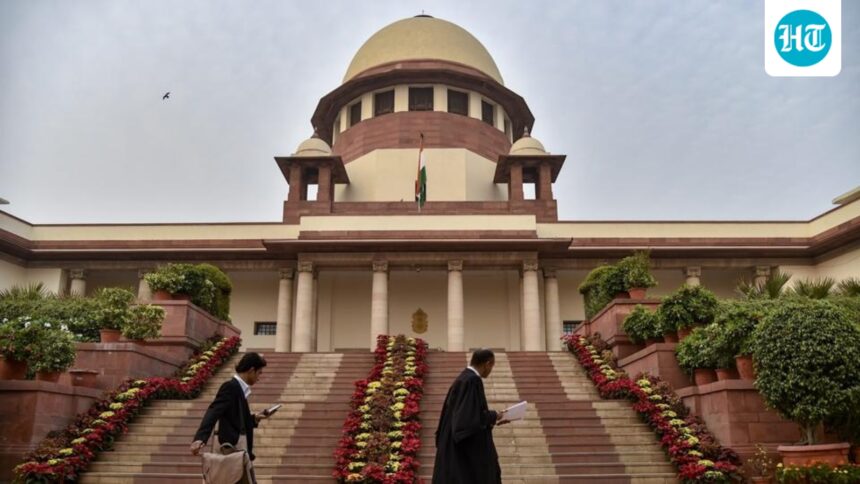
The Supreme Court of India on Wednesday noted that it may not be possible or desirable for the nine-judge bench to lay down uniform, prospective guidelines on the limits of judicial intervention in disputes falling at the intersection of faith and fundamental rights, stressing that such matters must be assessed on a case-by-case basis.

The observation came on the seventh day of a hearing before the Constitution Bench examining the reference arising from the Sabarimala temple entry case, which has raised larger constitutional questions about the scope of religious freedom and the state’s power to enact social reform.
The bench, comprising Chief Justice of India Surya Kant and Justices B V Nagarathna, M M Sundresh, Ahsanuddin Amanullah, Aravind Kumar, Augustine George Masih, R Mahadevan, Prasanna B Varali and Joymalia Bagchi, engaged in an exchange on how courts should handle the delicate balance between individual rights under the Fundamental Rights Chapter of the Constitution and communal autonomy and religious rights under Articles 25 and 26.
Read also | The Supreme Committee launches a massive settlement initiative to achieve faster justice
CJI Kant stressed the inherent limitations of judicial rule-making in this area. While admitting that the phrase “social welfare and reform” under Article 25(2)(b) is broad and that the State cannot be treated as an “outsider” in addressing social evils, he cautioned against any attempt to frame strict principles for future cases.
“It is very difficult for us to make any future guidance… It will always depend on a case-by-case basis as to whether reforms fall within Article 25(2)(b) or, in the name of reforms, amount to a violation of a religious practice,” the bench observed, suggesting a preference for contextual adjudication over abstract principles.
The discussion returned repeatedly to the presentation of Article 25(2)(b), which allows the state to intervene in religious practices for the purposes of social welfare and reform. The court seemed to be trying to define the line between legitimate reform and impermissible interference.
Read also | Supreme Court pulls police for not including hate crime charges in Muslim man’s abuse case in 2021
Justice Nagaratna asked a hypothetical question as to whether a law that expressly allows entry of women of all ages into Sabarimala can be justified as a reform measure, or whether it amounts to a violation of a protected religious practice.
Senior Advocate Gopal Subramanium, appearing for the review petitioner, replied that such questions could not be answered in the abstract and would require a careful investigation into the nature, origin and effect of the practice in question. He said courts should examine whether the exclusion is rooted in an established sectarian tradition and whether it fundamentally deprives worshipers of their right to worship.
At the same time, he warned that the language of “social reform” could not become a cloak for unwarranted interference with religious autonomy, stressing that any such legislation must withstand judicial scrutiny as to whether it truly addresses a social evil.
At one point during the day-long hearing, Justice Bagchi described Article 25(2)(b) as a “narrow window” for legislative interference in religious affairs, even as the bench explored whether constitutional directives, including directive principles and fundamental duties, could guide the content of social reform.
Read also | Delisted Bangladeshi Hindu refugees see little hope in Supreme Court order on Bengal Sir
The hearing also revisited the controversial “essential religious practices” doctrine, with the court considering its continued relevance. While Subramanium urged not to ignore the test entirely, calling it a necessary tool to distinguish between genuine religious practices and those so veiled, some judges on the bench expressed discomfort with courts assuming the role of theological arbitrators.
Justice Nagarathna suggested that the principle should operate as a protective instrument rather than a restrictive threshold, while Justice Sandresh noted that in challenges to legislation under Article 25(2)(b), focus may not always require a determination of significance.
The bench also pointed out the complexities involved in adjudicating competing claims within a religion, with Justice Kumar questioning the legal basis on which courts can choose between different interpretations or practices.
Subramanium responded that courts are not devoid of judicial tools and may rely on evidence to determine the nature of the practice, stressing that disputes involving legal rights cannot be left unresolved.
As hearings continue on Thursday, the nine-judge bench is expected to further define the limits of state interference in religious practices, a question at the heart of many ongoing disputes beyond Sabarimala.
At the heart of the debate is the interpretation of Articles 25 and 26 of the Constitution, which guarantee freedom of conscience and the right to freely profess, practice and propagate religion, while protecting the independence of religious communities in managing their own affairs. The body was tasked with answering seven fundamental questions arising from the 2019 reference, including the contours of basic religious practices, the balance between individual rights and sectarian autonomy, and the limits of judicial review in religious matters.